In a bid to counter India's increasingly robust air and missile defence networks, Pakistan’s military has steadily expanded its surface-to-surface strike capabilities.
However, a closer look reveals that this modernization relies heavily on a strategy of acquiring Chinese export-grade weapon systems and rebranding them under the domestic "Fatah" nameplate.
While framed as indigenous triumphs, these platforms are largely localized variants of Chinese technology, intended to provide a cost-effective conventional deterrent against India's advanced interception grids, such as the S-400 and Barak-8 (MRSAM) systems.
The Fatah-I: Battlefield Realities and Interceptions
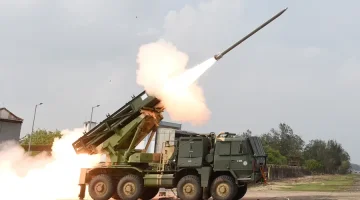
The foundation of the Fatah family is the Fatah-I, a guided multiple launch rocket system (GMLRS).It is an openly recognized derivative of the Chinese A-100 300mm rocket system developed by the China Academy of Launch Vehicle Technology (CALT).
Interestingly, the A-100 was originally tested by China's own People’s Liberation Army but was ultimately passed over in favour of the superior PHL-03.
Islamabad acquired multiple A-100 batteries, eventually manufacturing the rockets domestically and presenting the Fatah-I as a homegrown asset.
However, the system's battlefield effectiveness has faced heavy scrutiny.
During the high-intensity exchanges of Operation Sindoor in May 2025, Fatah-I salvos failed to penetrate heavily defended Indian airspace.
Open-source military reports from the conflict confirmed that Indian Air Force units successfully tracked and destroyed incoming Fatah variants using the Barak-8 surface-to-air missile system over Sirsa, Haryana.
This highlighted significant vulnerabilities in the rocket's guidance accuracy and its ability to survive against a modern, layered air defence shield.
Scaling Up: The Fatah-II and Fatah-IV
To address range limitations, Pakistan introduced the Fatah-II, extending its reach to approximately 400 kilometres.This larger guided rocket is structurally and technologically traced back to China’s A-200 and A-300 export systems.
The most undeniable evidence of its origin is its mobility platform: the Fatah-II utilizes a twin-canister setup mounted on the Chinese Taian TAS5450 8×8 heavy-duty chassis—the exact same vehicle Beijing employs for its own SY-400 and PHL-191 missile systems.
Moving beyond artillery rockets, the recently unveiled Fatah-IV represents a shift toward long-range subsonic cruise missiles.
With an estimated range of 750 kilometres, the Fatah-IV is an evolution of Pakistan’s Babur and Harbah programs, which themselves are rooted in Chinese DH-10 and C-602 technology.
Designed to evade radar by utilizing terrain-hugging flight profiles at just 50 metres above ground level and speeds of Mach 0.7, the Fatah-IV heavily incorporates Chinese-assisted GPS/INS navigation and electro-optical seeker technology to strike deep into adversary territory.
Fatah-III: The Push for Supersonic Speeds
The latest and most ambitious addition to the arsenal is the Fatah-III (or Fatah-3), heavily marketed as Pakistan's answer to India's formidable BrahMos missile.Defence analysts have firmly identified the Fatah-III as a localized version of the HD-1 supersonic cruise missile.
The HD-1 was developed by Guangdong Hongda Blasting Company, a Chinese firm historically rooted in commercial mining explosives rather than elite aerospace engineering.
Propelled by a solid-fuel ramjet and a launch booster, the Fatah-III claims a strike range of 290 to 450 kilometres and terminal speeds between Mach 2.5 and Mach 4.
While such velocities theoretically compress the reaction time for defending anti-aircraft units, military experts note that the HD-1 was designed as a budget-friendly export alternative.
Its real-world survivability against sophisticated, multi-tiered air defence networks remains entirely unproven outside of controlled testing environments.
The Strategic Trade-Off
The evolution of the Fatah series highlights a deliberate procurement doctrine: acquire affordable, second-tier Chinese platforms, implement minor local modifications, and field them rapidly to offset India's conventional superiority.This framework allows Islamabad to quickly build out its strike options without absorbing the immense financial burden of ground-up indigenous research and development.
However, this approach permanently tethers Pakistan's conventional deterrence to the supply chains and technological ceilings of foreign manufacturers.
As demonstrated by the interception rates during recent operational flare-ups, the gap between promotional marketing and actual battlefield performance continues to be a critical hurdle for the rebranded Fatah series.
| Variant | Weapon Type | Estimated Range | Chinese Origin / Technological Basis |
|---|---|---|---|
| Fatah-I | Guided Rocket (GMLRS) | 140–150 km | CALT A-100 (300mm MLRS) |
| Fatah-II | Guided Rocket / SSM | 400 km | CALT A-200 / A-300 Series |
| Fatah-III | Supersonic Cruise Missile | 290–450 km | Guangdong Hongda HD-1 |
| Fatah-IV | Subsonic Cruise Missile | 750 km | Babur/Harbah (DH-10 Lineage) |