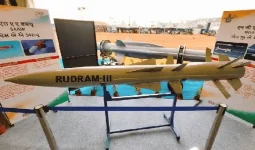
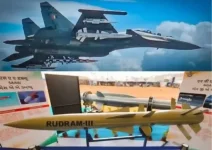
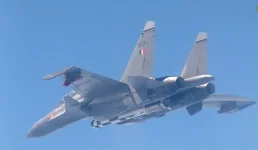
On June 2, 2026, the Defence Research and Development Organisation (DRDO) successfully test-fired the indigenous RudraM-II anti-radiation missile from an Indian Air Force Sukhoi Su-30MKI fighter jet off the coast of Odisha.
This landmark achievement significantly boosts India's capabilities in the Suppression and Destruction of Enemy Air Defences (SEAD/DEAD).
Crucially, this new weapon provides a highly effective solution to a long-standing tactical problem: taking down hostile radar systems even after they abruptly stop transmitting.
For years, air defence crews have relied on a technique known as "going dark" to evade incoming threats.
While modern surface-to-air missile (SAM) networks require high-powered radars to detect and track aircraft, actively emitting radio frequencies instantly gives away their exact battlefield position.
Older generations of anti-radiation missiles, such as the Russian Kh-31 that the RudraM-II is slated to replace, simply lock onto these radio waves and ride them directly to the source.
However, this creates an obvious flaw: if hostile operators detect a missile launch and immediately turn off their radar systems, the incoming weapon loses its tracking beacon and often misses its mark.
This constant technological duel between radar operators and strike aircraft has shaped the nature of electronic warfare for decades.
The indigenous RudraM-II, developed primarily by the Hyderabad-based Research Centre Imarat (RCI) with support from several other DRDO labs and industry partners like Hindustan Aeronautics Limited (HAL), has been engineered specifically to bypass this evasive tactic.
By utilising a sophisticated, multi-layered guidance system, the missile can relentlessly pursue its target long after the enemy radar goes silent.
The attack sequence begins with a wide-band passive radio-frequency (RF) seeker. When launched from considerable standoff distances—estimated to be between 300 and 350 kilometres—the missile detects enemy radar signals, locks onto their unique frequency profile, and initiates its strike trajectory.
The weapon’s true strength is revealed when the target attempts to hide.
If the hostile radar shuts down, the RudraM-II does not lose its way. Instead, its onboard computers memorise the emitter's exact geographical coordinates.
Aided by an Inertial Navigation System (INS) and satellite updates from India’s indigenous NavIC network, the missile blindly yet accurately continues its flight toward the last known location.
Consequently, merely turning off a radar system is no longer a viable survival strategy for enemy air defence units.
However, modern air defence batteries are highly mobile and routinely use "shoot-and-scoot" tactics.
To prevent a targeted radar vehicle from driving away to safety after shutting down, DRDO scientists integrated a secondary, terminal guidance mechanism. During the final moments of its flight, the RudraM-II activates an Imaging Infrared (IIR) seeker.
Unlike the initial RF seeker, this infrared sensor operates independently of radio emissions. It scans the target area for the distinct heat signatures and physical shapes of the enemy vehicles.
Therefore, even if the radar antenna is stowed and the launcher is on the move, the missile visually and thermally tracks the convoy. This dual-seeker architecture turns the RudraM-II into an advanced, multi-mode strike weapon capable of hunting down heavily camouflaged or silent targets.
Beyond its intelligent tracking, the missile’s sheer speed drastically reduces enemy survival chances. Capable of reaching hypersonic terminal velocities of up to Mach 5.5, the weapon shrinks the reaction time for targeted air defence crews to a matter of mere seconds.
Executing a rapid relocation—which involves retracting radar masts, starting heavy vehicles, and moving an entire battery—becomes virtually impossible when a missile is plunging from the sky at such extreme speeds.
This immense terminal velocity also delivers catastrophic kinetic energy. When combined with a pre-fragmented warhead weighing up to 200 kilograms, the RudraM-II can obliterate hardened infrastructure and heavily armoured systems.
Furthermore, the weapon's speed makes it exceptionally difficult to shoot down. Most short-range point-defence systems are designed to counter slower drones, subsonic cruise missiles, or aircraft.
Engaging an incoming threat travelling at Mach 5.5, while it performs complex evasive manoeuvres, overwhelms the processing capabilities of most existing interceptor networks.
The successful June 2026 test underscores India’s strategic shift towards robust offensive counter-air operations. In contemporary warfare, blinding enemy sensors and shattering communication nodes is the vital first step in opening safe operational corridors for friendly fighter jets.
In any potential future conflict, neutralising sophisticated, heavily defended integrated networks—such as the Chinese HQ-9 or the Pakistani LY-80 systems—will be an absolute necessity.
With the RudraM-II moving closer to full operational induction, the Indian Air Force is poised to secure total air superiority by systematically dismantling the opposition's most critical defences from safe standoff distances.