- Views: 3K
- Replies: 9
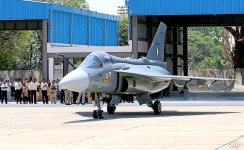
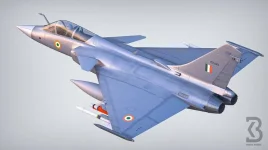
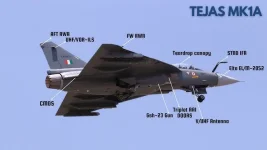
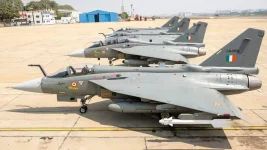
The Light Combat Aircraft (LCA) Tejas Mk1A has established a paradigm shift in modern military aviation architecture.
Moving away from traditional manufacturing philosophies that prioritise aerodynamics and mechanical components, the Tejas Mk1A is built as a software-defined combat asset.
This architectural shift grants India complete "software sovereignty"—the absolute independence to modify, modernise, and adapt the aircraft's operational capabilities without relying on foreign original equipment manufacturers (OEMs) or undergoing extensive physical modifications.
The Power of an Open Architecture System
At the heart of this operational independence is the Indigenous Open Architecture Computer (OAC), which serves as the fighter's primary Mission Computer.Designed by the Defence Research and Development Organisation’s (DRDO) Aeronautical Development Establishment (ADE) and manufactured by Hindustan Aeronautics Limited (HAL), this system moves away from legacy platforms.
Older generation fighter aircraft typically utilise restrictive, proprietary closed architectures, forcing air forces to obtain explicit manufacturer permission and source code access for any hardware or software modifications.
In contrast, the Tejas Mk1A operates on an open systems framework, using globally accepted, standardized data interfaces such as MIL-STD-1553B and ARINC 429.
This baseline allows the platform to act as a universal plug-and-play architecture.
The Indian Air Force (IAF) can seamlessly integrate an eclectic inventory of weapons from various international origins, including Israeli Derby missiles, British Advanced Short-Range Air-to-Air Missiles (ASRAAM), and domestic armaments like the Astra Mk1 beyond-visual-range missile and the Rudram anti-radiation weapon series.
These integrations are carried out entirely via software adjustments rather than complex, expensive structural redesigns.
Accelerating the Operational Loop
Complete ownership of the mission computer’s source code gives the IAF full tactical autonomy over critical systems, including weapon launch sequences, threat mitigation logic, and specific flight profiles.Rather than waiting through multi-year commercial negotiations for foreign suppliers to implement software patches, Indian engineers can update parameters internally.
This capability shortens upgrade timelines from several years to just weeks, which is a major advantage in electronic warfare environments where threat signatures mutate continuously.
New Radar Threat Detected -> In-House Code Modification (Takes Weeks, Not Years) -> Fleet-Wide Software Update
This rapid turnaround optimizes the aircraft's Observe-Orient-Decide-Act (OODA) loop.
The onboard Electronic Warfare (EW) suite updates its threat library during routine ground maintenance, allowing the Tejas Mk1A to adapt continuously to localized tactical realities rather than remaining frozen in its factory configuration.
Advanced Computing and Sensor Fusion
The software-centric design also powers the fighter’s sensor fusion capabilities.The main computing system aggregates real-time data feeds from the indigenous Uttam Active Electronically Scanned Array (AESA) radar, electronic warfare sensors, and secure tactical data links.
By processing these inputs simultaneously, the computer presents the pilot with a singular, comprehensive battlefield map.
Ongoing enhancements to target filtering and data prioritisation algorithms mean that the fighter's situational awareness can be boosted purely through software updates, without changing any physical hardware components.
To guarantee safety-critical and mission-critical operations remain flawless under extreme combat data loads, the technical backbone runs on high-performance multicore PowerPC-class processors.
These systems utilize a specialized Real-Time Operating System (RTOS) engineered for deterministic performance to ensure strict timing execution.
Data distribution relies heavily on high-speed pathways, including emerging Fibre Channel technologies, ensuring resilient and secure communication channels in heavily jammed environments.
Securing Strategic Autonomy
By eliminating "black boxes"—unmodifiable proprietary foreign subsystems that could limit deployment choices or contain security flaws—the Tejas program secures India's tactical freedom.Current industry assessments indicate that approximately 70 percent of the Tejas Mk1A's software suite is entirely indigenous.
This high level of domestic software development aligns with broader national indigenisation targets, which aim to push baseline domestic content past 70 percent across new production runs.
Ultimately, the evolutionary roadmap of the Tejas Mk1A remains anchored in software.
Future capabilities, ranging from advanced communication radios to new radar tracking mechanisms, will be delivered via digital code updates.
This approach significantly curbs overall fleet maintenance and lifecycle expenses, while ensuring that the Tejas Mk1A maintains an enduring operational edge against evolving regional threats for decades to come.