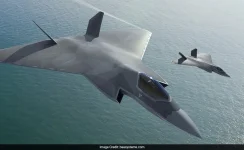
As India pushes forward with its ambitious Advanced Medium Combat Aircraft (AMCA) project, finding the right powerplant for the next-generation fighter remains a critical hurdle.
While the initial AMCA Mk1 jets will be powered by American GE F414 engines, New Delhi is actively seeking a more powerful, 110kN-class engine for the stealthier, more advanced AMCA Mk2.
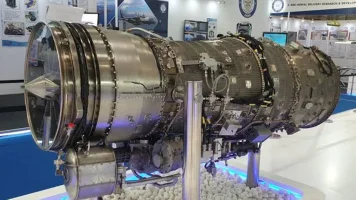
In this high-stakes search, Japan has emerged as a formidable contender by offering to co-develop and manufacture its cutting-edge IHI Corporation XF9-1 engine technology in India.
This development follows Japan's recent strategic shift to merge its domestic F-X fighter project with the Global Combat Air Programme (GCAP), a joint initiative with the United Kingdom and Italy targeting a 2035 deployment.
Rather than shelving the indigenous XF9-1 engine, Tokyo is leveraging its groundbreaking research to support the GCAP while simultaneously opening doors for international partnerships, including with India.
For the Indian Ministry of Defence and the Gas Turbine Research Establishment (GTRE), the goal has always been clear: India does not just want to buy engines; it wants to master the complex science of designing and building them.
In this context, Japan’s proposal joins the competitive race alongside offers from French aerospace giant Safran and Britain's Rolls-Royce, giving New Delhi a powerful strategic alternative.
A Technological Powerhouse
Developed by IHI Corporation, the XF9-1 is widely considered one of the most capable military engine demonstrators built outside the United States.It was purpose-built for stealth applications. The engine features a slim, compact profile that is essential for fifth-generation fighters, as it frees up crucial internal space for hidden weapon bays and extra fuel—all while keeping the aircraft's radar signature minimal.
Despite its compact size, the XF9-1 delivers massive power. Open-source data indicates the engine can generate roughly 11 tonnes of dry thrust and up to 15 tonnes when the afterburner is engaged. This places it perfectly within the thrust class required for India's AMCA Mk2.
Furthermore, Japanese engineers have achieved remarkable thermal efficiency. Using advanced single-crystal superalloys and Ceramic Matrix Composites (CMCs), the engine can withstand extreme turbine inlet temperatures nearing 1,800°C.
These cutting-edge materials allow the engine to produce higher thrust and operate more efficiently without needing to be physically larger.
Modern aerial warfare also requires massive amounts of onboard electricity. Fifth- and sixth-generation fighters rely heavily on active electronically scanned array (AESA) radars, advanced electronic warfare systems, and potentially even future directed-energy weapons.
The XF9-1 was designed with a highly capable electrical generation system to meet these exact demands, while also offering a core architecture that can be upgraded for future unmanned combat aerial vehicles (UCAVs) or sixth-generation jets.
Challenges on the Horizon
Despite the impressive specifications, the Japanese proposal is not without its hurdles. Defence analysts note that while the XF9-1 has undergone rigorous ground testing since its delivery in 2018, it is still a technology demonstrator.Unlike some competing engines that are based on mature, flight-tested cores, the XF9-1 lacks actual operational flight experience. If India chooses this path, it would have to invest significant time and resources into flight qualification and certification.
Technology transfer is another major sticking point. GTRE is looking for complete, unrestricted access to the closely guarded secrets of aero-engine manufacturing.
This includes the intricate processes of casting single-crystal turbine blades, formulating advanced metallurgy, and programming digital engine control systems. The viability of the Japanese offer will heavily depend on exactly how much of this proprietary knowledge Tokyo is willing to share.
Finally, there is the question of export autonomy. India intends to eventually export the AMCA to allied nations. While Japan has recently begun easing its historically strict post-war arms export regulations—specifically to accommodate the GCAP project—New Delhi will demand ironclad guarantees.
India must ensure it retains the intellectual property rights and sovereign freedom to manufacture and export the final engine without facing third-party vetoes.
A Crucial Decision for India’s Aerospace Future
Even if New Delhi ultimately selects a European partner for the AMCA Mk2, the presence of Japan's XF9-1 in the bidding process is a major advantage for India.Having multiple world-class contenders forces all bidding nations to offer better pricing, deeper technology transfers, and superior industrial cooperation packages.
The upcoming decision will be a defining moment for India's defence manufacturing sector.
The chosen partnership will not merely supply engines for a single fleet of fighter jets; it will lay the foundation for an indigenous aerospace ecosystem, determining India's ability to independently power the combat aircraft of tomorrow.