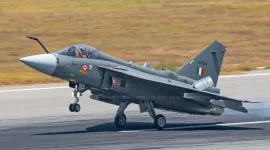
While public attention regarding the Tejas Mk1A often highlights its advanced AESA radar, enhanced electronic warfare capabilities, improved maintenance, and long-range missiles, its most critical strategic potential is largely overlooked.
This indigenous jet has the profound capacity to become India's pioneering airborne command centre, directly guiding unmanned aerial vehicles (UAVs) and loyal wingman drones in the heat of battle.
Realising this capability would completely shift the paradigm for the Tejas Mk1A.
Rather than serving strictly as a traditional light fighter, it would function as a central, networked management node in the sky, directing autonomous strike and surveillance systems with split-second precision.
The global landscape of aerial combat is swiftly transitioning towards manned-unmanned teaming (MUM-T). In this new era, human pilots fly in tandem with AI-driven combat drones and loyal wingmen.
Leading air forces are no longer building jets as solitary weapons; instead, they are developing them as flying headquarters designed to manage drone swarms, share vital targeting feeds, and direct electronic warfare tactics.
Nations including the United States, Australia, China, Russia, and Turkey are pouring massive investments into these next-generation concepts. India is now steadily positioning itself to join this elite tier of military innovators.
It is widely assumed that the upcoming Advanced Medium Combat Aircraft (AMCA) will naturally serve as India’s inaugural drone-controlling platform. Yet, pragmatic timelines suggest the Tejas Mk1A will achieve this milestone much sooner.
Because the Mk1A is already entering service, features a highly modern software framework, and offers absolute sovereign control over its source code and communication datalinks—unlike jets bought from abroad—it stands out as the immediate candidate.
This absolute domestic ownership over technological systems remains one of the most vital, yet least recognised, benefits of manufacturing fighter jets locally.
When dealing with imported combat aircraft, integrating new software or altering mission computers is frequently blocked by the original foreign vendors.
In contrast, the Tejas grants the Indian defence establishment unrestricted freedom to implement AI upgrades, alter network architectures, and evolve combat codes.
Consequently, it is the perfect testbed and operational vehicle for advancing autonomous drone teaming.
To facilitate this, Hindustan Aeronautics Limited (HAL) is already developing the "Mothership for Air Teaming eXploitation" (MAX) interface specifically for the Tejas Mk1A, which will allow a twin-seater variant to act as the primary command hub.
This transition aligns with a radical evolution in the fundamental nature of battle. Contemporary conflicts have moved past isolated dogfights between individual jets.
Today, air superiority relies on seamlessly blending sensor data, distributing target coordinates, and maintaining a heavily networked battlespace, turning piloted planes into comprehensive systems managers.
Operating within this networked doctrine, a Tejas Mk1A could guide surveillance drones, process live intelligence feeds, designate hostile targets for unmanned allies, and orchestrate swarm offensives.
Crucially, the manned jet could achieve all of this while remaining safely positioned well beyond the reach of enemy air defence systems.
The imminent Indian loyal wingman fleet is expected to encompass a variety of autonomous platforms, including stealth assets, radar-jamming UAVs, decoy drones, and lethal kamikaze units, all flying alongside Tejas squadrons.
Depending on the sophistication of the communication links, one Mk1A pilot could theoretically direct an entire group of these collaborative drones at the same time.
Within this formation, each drone would execute highly specialised tasks. Surveillance variants would scout deep inside hostile borders, while electronic warfare models would blind adversary radars.
Simultaneously, decoy units could overwhelm hostile missile batteries, leaving armed strike UAVs and self-destructing kamikaze drones to neutralise dangerous targets without ever risking an Indian pilot’s life.
Bringing this concept closer to reality, HAL successfully conducted the engine ground run of the CATS Warrior prototype in early 2025; this 2,100 kg stealthy drone is designed to cruise up to 700 kilometres away from its mothership while carrying a 650 kg weapon payload.
Developing this specific combat framework is exceptionally crucial when evaluating the strategic challenges posed by China.
Beijing is funnelling immense resources into AI-driven aviation, drone swarms, and heavily networked combat architectures.
Any potential future skirmishes across the Himalayan borders will likely transcend conventional dogfights, manifesting instead as complex clashes between integrated networks, automated strike groups, and coordinated electronic warfare swarms.
The Tejas Mk1A presents India with its most viable and immediate stepping stone to counter and master this advanced doctrine.
A number of active domestic defence initiatives are already laying the groundwork for this capability. HAL has actively showcased the Combat Air Teaming System (CATS) architecture, proving that the nation is serious about fielding autonomous wingmen.
Furthermore, ongoing projects to establish indigenous, hack-proof tactical datalinks and advanced battlefield networks serve as the mandatory backbone for these manned-unmanned operations.
In parallel, the Defence Research and Development Organisation (DRDO) is rapidly accelerating its research into artificial intelligence for target identification, self-navigating flight systems, and swarm logic.
These technologies are the fundamental building blocks necessary to empower a fighter jet to command drone formations.
Looking ahead, the open-architecture framework of the Tejas Mk1A stands as its greatest enduring asset.
Unlike foreign jets that severely restrict deep system access and artificial intelligence integration, the Tejas allows Indian engineers to rapidly and independently upgrade its combat software to meet emerging battlefield requirements.
Subsequent modifications to the aircraft could seamlessly introduce dedicated drone-command screens, AI-backed mission computers, and automated target-designation tools straight into the pilot’s cockpit interface.
Envisioning a future conflict over the Himalayas, a squadron of Tejas Mk1A fighters could fight in unison with a fleet of kamikaze, surveillance, and radar-jamming drones.
While the manned jets hover at a safe distance from lethal anti-aircraft batteries, their mechanical wingmen would advance to pinpoint missile sites, disrupt enemy frequencies, execute strikes, and instantly stream battle damage assessments back to the human commanders.