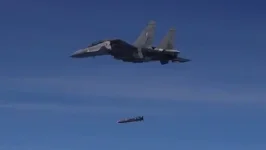
The highly anticipated flight testing phase of the upcoming BrahMos-NG (Next Generation) supersonic cruise missile has been temporarily postponed.
According to Alexander Maksichev, the Co-Managing Director of BrahMos Aerospace, the delay stems from the customer introducing updated and more demanding operational specifications.
These newly established criteria have prompted the engineering team to implement essential design enhancements before taking the missile to the skies.
Addressing the current state of the development, Maksichev explained that the revised expectations mandate specific structural adjustments.
He emphasized that the parameters for the weapon system have grown more rigorous, requiring additional time to align the missile's architecture seamlessly with the user's latest demands.
Despite this shift in the testing schedule, he assured that the overall development process continues to move forward in an orderly and planned manner.
This adjustment period is a strategic operational decision rather than the result of a technical failure.
By absorbing these advanced specifications during the current development phase, BrahMos Aerospace intends to guarantee that the finished weapon fulfills every operational need right from the start.
Taking this proactive step avoids the need for massive and costly overhauls once live testing gets underway.
As a highly advanced offshoot of the renowned India-Russia joint venture, the BrahMos-NG is engineered to be a smaller, stealthier, and more agile version of the original missile, promising a substantial leap in modern defence capabilities. Open-source data reveals several impressive technological upgrades:
- Compact Dimensions: The new variant will weigh around 1.5 to 1.6 tonnes and measure roughly 6 metres in length — a significant reduction from the earlier 3-tonne, 9-metre version.
- Maintained Lethality: Despite the reduction in size, it retains an impressive top speed of up to Mach 3.5 and a baseline strike range of nearly 290 kilometres.
- Advanced Stealth: The NG variant incorporates a domestic seeker with an Active Electronically Scanned Array (AESA) radar and boasts a lower radar cross-section to significantly boost its stealth profile.
Specifically, the reduced dimensions make it fully compatible with lighter fighter aircraft.
While the heavier Sukhoi-30MKI will be able to carry a larger cluster of these missiles, India's indigenous Light Combat Aircraft (LCA) Tejas will also be fully equipped to deploy them.
The missile is ultimately intended for multi-platform integration, including naval vessels and land-based launchers.
While officials at BrahMos Aerospace have yet to release a definitive date for the rescheduled flight trials, the company remains steadfast that the project is progressing smoothly.
The engineering teams are now dedicating their efforts to fine-tuning the missile's design to not only meet but exceed the customer's upgraded performance standards, ensuring the BrahMos-NG is perfectly tailored for future combat scenarios.