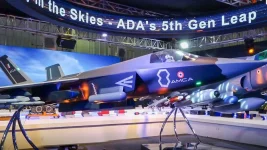
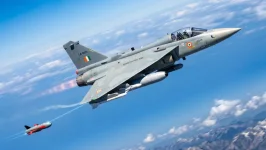
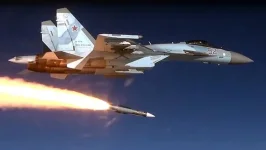
In a significant step to bolster its aerial combat capabilities, the Indian Air Force (IAF) is gearing up to rapidly expand its stockpile of advanced beyond-visual-range air-to-air missiles (BVRAAM).
Plans are currently underway to ramp up the manufacturing of the Astra Mk2 and the upcoming Astra Mk3 "Gandiva" missiles.
To achieve this, the government is incorporating private manufacturing firms to work alongside established public sector enterprises.
Once the final flight trials are successfully concluded, the IAF is anticipated to issue a primary order for approximately 700 Astra Mk2 units, marking one of the largest single acquisitions of air-to-air weaponry in its history.
The new Astra Mk2 offers a massive leap in lethality compared to its predecessor, the 110-km range Mk1.
Equipped with a sophisticated dual-pulse solid rocket motor and an indigenous active electronically scanned array (AESA) seeker, the Mk2 can accurately strike enemy aircraft from distances between 200 and 240 kilometres.
This extended reach firmly positions it as a top-tier long-range weapon. It provides frontline fighters with true standoff capabilities, allowing pilots to dominate contested airspace and eliminate high-value targets while remaining safely out of the enemy's retaliatory range.
To adequately equip its fighter squadrons and build a resilient reserve for potential prolonged conflicts, the IAF’s total requirement for the Astra Mk2 is projected to climb to 1,500 units.
A similarly massive demand is expected for the next-generation Astra Mk3.
Currently under development, the Mk3 will utilise cutting-edge Solid Fuel Ducted Ramjet (SFDR) technology.
This air-breathing propulsion system will allow the weapon to intercept highly protected assets, such as aerial refuelers and airborne warning and control systems (AWACS), at extreme ranges of up to 350 kilometres.
Supplying thousands of advanced missiles requires an industrial strategy capable of immense scale. The DRDO and the IAF are implementing a hybrid manufacturing model to meet these targets.
Private aerospace companies are being integrated into the supply chain as parallel production partners alongside traditional state-run manufacturers like Bharat Dynamics Limited (BDL).
This collaborative strategy is designed to drastically accelerate production rates, eliminate delivery bottlenecks, and lower the per-unit cost of the missiles through mass manufacturing efficiencies.
Integrating commercial enterprises into complex weapons development is not entirely new for India.
Private companies are already actively contributing to the production ecosystems of the Rudram-1 anti-radiation weapon and the Naval Anti-Ship Missile (NASM).
However, expanding this cooperative framework to the highly sophisticated Astra missile family represents a major milestone.
It signals that India's domestic defence industry has matured to a point where private entities can reliably handle the production of cutting-edge, high-technology munitions.
This procurement strategy perfectly aligns with the national vision of self-reliance, significantly reducing the military's dependence on expensive foreign imports like the MICA and R-77 systems.
Establishing a broader, more diversified industrial base guarantees that the IAF will maintain a robust and scalable supply chain.
As the need for modern aerial weaponry increases, this domestic manufacturing foundation will ensure that critical weapon systems are inducted into active service without external delays or geopolitical disruptions.
Ultimately, successfully executing this large-scale production plan will fulfil India's internal security needs while opening doors for international trade.
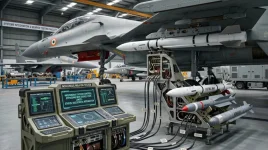
The Astra missile series is being actively integrated into a variety of platforms, including the Su-30MKI, Tejas LCA, and Mirage 2000.
This versatility makes the indigenous missile a highly attractive and cost-effective export option for friendly foreign nations that operate compatible fighter jets, positioning India as an emerging exporter of world-class aviation weaponry.