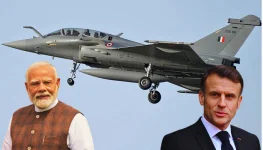
India-France 114 Rafale Deal to Include F4 Upgrade for Current IAF Fleet and Procurement of At Least 24 F5 Variants, Claims French Media

Rafale-F4--ManufacturingMake-in-India.webp


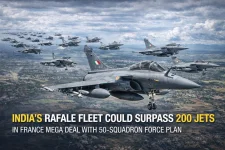
A recent report by the French defence aviation portal avionslegendaires.net has claimed that India and France are finalising a comprehensive "super contract" that significantly exceeds the scope of the original Multi-Role Fighter Aircraft (MRFA) requirement.

According to the report, the proposed government-to-government deal for 114 fighter jets is not merely for the production of standard aircraft but involves a multi-phased evolution of the Indian Air Force’s (IAF) combat capabilities.

The package reportedly includes the supply of 90 new Rafale F4 jets manufactured in India, the direct import of at least 24 futuristic Rafale F5 variants, and a complete upgrade of India’s existing fleet to the F4 standard.

Three Generations of Rafale in One Fleet

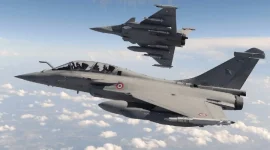
If the report proves accurate, the agreement would position the IAF as one of the world's most advanced operators of the Dassault Rafale, fielding a fleet that spans three distinct technological standards:
  • Existing Fleet: The 36 Rafale jets currently in service (originally F3R standard) will be upgraded to the F4 operational baseline.
  • New Production: 90 new aircraft will be built to the F4 standard, likely under the "Make in India" initiative.
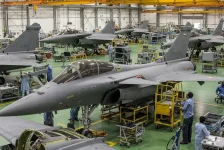
  • Future Acquisition: A specific batch of at least 24 aircraft will be of the next-generation F5 standard, expected to be manufactured entirely in France by Dassault Aviation to protect sensitive technologies.
This structure implies a long-term strategic partnership, ensuring the Rafale remains the backbone of Indian air power well into the 2040s.

Rafale F4: A Network-Centric Transformation​

The report highlights that upgrading the existing 36 jets to the F4 standard is a central component of the deal.

Unlike a routine mid-life update, the transition to F4 represents a "deep modernisation" designed to make the aircraft a node in networked warfare.

Key enhancements in the F4 standard include:​

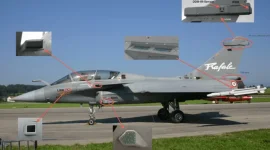
  • Advanced Avionics: The RBE2 AESA radar receives significant software upgrades, including new Ground Moving Target Indication and Tracking (GMTI) and Synthetic Aperture Radar (SAR) modes. These allow the aircraft to generate high-resolution maps and track moving vehicles in all weather conditions.
  • Scorpion Helmet Mounted Display (HMD): The F4 integrates the Thales Scorpion HMD, a critical capability that allows pilots to lock onto targets simply by looking at them, drastically reducing reaction times in dogfights.
  • Connectivity: The standard integrates the Thales CONTACT software-defined radio and improved satellite communications. This ensures secure, jam-resistant data sharing between aircraft, ground stations, and naval assets, effectively creating a "combat cloud" where the Rafale acts as a data hub.

The F5 Variant: The "Super Rafale"​

The most significant revelation in the French report is the inclusion of the Rafale F5, often dubbed the "Super Rafale."

Scheduled for production after 2030, this variant is designed to bridge the gap between fourth-generation fighters and future sixth-generation systems.

While specific details remain classified, the F5 is expected to feature:
  • AI-Driven Sensor Fusion: Extensive use of artificial intelligence to process vast amounts of battlefield data.
  • Manned-Unmanned Teaming (MUM-T): The ability to control "loyal wingman" drones, such as the nEUROn combat drone, directly from the cockpit.
  • Next-Gen Weapons: Integration with future hypersonic nuclear missiles (ASN4G) and new long-range strike weapons.
The report notes that because of the highly sensitive nature of the F5's technology, these 24 distinct units would likely be manufactured in France rather than on an Indian assembly line.

Strategic Context​

This potential agreement comes as India seeks to expedite the procurement of 114 fighters to address its depleting squadron strength.

By offering a mix of domestic production (for the F4s) and high-tech direct imports (for the F5s), France appears to be addressing both India’s "Atmanirbhar Bharat" goals and its immediate need for cutting-edge technology.

Speculation suggests that this deal could be formally discussed or announced during French President Emmanuel Macron’s expected visit to India in early 2026 for an Artificial Intelligence summit, highlighting the deep technological cooperation between the two nations.
 
As the first aircraft won't come before 2030 then why only 24 F5 we should opt atleast 2,3 squadrons of F5 bcz if the remaining accounts for F4 then we will have 95 F4(35 which will get upgraded and 60 new from MRFA) which is a considerable amount, and the previous F3 and new F4 should also get F5 upgrades after induction of tejas mk2, AMCA (so that we don't ran out of money in ordering indigenous ones)
 
If that's the case then why the case of IAF is so deteriorated
Coz IAF is dependent on HAL, which is a handicapped institution.
Also, Airforce has seen numerous advancements in a very short span of time. HAL, which is supposed to be working on Tejas program since 1980s is still struggling to build the orders, we're 4 decade behind.

Biggest issue is engines, there are very few companies in the world which manufacture reliable jet engines. Not sure which brilliant mind planned for a single engine fighter jet in Tejas, knowing very well that to fly a single engine jet, the engine maturity has to be of the highest order.

Rolls Royce and GE are under US influence, Chinese engines are suboptimal, Russian engines have supply chain issues. Safran was literally the only option as IAF can't wait any longer.
 
Coz IAF is dependent on HAL, which is a handicapped institution.
Also, Airforce has seen numerous advancements in a very short span of time. HAL, which is supposed to be working on Tejas program since 1980s is still struggling to build the orders, we're 4 decade behind.

Biggest issue is engines, there are very few companies in the world which manufacture reliable jet engines. Not sure which brilliant mind planned for a single engine fighter jet in Tejas, knowing very well that to fly a single engine jet, the engine maturity has to be of the highest order.

Rolls Royce and GE are under US influence, Chinese engines are suboptimal, Russian engines have supply chain issues. Safran was literally the only option as IAF can't wait any longer.
That's why different opinions are necessary, no force in the world is dependent on a single company and that also on which gives proof of its credibility continuously, MRFA wasn't dependent on HAL,MTA wasn't dependent on HAL, Refuellers procurement wasn't dependent on HAL, the most accountable is the DAC,MoD for ignoring the setbacks, gov for not providing proper funding, you can blame HAL for only tejas program delays and they deserve it but not the entire IAF existence and functionality and procurement
 
That's why different opinions are necessary, no force in the world is dependent on a single company and that also on which gives proof of its credibility continuously, MRFA wasn't dependent on HAL,MTA wasn't dependent on HAL, Refuellers procurement wasn't dependent on HAL, the most accountable is the DAC,MoD for ignoring the setbacks, gov for not providing proper funding, you can blame HAL for only tejas program delays and they deserve it but not the entire IAF existence and functionality and procurement
I concur with your thoughts.
Take an example of Indian Navy...they aren't dependent on MDL to do everything. They have GRSE, GSL, HSL, CSL to keep multiple production lines active. Hence, one way or the other, the production never stops.

MMRCA tender was first floated in 2007, in 2012 Dassult was selected but there was no progress and cost ballooned up like anything, plus Dassault refused to take any ownership of the quality issues of the jets made by HAL, this lead to collapse of the deal and hence a short order of 36 jets were placed in 2016, assuming that HAL would be able to provide Tejas mk1a as an alternate. That's why 83 jets were ordered in 2021 (plus additional 97 order in 2025), but it's been 2026 and Airforce hasn't even gotten one mk1a aircraft.

Refuellers are indeed the key for the long missions. But our immediate needs are fighter aircraft + long range BVR missiles. Jaguars and Mirages are at the dawn of their serviceability. We're playing a catching game courtesy of our defence cuts, we need to enhance Defence budget to atleast 2.5% of our GDP to address our needs for the next 15 years.
 

Forum statistics

Threads
6,100
Messages
61,821
Members
4,812
Latest member
MyrtleBean
Back
Top