- Views: 2K
- Replies: 8
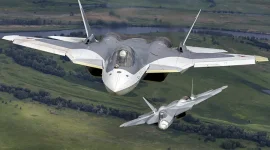
Speculation is intensifying within global strategic circles that the Russian Sukhoi Su-57E fifth-generation stealth fighter remains a vital fallback option for the Indian Air Force (IAF).
This comes as Defence Minister Rajnath Singh skillfully avoided direct answers regarding India’s interest in the aircraft during a recent Confederation of Indian Industry (CII) summit.
With India's indigenous fifth-generation stealth fighter, the Advanced Medium Combat Aircraft (AMCA), still years away from deployment, maintaining the Su-57E option provides a critical strategic cushion.
This backup plan could act as a rapid countermeasure if the Pakistan Air Force (PAF) accelerates its procurement of China's newly unveiled J-35A stealth jet, an acquisition heavily supported by the People's Liberation Army Navy (PLAN).
However, Beijing's military export pipeline faces significant hurdles. The People’s Liberation Army Air Force (PLAAF) has not yet committed to large-scale, domestic orders for the jet, which could severely delay any future shipments to Islamabad.
Adding to the mystery, Pakistani defence authorities and Defence Minister Khawaja Asif have gone completely silent on the J-35A, while prior reports detailing dedicated training programs for Pakistani pilots have vanished from public record.
Delhi's Strategic Equilibrium and the 'Make in India' Focus
Defence Minister Rajnath Singh's non-committal stance during the November 8 summit signals a highly calculated approach.By framing future acquisition talks strictly around the 'Make in India' initiative, New Delhi is navigating complex geopolitical waters, including Russia's ongoing conflict in Ukraine and the persistent threat of American CAATSA (Countering America's Adversaries Through Sanctions Act) sanctions.
"We are evaluating all options from friendly nations to bridge our fifth-gen gap," Singh remarked.
His words echo statements made during Aero India 2025, carefully keeping options open without explicitly endorsing the Russian platform.
This calculated ambiguity allows New Delhi to pursue a twin-track strategy: aggressively accelerating the development of the domestic AMCA while refusing to close the door on off-the-shelf foreign stealth platforms to prevent any sudden imbalance in the Indo-Pakistani aerial equation.
The History of India’s Su-57E Negotiations
India’s engagement with Russia’s premier stealth fighter platform has evolved significantly over the years:- 2018: India originally withdrew from the joint Fifth Generation Fighter Aircraft (FGFA) venture due to technical differences.
- 2024: Dialogue was revived, centering on a potential co-production framework valued between $15 billion and $20 billion for 114 units.
- August 2025: Russian President Vladimir Putin intensified the pitch by offering a comprehensive "golden deal" that included full technology transfer and domestic assembly at Hindustan Aeronautics Limited (HAL) facilities—a move widely interpreted as a counter to American overtures involving the F-35.
- Late 2025: Progress slowed as New Delhi chose to pause active negotiations, preferring to wait out the supply-chain vulnerabilities and international diplomatic friction caused by the Ukraine war.
Bridging the Capability Gap for the IAF
The Indian Air Force currently operates 31 active fighter squadrons against a sanctioned strength of 42.In this tight operational environment, the Su-57E offers a low-risk capability accelerator.
The fighter boasts a combination of supercruise ability, thrust-vectoring AL-51F1 engines, and N036 Byelka AESA (Active Electronically Scanned Array) radar systems.
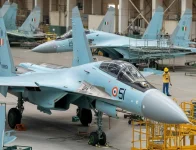
This architecture would allow smooth integration alongside the IAF’s extensive, existing fleet of Russian-origin Sukhoi Su-30MKI fighters.
Defence analysts estimate that if the Indian government issues an immediate green light, deliveries could begin as early as the 2027–28 window.
This would effectively secure Indian airspace until the indigenous AMCA Mk1 begins its projected rollout in 2032.
Former military commanders note that while foreign procurement is never the primary goal, it serves as a necessary buffer against adversarial technological advancements.
China’s J-35A and the Complications in Islamabad
Across the border, the Shenyang J-35A was publicly introduced as a carrier-capable, multirole stealth fighter designed to strengthen Chinese carrier strike groups.Equipped with WS-21 engines, KLJ-7A AESA radar, and internal weapons bays optimized for long-range PL-15 missiles, the aircraft was explicitly positioned as a Chinese counter to the American F-35 in global export markets.
Initial reports suggested a highly discounted deal valued at $50–$60 million per unit for Pakistan to acquire 40 jets, with deliveries originally projected to begin ahead of schedule to neutralize India's upgraded Rafale fleet.
However, major roadblocks have emerged:
| Procurement Factor | Current Status & Impact on Export |
|---|---|
| PLAAF Domestic Commitment | Air force procurement remains opaque; priority is given to heavier J-20 fighters, leaving domestic J-35A orders unconfirmed. |
| Production Timeline Friction | If China's air force places a substantial domestic order, the export queue could push Pakistan's actual delivery timelines back by two to three years. |
| Official Denials | Pakistan's Defence Minister Khawaja Asif publicly dismissed the immediate J-35A acquisition claims as speculative. |
| Information Blackout | Social media claims and media reports regarding Pakistani pilots training on the J-35A platform have been systematically deleted. |
The Broader Regional Outlook
The current freeze in active Su-57E talks, paired with the visible slowdown in Pakistan's J-35A narrative, offers India crucial breathing room.This window allows defence planners to concentrate resources on refining the AMCA's advanced stealth coatings and artificial intelligence-driven avionics.
Nevertheless, the underlying security dynamics of the region demand continuous vigilance.
A sudden influx of stealth platforms into Pakistan could shift tactical calculations along the border, while an over-reliance on slow domestic timelines risks worsening the IAF's squadron deficit.
As New Delhi doubles down on self-reliance—buoyed by indigenous defence exports scaling to record heights—the overarching posture remains firm: true strategic deterrence cannot simply be bought on short notice; it must be sustainably engineered at home.