India’s comprehensive aerial protection plan, known as Mission Sudarshan Chakra, will be rolled out in stages and is projected to reach full operational maturity between 2030 and 2040.
Defence Secretary Rajesh Kumar Singh shared these strategic timelines during his keynote speech at the Confederation of Indian Industry (CII) Annual Business Summit 2026 in New Delhi, shedding light on the nation's future security framework.
Initially unveiled by Prime Minister Narendra Modi during his 2025 Independence Day speech, this initiative stands as a cornerstone of India’s long-term military strategy.
The fundamental objective is to construct an impenetrable, multi-tiered shield across the country.
This network is designed to safeguard essential military bases, nuclear facilities, and major population centres from a diverse array of incoming threats, ranging from hostile drones and cruise missiles to advanced air-breathing projectiles.
According to the Defence Secretary, the planned architecture will function as a highly synchronised, multi-layered defensive umbrella.
By linking systems capable of intercepting targets at varying altitudes and distances, the network will seamlessly combine deep-space (exo-atmospheric) and lower-altitude (endo-atmospheric) interceptors.
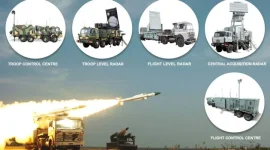
This robust physical defence will be guided by state-of-the-art early warning radars and a unified command-and-control infrastructure.
The decade-long window from 2030 to 2040 highlights the immense technical challenges associated with such an advanced grid.
Authorities are adopting a phased approach to deployment, ensuring that technologies are fully matured and tested before integration.
This careful timeline is necessary to guarantee the system can effectively neutralise modern, highly sophisticated threats, including hypersonic glide vehicles, stealth-enabled cruise missiles, and agile ballistic weapons.
Mission Sudarshan Chakra will not start from scratch; rather, it will leverage the substantial progress already achieved under the Defence Research and Development Organisation’s (DRDO) existing Ballistic Missile Defence (BMD) programme.
India has successfully proven its ability to destroy incoming missiles both inside and outside the earth's atmosphere using interceptors like the Prithvi Air Defence (PAD), Advanced Air Defence (AAD), as well as the newer AD-1 and AD-2 systems.
The foundational Phase 1 of the BMD, which was originally focused on creating a shield for critical cities like New Delhi and Mumbai, provides the technological bedrock for this wider national umbrella.
To create a truly comprehensive net, the initiative will fuse indigenous tracking networks—such as the Swordfish Long Range Tracking Radar—and space-based sensors with an array of kinetic weapons.
Existing elite assets like the Russian-origin S-400 Triumf, home-grown Akash surface-to-air missiles, and the upcoming Project Kusha (India's Long-Range Surface-to-Air Missile system) will form critical layers.
Furthermore, future next-generation tools, including the XRSAM and experimental directed-energy weapons (lasers), will eventually be plugged into this national grid, bringing India's capabilities on par with global military superpowers.
The push for a nationwide missile shield aligns with shifting realities in global warfare.
Recent international conflicts have vividly demonstrated how easily strategic infrastructure, power grids, and cities can be overwhelmed by coordinated drone swarms and precision missile strikes.
For India, developing a reliable and overlapping defence mechanism is no longer optional but an absolute strategic necessity in a volatile geopolitical landscape.
Realising the vision of Mission Sudarshan Chakra will require sustained financial backing and unprecedented cooperation across the defence manufacturing sector.
The Defence Secretary's statements signal a massive upcoming investment in sensor technology, aerospace engineering, and infrastructure hardening.
The project will heavily depend on a collaborative ecosystem bringing together the armed forces, DRDO scientists, state-run defence enterprises, and private-sector innovators to achieve self-reliance in this highly complex military domain.