India’s state-owned Hindustan Aeronautics Limited (HAL), in collaboration with private sector partner NewSpace Research and Technologies, is advancing the Air-Launched Flexible Asset Swarm (ALFA-S) pod as a vital component of its broader Combat Air Teaming System (CATS).
This innovative concept is designed to transfer the immense risks of initial combat strikes from expensive manned fighter jets to a network of expendable loitering munitions.
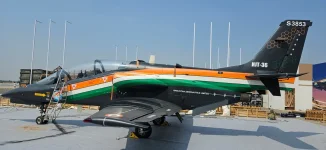
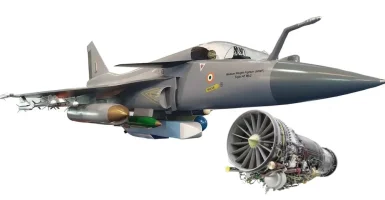
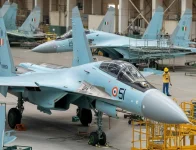
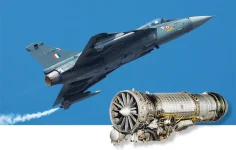
Built around a stand-off launch strategy, a "mothership" aircraft—such as a modified Jaguar MAX, Tejas, or Su-30MKI—can deploy the ALFA-S pod from a safe distance, well beyond the reach of hostile short-range air defence (SHORAD) systems.
Once released, the carrier pod can reportedly glide for roughly 100 kilometres before autonomously executing its deployment phase.
Upon reaching a designated coordinate, the pod's casing opens to disperse a swarm of up to 24 individual ALFA-S drones.
Each munition is a lightweight system weighing roughly 25 kilogrammes with foldable wings, carrying a precision 5 to 8 kilogramme explosive warhead.
These drones are specifically engineered to neutralise critical enemy air defence infrastructure, including radar installations, surface-to-air missile batteries, and command nodes.
Instead of relying on a single powerful weapon, this strategy employs a coordinated saturation strike.
By flooding the airspace with multiple targets travelling at speeds of around 100 kilometres per hour, the swarm heavily complicates interception efforts and overwhelms the enemy's processing systems.
A defining feature of the ALFA-S initiative is its shift away from continuous human oversight in favour of distributed autonomy.
The drone swarm operates on a collaborative decision-making network known as the “Chanakya” framework.
This artificial intelligence-driven architecture enables the individual munitions to communicate with one another, share targeting data, and dynamically adjust their objectives during flight.
Should enemy forces manage to jam communications or shoot down a few drones, the surviving units instantly adapt and reallocate targets among themselves.
This high level of resilience ensures the mission continues effectively without pilot input, which is particularly vital in modern combat zones where electromagnetic jamming routinely disrupts conventional datalinks.
Operationally, this architecture allows manned combat aircraft to stay safely outside the range of hostile air defences while still engaging highly defended targets.
The combination of long-range pod deployment and the swarm's autonomous targeting drastically limits the exposure of human pilots and highly valuable jet fighters.
This is especially crucial during the initial suppression of enemy air defences, historically the most hazardous phase of any aerial campaign.
By utilising unmanned swarms for these forward engagements, the air force can maintain a relentless offensive tempo while significantly improving the survivability of its human aviators.
The introduction of the ALFA-S also highlights a major strategic shift towards favouring sheer mass over expensive, singular assets.
Rather than sending a high-value fighter jet—often costing upwards of ₹600 crore—into a dense web of surface-to-air missiles, the military can utilise a wave of these cost-effective loitering munitions, which are estimated at merely ₹50 lakh each.
This creates a severe cost asymmetry for the enemy. Hostile forces are compelled to waste their expensive, high-tier interceptor missiles and radar capacities to shoot down relatively cheap drones, severely weakening their defensive posture before follow-up strikes by manned aircraft occur.
From a technological perspective, the ALFA-S represents a fusion of swarm intelligence, precision strike capabilities, and network-centric warfare.
Its overall success hinges on secure communication between the drones, advanced onboard autonomy, and the ability to identify targets accurately in heavily contested environments.
By executing synchronised, multi-angle strikes and drastically shortening reaction times, this swarm technology provides a profound tactical edge.
It effectively outpaces both legacy and contemporary air defence grids, which are traditionally built to track and engage only a limited number of incoming threats at any given moment.