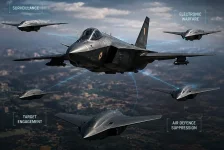
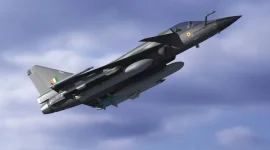
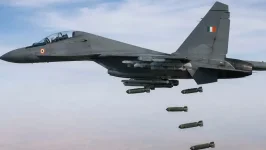
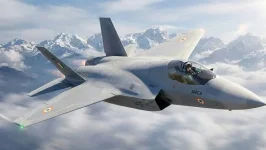
As India pushes forward with its homegrown Advanced Medium Combat Aircraft (AMCA) project, which targets a prototype flight by 2029, a vital strategic question is taking shape: how should the nation approach sixth-generation combat aviation?
Recent developments highlight New Delhi's delicate balancing act between the UK-Italy-Japan Global Combat Air Programme (GCAP) and the French-led Future Combat Air System (FCAS).
With China rapidly advancing its stealth fleets and testing sixth-generation prototypes, India's pursuit of next-generation air dominance has become more urgent.
Defence experts and economists widely acknowledge that participating in either multinational initiative would grant India exposure to highly advanced technologies.
However, each path presents distinct financial burdens, industrial rewards, and long-term strategic uncertainties.
Furthermore, any international commitment must be carefully weighed against India’s indigenous AMCA programme to ensure the country’s defence budget is not stretched beyond its limits.
GCAP: Financial Stability and New Dialogue Status
The GCAP project, a collaborative effort between the UK, Japan, and Italy, is viewed by experts as possessing a relatively steady management and financial framework.Industry calculations indicate that acquiring just a 10% industrial share could cost India roughly US$6.5 to US$7.5 billion during the development stage, while a more substantial role could push lifecycle investments past US$10 billion.
Recently, in late August 2026, India officially joined the GCAP as a 'Dialogue Partner'. This status allows New Delhi to closely study the programme's technological capabilities without a formal obligation to purchase or manufacture the jets.
Although participating in GCAP would demand massive funding, observers note that the initiative is bolstered by an efficient administrative structure.
The three core nations have largely stayed united on their funding and strategic goals. This unity minimises the chances of extended budgetary conflicts and serious timeline delays, which typically cause development costs to skyrocket.
FCAS: Deep Industrial Ties and Recent Restructuring
The FCAS programme presents a unique alternative.Initially conceived jointly by France, Germany, and Spain, it was estimated to be one of Europe's costliest defence ventures, with expenses likely topping €100 billion.
However, following a recent split in June 2026 over workshare disputes, France is now driving the crewed fighter component largely on its own under Dassault Aviation.
Despite these shifts, the French-led ecosystem heavily complements India’s current aerospace alliances. In fact, India's Defence Ministry informed Parliament in August 2026 that it has already begun concerted efforts to co-join the FCAS project.
India enjoys robust ties with French aerospace firms, most notably through the procurement of Rafale jets.
Furthermore, French manufacturer Safran is actively negotiating a major partnership with the Defence Research and Development Organisation's (DRDO) Gas Turbine Research Establishment (GTRE).
This collaboration aims to jointly create a 120KN high-thrust engine intended to power the upcoming AMCA Mk2.
Because of these well-established relationships, analysts predict that collaborating with France could lower integration expenses.
It would also offer India smoother access to critical sixth-generation technologies, such as advanced propulsion systems, stealth materials, modern digital engineering, and cutting-edge manufacturing processes.
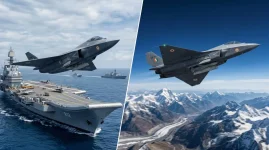
Additionally, experts frequently point out that the FCAS initiative includes plans for a carrier-based fighter variant.
This specific model could align perfectly with the Indian Navy’s future aviation needs, possibly eliminating the financial burden of developing a separate, homegrown naval stealth fighter.
The Crucial Role of Technology Transfer
The depth of technology transfer and domestic manufacturing opportunities will be a critical deciding factor for New Delhi.Many defence experts observe that France has traditionally been more willing to share technology and collaborate industrially with India compared to other Western nations.
Consequently, observers suggest that the French-led FCAS could present superior opportunities for India's domestic industries to advance in areas like systems integration, composite materials, and advanced metallurgy.
On the other hand, the GCAP initiative promises top-tier advancements in radar systems, sensor fusion, next-generation engines, and electronic warfare.
Yet, specialists warn that joining GCAP at this stage could subject India to stricter limits on intellectual property and manufacturing workshares.
Without aggressive negotiations to ensure comprehensive technology access, India's domestic production benefits could remain restricted.
Balancing with Indigenous AMCA Priorities
The most significant limitation in this strategic puzzle remains India’s domestic fifth-generation fighter project. The AMCA is already one of the most heavily funded aerospace initiatives in the nation's history.Attempting to finance the AMCA's development while simultaneously pouring billions into an international sixth-generation consortium would place tremendous strain on India's future defence budgets.
Defence economists refer to this situation as a "dual-programme dilemma." Should India decide to allocate billions toward either FCAS or GCAP alongside the AMCA, it would also need to spend heavily on expanding testing facilities, engineering personnel, manufacturing infrastructure, and operational resources.
For this reason, experts firmly believe that any international partnership must be strategically designed to support and enhance the AMCA project, rather than drawing vital resources away from it.
Evaluating Political and Programme Risks
When evaluating financial and political stability, the two options contrast sharply. The GCAP consortium has moved forward relatively smoothly, with minimal public friction among the UK, Italy, and Japan.In stark contrast, the FCAS project has been plagued by ongoing arguments over programme leadership, intellectual property rights, and industrial responsibilities between Germany and France, which ultimately led to their recent split on the crewed fighter development.
Experts caution that dealing with unpredictable political turbulence and shifting partnerships could drive up development expenses for new members and severely delay the delivery of combat-ready aircraft.
Making the Right Economic Choice
Looking through an industrial lens, many analysts maintain that FCAS provides greater synergy due to India’s deep-rooted ties with French aerospace giants like Dassault and Safran.Expanding upon these existing partnerships could decrease infrastructure expenses, boost local manufacturing, and facilitate the transfer of vital technologies that directly benefit the AMCA.
Even so, these same experts warn that the FCAS route involves elevated programme-management risks, especially given its history of industrial disputes and recent structural changes.
In contrast, GCAP stands out as a more financially reliable option, supported by clear governance and consistent funding from its three core members.
However, analysts conclude that this stability comes with a trade-off: India's recent entry as a dialogue partner is a positive step, but securing a formal role would require a massive initial financial commitment and intense negotiations to acquire valuable manufacturing shares and intellectual property rights.