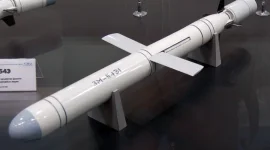
India’s ambitious long-range anti-ship weapon initiative, widely recognised as the "carrier-killer" missile, has successfully transitioned out of its initial design phase.
Spearheaded by the Defence Research and Development Organisation (DRDO) and recently showcased at the 2026 Republic Day parade as the Long-Range Anti-Ship Missile (LR-AShM), the system has completed three crucial developmental test flights.
As preparations begin for user trials with the Indian Navy, current timelines point toward a full operational induction between 2029 and 2030.
However, reports suggest that a Limited Series Production (LSP) run could facilitate a much earlier deployment of these hypersonic weapons in a land-based, coastal defence capacity.
The upcoming progression into user trials represents a major milestone for the weapon system.
During this phase, the Indian Navy will rigorously evaluate the missile under realistic combat conditions to ensure absolute reliability and seamless integration with existing military command networks.
Because the LR-AShM is designed to neutralise heavily defended, high-value naval warships, raw speed and its 1,500-kilometre reach are only part of the equation.
Evaluators will closely test the missile's indigenous terminal sensors, its ability to survive intense electronic warfare, and its capacity to precisely track and strike moving maritime targets using real-time data feeds.
Furthermore, the missile is expected to play a central role in India’s proposed Integrated Rocket Force (IRF), marking a significant shift in national military strategy.
The IRF is envisioned as a unified, tri-service command that will centralise the control of conventional long-range precision weapons.
By bringing together anti-ship, land-attack, and hypersonic systems like the LR-AShM and the Pralay ballistic missile under one operational umbrella, the Indian Armed Forces aim to achieve a more cohesive and efficient command structure for deep-strike operations.
Deploying the missile initially through coastal defence batteries is a practical strategy that mirrors modern global military tactics.
Firing from mobile Transporter Erector Launchers (TELs) situated along India's vast mainland coastline and strategic island territories provides a highly survivable and cost-effective method of sea denial.
This land-based approach allows the military to establish immediate, layered defensive perimeters to secure vital sea lanes, heavily complicating any hostile naval movements without waiting for the complex process of integrating the missiles onto warships.
In terms of technical performance, this new weapon merges vast reach with devastating terminal velocity.
Powered by a solid-propellant booster before entering a hypersonic glide phase, the missile travels at speeds between Mach 5 and Mach 10, executing unpredictable aerodynamic manoeuvres to bypass enemy air defences.
To maximise its over-the-horizon strike potential, the missile relies on multi-mode seekers and networked mid-course guidance updates.
This requires perfect synchronisation with surveillance satellites, unmanned aerial vehicles (UAVs), and maritime patrol aircraft to continuously track targets over vast ocean distances.
The strategic rollout of the missile will follow a carefully structured timeline.
Comprehensive user trials to confirm the system's combat readiness alongside the Indian Navy are scheduled to take place throughout 2027 and 2028.
Following these validations, the formal induction of the coastal defence variant is slated for 2029 to 2030, paving the way for future adaptations designed for submarines and fighter jets.
Should the initial production begin ahead of schedule, the armed forces will receive a small number of early units, allowing personnel to train and develop operational tactics well before the official induction.
On a strategic level, the successful fielding of this hypersonic glide vehicle firmly cements India’s Anti-Access/Area Denial (A2/AD) posture across the Indian Ocean Region.
By severely reducing an adversary's reaction time to mere minutes, this long-range capability creates a formidable deterrent, drastically increasing the risks for hostile carrier strike groups venturing near Indian waters.
Working in tandem with existing supersonic assets like the BrahMos, the new carrier-killer missile establishes an impenetrable, multi-layered maritime defence architecture.