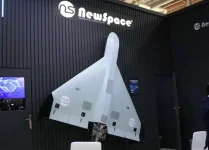
India has achieved a major milestone in autonomous military technology with the successful trial of the Sheshnaag-150 swarming attack drone at the Pokhran test facility.
Created by NewSpace Research and Technologies (NRT), a Bengaluru-based aerospace startup, this system offers a cost-effective, long-range loitering munition built to function effectively in highly contested battlegrounds.
Public sources indicate that the development of this indigenous platform was accelerated to meet the armed forces' growing requirement for advanced unmanned capabilities following recent strategic initiatives.
During the evaluation, the unmanned aerial vehicle remained in flight for roughly five hours.
It successfully navigated a series of predetermined waypoints over a 720-kilometer flight path before striking its assigned ground target with exceptional precision.
Visual recordings of the trial confirmed a direct hit, though the prototype was flown without a live warhead, as there was no detonation upon impact.
While this specific test covered 720 kilometers, open-source data reveals the platform is ultimately designed to achieve an operational range exceeding 1,000 kilometers for deep-strike missions.
The Sheshnaag-150 is built for pinpoint accuracy, boasting a Circular Error Probable (CEP) of less than 10 meters.
In a combat scenario, the munition can be equipped with a high-explosive warhead weighing between 25 and 40 kilograms.
This payload capacity makes it highly effective at destroying hardened enemy bunkers, radar stations, and other high-value tactical infrastructure.
To sustain its long-endurance flights, the drone is reportedly powered by an air-cooled boxer engine, an engineering choice that reduces vibration and ensures reliable performance even in freezing, high-altitude environments like the Himalayas.
A defining characteristic of the Sheshnaag-150 is its advanced swarming technology.
Driven by a proprietary "mother code" software architecture, the system enables 50 or more drones to communicate, coordinate flight paths, and execute saturation attacks simultaneously.
This intelligent network is self-healing; if enemy fire brings down a leading drone, the rest of the swarm automatically adapts and regroups to ensure the mission is completed without requiring manual input from human operators.
Furthermore, the munition is highly resilient against electronic warfare.
Modern battlefields frequently feature intense GPS jamming, which can blind conventional drones.
To counter this, the Sheshnaag-150 utilises visual navigation technology and internal sensors to maintain its course and lock onto targets even when satellite signals are blocked.
This design choice reflects a global shift in warfare, where electronic resilience is just as critical as explosive power.
The successful demonstration at Pokhran solidifies the Sheshnaag-150 as a robust, homegrown alternative to expensive foreign loitering munitions.
By combining impressive range, swarm intelligence, heavy payload capacity, and electronic warfare survivability, the system perfectly supports India's evolving network-centric defence posture.