In the event of renewed cross-border hostilities, a potential "Operation Sindoor 2.0" would demonstrate the strategic value of India's ongoing transition to joint theater commands.
By restructuring the Army, Navy, and Air Force into unified military theaters, the armed forces would operate as a cohesive unit.
Drawing on lessons from recent years—which highlight the need for rapid decision-making, clear political directives, and seamless government coordination—India’s future military strategy focuses on a multi-domain approach.
This strategy is designed to decisively punish state-sponsored terrorism at its origin while establishing a strong deterrence against future provocations.
Under this integrated structure, newly envisioned specialized strike formations, such as the proposed elite 'Bhairav' commando battalions and 'Rudra' rapid-reaction brigades, would be tailored specifically for cross-border precision operations.
These ground units would not act alone; they would be heavily supported by long-range standoff weapons. Simultaneously, the Indian Navy would secure the maritime borders.
Utilizing carrier strike groups and advanced Boeing P-8I maritime patrol aircraft, the Navy would monitor the seas and block any logistical supply routes used by terror networks.
To understand how this would work in practice, military planners often look at compelling hypothetical scenarios.
For instance, if intelligence agencies locate a high-value Jaish-e-Mohammed (JeM) commander in a fortified compound near Bahawalpur—hundreds of kilometers inside Pakistan—a multi-domain strike would be launched.
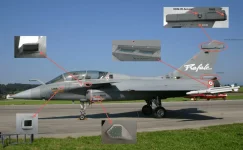
Under the cover of night, special forces would be deployed via high-altitude parachute drops, escorted by Indian Air Force Rafale fighter jets and advanced drone swarms. In a swift 45-minute operation, the commandos would eliminate the target and secure vital intelligence.
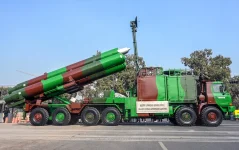
Meanwhile, Indian naval vessels would launch BrahMos supersonic cruise missiles to suppress any approaching enemy quick-reaction forces, and cyber warfare teams would jam local communication networks to block reinforcements.
Before sunrise, the strike team would be safely extracted by Mi-17 helicopters, heavily guarded by a multi-layered air defence umbrella.
The backbone of this modern campaign would be precision-guided munitions.
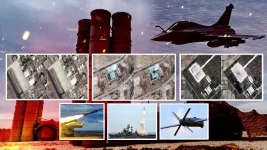
In the opening days of such an operation, synchronized barrages of BrahMos missiles, air-launched SCALP cruise missiles, and loitering munitions deployed from land, air, and sea would precisely destroy dozens of terror infrastructure targets.
Furthermore, if the adversary attempted to escalate the conflict—such as by moving tactical nuclear assets or launching major counter-attacks—India’s response would dynamically expand.
The military would surgically dismantle enemy missile storage facilities, dual-use command and control (C4ISR) centers, and military airbases, deliberately avoiding civilian casualties.
The Navy could also enforce a maritime blockade in the northern Arabian Sea, utilizing submarine-launched weapons to neutralize port facilities that supply arms to militant groups.
Parallel to the physical battlefield, a rigorous information warfare campaign would take place.
By releasing real-time drone footage of the surgical strikes to international media, India could transparently demonstrate its operational restraint and frame the strikes as a legitimate act of self-defence.
To further protect Indian troops during any limited ground operations, the military would rely on rapid defence procurements, including advanced counter-drone systems, VSHORAD (Very Short Range Air Defence) missiles, and anti-tank weaponry.
Ultimately, within a matter of days, this synchronized joint campaign would severely cripple terrorist infrastructure, applying intense internal pressure on the adversary to abandon proxy warfare—all achieved without the need for a large-scale, conventional border crossing.