- Views: 880
- Replies: 3
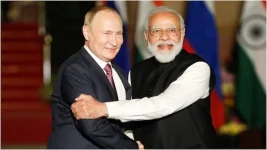
Russian President Vladimir Putin has renewed a major strategic offer to New Delhi, inviting India to join the Sukhoi Su-57 fifth-generation fighter programme.
Speaking recently at the St. Petersburg International Economic Forum (SPIEF), Putin emphasised that Moscow is fully prepared to not only export the advanced stealth jets but also partner on the joint development of future technologies for the platform.
Reflecting on the historical defence partnership between the two nations, the Russian leader recounted previous negotiations tied to the Fifth Generation Fighter Aircraft (FGFA) initiative.
Russia had initially presented India with a chance to co-develop the Su-57 from the ground up. However, the Indian government opted to step back, preferring to wait and assess the aircraft once its technology had fully matured.
During an interaction with heads of global news agencies, including India's PTI, Putin remarked that Russia had once asked its Indian counterparts to collaborate on what he described as the best fifth-generation technology in the world.
He noted that India’s response at the time was to encourage Russia to proceed independently, keeping the door open to potentially join the project at a later stage.
Despite Russia ultimately bringing the Su-57 to completion on its own, Putin made it clear that the possibility for collaboration remains wide open.
He highlighted that future cooperation could easily expand beyond direct sales to include the joint manufacturing and continuous upgrading of the fighter jet and its associated systems.
"The aircraft could have been our joint project," Putin stated, adding that while Russia built it independently, Moscow remains entirely ready to work alongside India to supply the platform and continue its development.
These renewed remarks arrive at a critical juncture for Indian aerospace planning.
The Indian Air Force (IAF) is currently operating with around 29 fighter squadrons—significantly short of its sanctioned strength of 42.
With regional dynamics shifting as China expands its J-20 stealth fleet and Pakistan plans the acquisition of Chinese J-35s, the need to bolster the IAF is pressing.
While India is aggressively pushing its indigenous Advanced Medium Combat Aircraft (AMCA) programme, the stealth jet is not expected to enter operational service until roughly 2035, keeping the debate on interim foreign acquisitions highly active within defence circles.
The Su-57 stands as Russia’s flagship fifth-generation fighter, boasting advanced stealth characteristics, internal weapons bays, supercruise capability, and cutting-edge sensor fusion.
Having successfully inducted the jet into its own Aerospace Forces, Russia has been actively marketing export variants globally, proudly pointing to its combat operational history and a clear roadmap for future modernisation.
Highlighting a key difference from Western defence suppliers, Putin assured that Russia places no limitations or restrictions on its military cooperation with India.
This policy of unrestricted technology transfer extends across multiple strategic domains, from advanced combat aviation to ground-based interceptors.
"We don’t have any issues with it, any limitations. The same goes for air defence systems," the Russian President affirmed. This is particularly relevant as India continues to integrate Russian-origin S-400 missile systems into its broader, indigenous air defence network.
The SPIEF comments have inevitably reignited debates regarding the future of aerospace collaboration between New Delhi and Moscow.
India and Russia previously spent over a decade negotiating the FGFA programme. However, India officially withdrew from the project in 2018 due to unresolved concerns over the estimated $30 billion cost, the extent of technology transfer, engine performance, and the stealth platform's overall maturity at the time.
Since India's departure from the project, the Su-57 has crossed several developmental milestones.
Russia has moved the fighter into active service, scaled up production, and begun offering extensive technology-sharing frameworks to attract international partners. Recent reports indicate that the Sukhoi Design Bureau has even made fresh capability presentations to the IAF.
Moving forward, any renewed involvement with the Su-57 will be strictly weighed against New Delhi's comprehensive fighter modernisation strategy.
In response to Putin's remarks, India's Ministry of External Affairs acknowledged the robust defence ties between the two nations, deferring specific procurement decisions to the Ministry of Defence.
Currently, the IAF is balancing several parallel tracks to bridge its capability gap, including the induction of new Tejas Mk-1A and Mk-2 variants, the accelerated development of the indigenous AMCA, the comprehensive "Super Sukhoi" upgrades for the Su-30MKI fleet, and the long-anticipated Multi-Role Fighter Aircraft (MRFA) competition.