India’s next-generation combat-aircraft planning may need to look beyond conventional radar-evading stealth, with former DRDO Director General Dr. Suma Varughese warning that future sensing technologies could challenge aircraft designed primarily around radio-frequency (RF) signature reduction.
Speaking to Wing Commander Julie Rosy (Retd.) during a podcast, Varughese argued that defence research organisations should begin examining counter-sensing technologies now rather than waiting until emerging detection systems mature.
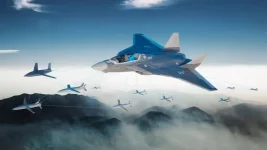
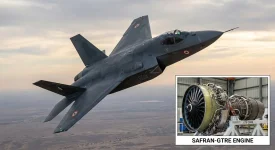
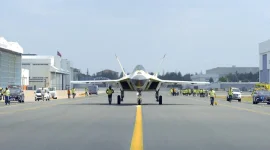
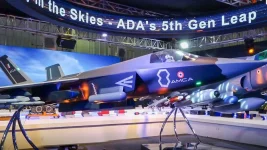
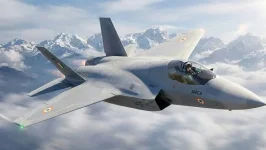
The warning has particular relevance for India’s Advanced Medium Combat Aircraft (AMCA), which is being developed as the country’s first indigenous fifth-generation stealth fighter.
AMCA is expected to rely heavily on low-observable design, internal weapons carriage, advanced electronic warfare, and sensor fusion to survive inside heavily defended airspace.
But a fighter entering service years from now will have to remain operationally relevant for decades, potentially into an era in which new sensing technologies are significantly more capable than today’s radar systems.
Varughese’s central argument is not that quantum detection has already made conventional stealth obsolete.
Rather, it highlights a classic defence-planning problem: an aircraft designed against today’s threat environment can face a different sensor architecture by the time it reaches widespread operational service.
This is particularly important for combat aircraft because their development and service lives can span several decades.
Quantum sensing is attracting increasing global research interest because quantum technologies can potentially enable measurements with sensitivity beyond conventional sensing approaches in certain applications.
However, the operational significance of so-called “quantum radar” remains highly uncertain, and there is currently no demonstrated battlefield system that has rendered conventional aircraft stealth irrelevant.
That distinction is crucial for discussions surrounding AMCA. Conventional stealth is not simply about making an aircraft invisible to radar.
Modern low-observable aircraft combine carefully controlled radar cross-sections, infrared-signature management, electronic warfare, emissions control, tactical employment, and networked situational awareness.
Even if an adversary eventually develops a sensor capable of detecting an aircraft at greater distances, the aircraft’s survivability could still depend on how accurately that sensor can identify, track, and engage it.
The former DRDO official’s recommendation for a proactive counter-sensing strategy therefore has broader implications than quantum radar alone.
India’s future combat-aircraft research could examine technologies capable of managing signatures across multiple portions of the electromagnetic spectrum rather than concentrating predominantly on RF characteristics.
One potential area is advanced metamaterials and engineered electromagnetic surfaces. Such materials could eventually provide designers with greater control over how an aircraft interacts with electromagnetic energy.
Other possibilities include multispectral signature management, adaptive electronic warfare, advanced infrared suppression, and distributed sensing designed to confuse or complicate an adversary’s targeting chain.
For AMCA, incorporating such technologies during the design and development phase would be considerably easier than attempting to retrofit them after the aircraft has entered mass production.
Structural geometry, materials, thermal management, apertures, and sensor placement are all closely interconnected. Major changes to these areas after an aircraft has been certified can be extremely expensive and technically disruptive.
The issue also reinforces the importance of designing AMCA as an open and upgradeable combat architecture.
Rather than treating the aircraft’s stealth characteristics as a fixed specification, India could develop a platform capable of receiving new signature-management technologies, electronic-warfare systems, sensors, and mission software throughout its service life.
This philosophy would be particularly important for the proposed AMCA Mk2.
If India eventually develops a more powerful engine, larger weapons capacity, and more advanced mission systems for the second-generation aircraft, the opportunity exists to incorporate lessons from emerging sensor technologies into the design from the outset.
The warning also highlights why India’s investment in next-generation research cannot stop with AMCA. Quantum sensing, photonics, artificial intelligence, electronic warfare, and autonomous systems are advancing simultaneously.
India’s future air-combat architecture will therefore need to account for an increasingly complex sensor environment in which stealth is only one component of survivability.