- Views: 1K
- Replies: 1
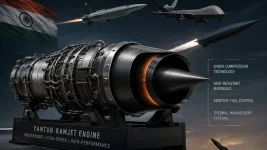
Hyderabad-based startup Paninian India has marked a major milestone in the country's aerospace sector by introducing the Yantur compact turbofan.
Generating a thrust of 4.5 kilonewtons (kN), it is the first privately built engine in this category within India.
While currently in the developmental stage, the Yantur project is a clear sign that private companies are now stepping into a complex field that was once exclusively controlled by state-run institutions like the Defence Research and Development Organisation (DRDO) and its Gas Turbine Research Establishment (GTRE).
The main purpose of the Yantur engine is to power Paninian's own Svayatt-L1, an autonomous long-range cruise missile platform designed to meet the requirements of the Ministry of Defence's Make-I programme for the Long-Range Land Attack Cruise Missile (LRLACM).
However, the engine's core is highly adaptable. According to Paninian, the technology can be scaled up to produce powerful engines with up to 12.5 kN of thrust.
This means the same basic design could eventually power advanced combat drones, unmanned wingman aircraft, and other future unmanned aerial systems.
If successful, Yantur will offer a versatile family of homegrown engines suited for both missiles and high-performance drones.
This new private venture is naturally drawing comparisons with GTRE's Manik engine, also known as the Small Turbofan Engine (STFE).
The Manik, which also produces around 4.25 to 4.5 kN of thrust, was designed by the government to power India's long-range cruise missiles, such as the 1,500 km range Nirbhay and the Indigenous Technology Cruise Missile (ITCM).
While both the Yantur and Manik engines are in the same thrust class, they highlight two completely different methods of building national defence capabilities.
The Manik engine is the result of decades of steady, state-funded research by DRDO, focusing on building long-term technological foundations. In contrast, Paninian relies on private investment and commercial agility to achieve faster results in a notoriously difficult engineering sector.
The end goals of the two projects also reflect differing strategies. The DRDO's Manik is specifically tailored to provide a reliable propulsion system for India's strategic, long-range missile arsenal.
While the initial 4.5 kN Yantur engine is also meant for cruise missiles, its modular design looks further ahead.
By planning to scale the engine up to 12.5 kN, Paninian aims to meet the future needs of the Indian Armed Forces, which are heavily investing in artificial intelligence, stealth combat drones, and loyal wingman aircraft.
Technologically, Paninian highlights several modern innovations in the Yantur programme, having filed multiple patents for advanced compressor and combustor designs, as well as digital manufacturing techniques.
A key feature is the use of "digital twin" technology, which creates a virtual replica of the engine to monitor its real-time health, predict maintenance needs, and optimise its lifespan.
On the other hand, the GTRE Manik programme relies on years of traditional, proven expertise in gas turbine mechanics, compressor aerodynamics, and system integration.
While it may not heavily advertise digital manufacturing, the Manik engine forms the backbone of India's current gas turbine capabilities.
There is also a stark difference in how close each engine is to entering service.
The GTRE Manik is highly mature; it has already undergone extensive flight testing and is integrated into national cruise missile programmes, bringing it very close to mass production and operational deployment.
The Yantur, however, is still in its early stages. Paninian has finished the design phase and is moving towards testing its individual parts and securing more funding.
Developing an aero-engine is one of the toughest challenges in engineering. It requires thousands of hours of testing under extreme conditions, and private startups face the daunting, expensive task of securing specialised facilities like high-altitude test cells to prove their engine is safe and reliable.
Despite the hurdles, the arrival of the Yantur engine is a strategic victory for India.
For years, only government labs built small gas turbine engines. A private company entering this space brings healthy competition and fresh innovation to the industry.
Defence experts view the two engines not as rivals, but as partners in national security. GTRE has built the essential groundwork over decades, and now private firms like Paninian are using that foundation to move quickly with private money.
If Paninian can successfully test and certify the Yantur, India will gain a robust, scalable engine family for both missiles and future combat drones, massively boosting the nation's self-reliance in aerospace defence.