The nature of contemporary combat is undergoing a major shift, with robotic and autonomous weaponry moving beyond basic surveillance to execute highly precise strikes.
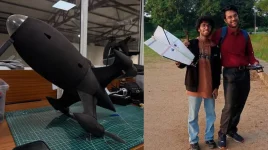
Within India, the spotlight is currently on the Ahuti MK-II, a remarkably fast interceptor drone.
At the same time, the growing deployment of suicide drones and independent combat vehicles is prompting important discussions regarding their operational control and global regulation.
To understand these technologies, unmanned systems are generally grouped by how much human control is involved.
"Human-in-the-loop" platforms can spot a threat but need a person to authorize the actual attack. "Human-on-the-loop" systems operate automatically while allowing an operator to oversee the mission and cancel it if needed. Finally, "Human-out-of-the-loop" weaponry can independently hunt and destroy targets without any human input.
These Lethal Autonomous Weapons Systems (LAWS) rely heavily on advanced sensors, artificial intelligence, and visual recognition software to carry out their missions.
A prominent example is the loitering munition, commonly called a kamikaze drone, which circles a designated zone to find a target before crashing into it and detonating its payload.
India recently marked a major milestone in this sector. On September 1, 2026, the India Book of Records officially certified the Ahuti MK-II as the fastest multi-rotor unmanned aerial vehicle (UAV) in the country, achieving an impressive top speed of 498 km/h.
This marks a massive leap over the previous national record of roughly 325 km/h for similar multi-rotor platforms.
The electric interceptor was created by Apollyon Dynamics, a defence technology startup incubated at the BITS Pilani Hyderabad Campus and co-founded by Jayant Khatri and Sourya Choudhary.
While the initial Ahuti model reached speeds around 300 km/h in 2025, the MK-II represents a 66% improvement in speed. Unlike standard drones meant for carrying cameras, the Ahuti MK-II is strictly designed to hunt down and crash into enemy drones.
Achieving this extreme performance required about ten design iterations of the frame and motors, resulting in a machine capable of drawing a massive 400 amperes of burst current during high-speed chases.
Alongside interceptors, the Indian armed forces are heavily investing in indigenous loitering munitions.
The ALS-50, built by Tata Advanced Systems Limited, is an advanced suicide drone featuring Vertical Take-Off and Landing (VTOL) capabilities and a strike range of over 50 kilometres.
It has been successfully delivered to the Indian Air Force and is optimized for difficult terrains like the high-altitude regions of Ladakh.
Similarly, the Indian Army has utilized emergency procurement to acquire the Nagastra-1.
Developed by Economic Explosives Limited and Z-Motion Autonomous Systems, the man-portable Nagastra-1 boasts high indigenous content and features a 15 to 40-kilometre range depending on the control mode, carrying a 1 to 1.5 kg warhead.
These advanced platforms are crucial for modern militaries, allowing them to hit specific targets accurately without risking large, expensive aircraft.
Rapid interceptors like the Ahuti MK-II are especially valuable for neutralizing cheap enemy drones, providing a far more budget-friendly defence than firing expensive surface-to-air missiles.
Apollyon Dynamics has actively tested its technology at prominent military firing ranges like Babina and Gopalpur, receiving strong support from the Indian Army.
Furthermore, the startup has already begun supplying tactical unmanned systems to active military units, proving its readiness for real-world operations.
On a global scale, many countries are adopting similar autonomous technologies.
South Korea utilizes the Samsung-developed SGR-A1 automated sentry gun, while the United States relies on the MQ-9 Reaper for semi-autonomous missions and the Sea Hunter for unmanned naval patrols.
Russia has also deployed the Uran-9, a heavily armed robotic tank used for scouting and fire support.
The international community, through the United Nations Group of Governmental Experts under the Convention on Certain Conventional Weapons, is currently trying to establish rules for these weapons.
The recent 498 km/h speed record set by Apollyon Dynamics demonstrates how Indian startups are rapidly advancing UAV technology.
As the military relies more heavily on both kamikaze drones and the interceptors built to stop them, the distinctions between human-controlled and fully autonomous weapons will remain a vital topic in global defence strategies.