Recent reports and photographic evidence indicate that Russia has initiated ground taxi trials for a brand-new, twin-seat model of its fifth-generation Su-57 stealth fighter.
This modified aircraft features an elongated cockpit canopy with a tandem seating arrangement, bearing a strong visual resemblance to the well-known Su-30 platform.
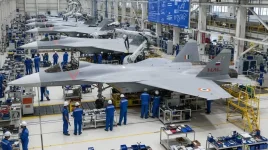
With this development, the Russian Su-57 becomes only the second fifth-generation fighter jet globally to feature a two-seater design, following China's J-20S variant which first appeared in 2021.
According to prominent Russian military aviation channels, this new stealth aircraft could potentially be designated as the Su-57D, Su-57UB, or Su-57ED.
Traditionally, a two-crew aircraft helps reduce pilot workload by splitting operational responsibilities; the front pilot focuses on flying and aerial combat, while the rear crew member handles complex targeting and weapon systems.
However, modern aerial combat doctrines are shifting rapidly towards Manned-Unmanned Teaming (MUM-T). In this emerging concept, the back-seat Weapon Systems Officer (WSO) acts as a dedicated tactical mission commander.
Instead of merely operating onboard sensors, the WSO would actively direct supporting unmanned combat aerial vehicles (UCAVs) in real-time.
Military analysts suggest this twin-seat Su-57 variant is designed specifically to serve as a secure airborne command centre to coordinate heavy strike drones, such as Russia's 20-ton S-70 Okhotnik-B, deep within hostile airspace.
The initial imagery of the twin-seat prototype, circulated by Russian aviation bloggers, shows an aircraft with heavily blurred backgrounds and obscured identification markings.
Only a small section of the fuselage behind the cockpit remains unedited in the leaked photographs.
Despite these visual alterations, independent military aviation researchers have identified that the airframe carries the bort number "055 Blue."
This specific designation suggests the prototype may have been developed by structurally modifying an existing early-production airframe rather than being built entirely from scratch.
Open-source data also indicates the aircraft is slated to utilize the advanced AL-51F1 (Izdeliye 30) engines to maintain its supercruise capabilities despite the added weight of a second crew member.
This development is particularly significant for the Indian Air Force (IAF), which had heavily insisted on a two-seat configuration during the initial Indo-Russian Fifth Generation Fighter Aircraft (FGFA) initiative.
The IAF originally sought to replicate the highly successful operational model of its 270-strong Su-30MKI fleet.
Following India's withdrawal from the FGFA programme in 2018, New Delhi's pursuit of an immediate stealth platform stalled.
Now, facing an expanding presence of Chinese J-20 stealth fighters near its borders and Pakistan's impending acquisition of the stealthy J-35, India's interest may be reignited as its own Advanced Medium Combat Aircraft (AMCA) is still years away from induction.
Moscow is reportedly offering a customised, Su-30MKI-style joint programme for this twin-seat Su-57.
Defence experts note that this proposal likely includes full Transfer of Technology (ToT), local manufacturing rights, and the flexibility to seamlessly integrate indigenous Indian defence systems and weapons.