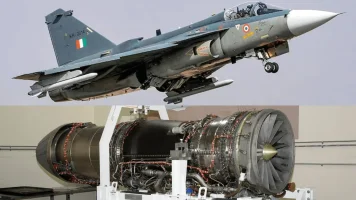
The selection of a jet engine for India's Advanced Medium Combat Aircraft (AMCA) Mk2 has transformed from a standard purchasing agreement into a broader discussion on long-term technological strategy.
Leading aerospace giants Rolls-Royce and Safran are no longer just offering fixed engine models; instead, they are proposing highly adaptable, modular propulsion networks designed to evolve over decades.
Rolls-Royce's Vision for a Flexible Fleet
Sources indicate that British firm Rolls-Royce has put forward a 120 kN-class engine core built for scalability. This flexible design can be modified for naval warships or upgraded for future sixth-generation fighter jets.Indian military planners are highly focused on the long service life of combat jets, and this adaptable approach guarantees that the AMCA Mk2 will not become outdated soon after it enters service.
Furthermore, using a unified engine framework across both the air force and navy would create massive savings in logistics and maintenance.
Recent developments highlight the depth of this proposal. Earlier in 2026, Rolls-Royce CEO Tufan Erginbilgic held high-level discussions with Prime Minister Narendra Modi, reinforcing this commitment.
Erginbilgic outlined a strategic roadmap that views India as a "third home market," aiming to double the company's local workforce to 10,000 employees.
To support India’s Atmanirbhar Bharat vision, the British company is offering 100% intellectual property (IP) rights alongside the establishment of a dedicated local design centre.
Safran's Adaptive Push
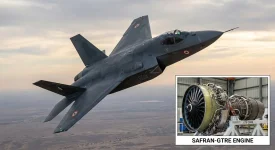
To maintain its competitive edge, France's Safran significantly updated its pitch in late 2025 by incorporating elements of Adaptive Cycle technology.This addition is intended to help the AMCA achieve continuous supersonic flight without afterburners (supercruise) while keeping pace with modern global engine advancements.
According to recent open-source reports, Safran's proposal features an engine co-developed with India's Gas Turbine Research Establishment (GTRE) that offers a scalable thrust envelope starting at a 120 kN baseline and expanding up to 140 kN to accommodate potentially heavier future variants of the AMCA.
The French aerospace leader has also proposed establishing a complete engine assembly line in India, guaranteeing full technology transfer and ensuring that GTRE retains absolute ownership of the intellectual property.
While Rolls-Royce’s Variable Cycle Engine (VCE) technology is widely regarded as superior for long-distance fuel efficiency and versatile mission profiles, India's Ministry of Defence is carefully weighing these advanced capabilities against strict delivery schedules and the need for national self-reliance.
The Variable Cycle Advantage
The VCE framework gives an engine the unique ability to shift seamlessly between two distinct operating modes:- High-Thrust Mode: Optimized for rapid interception and intense aerial combat.
- High-Bypass Mode: Engineered for extended patrols and maximum fuel efficiency.
Drawing from its experience with the UK's Global Combat Air Programme (GCAP), Rolls-Royce is marketing this dual-mode capability as a definitive way to future-proof India’s aerospace fleet.
India's "Evolutionary Ladder" Strategy
Within India's defence sector, a dual-track strategy is currently gaining traction.Because Safran is fully prepared to hand over complete technology transfers and joint IP rights—crucial steps for India's long-term independence—it is currently viewed as the frontrunner to provide the primary engine for the AMCA Mk2.
Simultaneously, the Ministry of Defence is exploring a secondary, parallel partnership with Rolls-Royce.
This collaboration would focus on creating a domestic 90–100 kN engine to eventually replace the American GE F404 and F414 engines currently used in the Tejas Mk1A and Mk2 fighters.
This move would protect India from future supply chain issues and international delivery delays.
This balanced approach highlights a major shift in New Delhi's aero-engine strategy.
Instead of relying exclusively on one foreign supplier, India is hedging its bets: partnering with Safran to meet immediate fifth-generation needs, while simultaneously working with Rolls-Royce to develop next-generation technologies and build a strong domestic manufacturing base.
The Future is Inside the Core
At the heart of both foreign proposals is the principle of modular design.The first iteration of the AMCA Mk2 engine, projected to be ready by the mid-2030s, will be a robust fifth-generation turbofan producing 110 to 130 kN of thrust.
This baseline engine will focus on extreme reliability, a high thrust-to-weight ratio, and the use of cutting-edge materials like high-temperature alloys and single-crystal turbine blades.
However, unlike older jet engines, the outer casing and overall external dimensions of this new engine will remain permanent.
The true breakthrough is hidden inside the engine. Both Safran and Rolls-Royce are designing systems where the internal core and bypass components can be swapped out and upgraded.
When India inevitably moves towards sixth-generation fighter requirements in the 2040s, there will be no need to fund and develop an entirely new propulsion system.
Instead, engineers can simply replace the internal core with an advanced Variable or Adaptive Cycle module.
This revolutionary "core swap" strategy turns the engine from a disposable product into a permanent, evolving platform.
By securing co-ownership of the intellectual property today, domestic institutions like GTRE will have the freedom and knowledge to independently design and integrate these advanced modules in the decades to come.
Ultimately, this approach provides India with a seamless bridge from fifth- to sixth-generation airpower without ever having to start development cycles from scratch again.