- Views: 2K
- Replies: 2
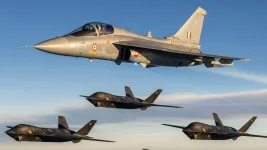
Hindustan Aeronautics Limited (HAL) has received a major boost with the Indian Air Force (IAF) showing strong support for the HLFT-42 (Hindustan Lead-in Fighter Trainer) programme.
Even though the aircraft is yet to pass its Critical Design Review (CDR), the IAF has already signalled its intent to order at least 100 units.
This massive induction is expected to completely transform India's pilot training and light combat ecosystem beyond 2035, with final procurement numbers potentially rising even higher.
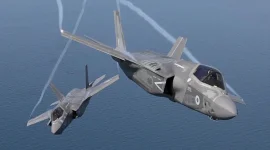
The HLFT-42 is being developed as a versatile, dual-purpose platform to serve as both a Lead-In Fighter Trainer (LIFT) and a capable combat jet.
As the current fleet of subsonic Hawk 132 trainers nears the end of its service life in the coming decade, the IAF requires a supersonic trainer to take its place.
This new jet will closely mirror the high-end avionics and performance of frontline aircraft, ensuring pilots are fully prepared before they transition to advanced operational squadrons flying the Su-30MKI, Rafale, Tejas Mk2, and the upcoming Advanced Medium Combat Aircraft (AMCA)
Built around a 16.5-tonne maximum take-off weight (MTOW), the HLFT-42 represents a significant technological leap over traditional trainers.
Recent open-source updates indicate the aircraft's design has been refined with Tejas Mk2-style lateral air intakes to improve aerodynamic efficiency and standardisation.
The aircraft will feature a modern glass cockpit, an Active Electronically Scanned Array (AESA) radar, an Infrared Search and Track (IRST) sensor, and a full Fly-by-Wire system.
This configuration allows trainee pilots to master complex combat scenarios, including beyond-visual-range (BVR) tactics and sensor fusion, at a fraction of the cost of operating a twin-seat frontline fighter.
Crucially, the IAF’s vision for the HLFT-42 extends far beyond pilot instruction. The twin-seat jet is being engineered for full combat readiness during conflicts.
Featuring 11 hardpoints and a payload capacity of around 4.5 tonnes, it is designed to be armed with Astra air-to-air missiles, precision-guided bombs like the DRDO SAAW, and potentially the BrahMos-NG.
This allows the aircraft to perform secondary strike missions, conduct air defence Combat Air Patrols (CAP), and act as a heavily armed "missile truck" during wartime surges, thereby freeing up heavier fighters for specialised, high-risk missions.
A groundbreaking feature of the HLFT-42 is its integration into HAL’s evolving Manned-Unmanned Teaming (MUM-T) framework.
The aircraft is being tailored to function as an airborne "mothership" for the Combat Air Teaming System (CATS).
The pilot or mission commander in the rear seat will be able to direct unmanned stealth assets, such as the CATS Warrior, CATS Hunter cruise missiles, and drone swarms.
This capability effectively extends the aircraft's striking range and sensor network deep into contested airspace without putting human pilots at unnecessary risk.
The strong backing from the IAF highlights a rare and highly effective alignment between India's military requirements and the domestic aviation industry's vision.
With an anticipated base price tag of around $20 million per unit, the jet is also expected to be a highly competitive option for the global export market.
If development timelines are met, the HLFT-42 will serve as much more than a Hawk 132 replacement; it will become a central pillar of India’s combat readiness, air defence flexibility, and autonomous airpower doctrine well into the 2040s.