- Views: 2K
- Replies: 8
The forthcoming HAL Tejas Mk2, India's new medium-weight combat aircraft, is being developed with substantially enhanced attack capabilities.
Reports indicate that the fighter jet is already being prepared to carry several advanced long-range precision weapons currently utilised by the Indian Air Force (IAF).
During its initial phase, the aircraft is set to be equipped with formidable air-to-ground munitions, including the European SCALP-EG long-range cruise missile and the Israeli Crystal Maze precision strike system.
These weapons are already active in the IAF's arsenal, notably on the Dassault Rafale and upgraded Mirage 2000 jets.
Envisioned as a far more capable successor within the Tejas lineage, the Mk2 variant aims to become the backbone of the IAF's medium-weight fighter fleet.
Spearheaded by the Aeronautical Development Agency (ADA) and manufactured by Hindustan Aeronautics Limited (HAL), this modernised jet boasts a larger physical structure and superior electronic systems compared to the earlier Mk1 models.
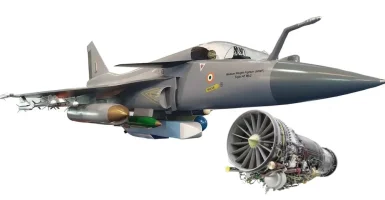
At its core is the robust General Electric F414-INS6 turbofan engine, which produces roughly 98 kilonewtons of thrust. This added power allows the Tejas Mk2 to lift an impressive payload of up to 6.5 tonnes across 11 hardpoints, cementing its status as a "heavy hitter" capable of transporting substantial weaponry over extended distances.
Before entering mass production, the jet will undergo a phased weapons integration programme. The initial stage will focus heavily on essential air-to-air and air-to-ground combat systems.
For aerial engagements, the fighter will be armed with India's domestically produced Astra Mk1 and the extended-range Astra Mk2 beyond-visual-range missiles, with provisions for the future Astra Mk3.
Additionally, the infrared-guided ASRAAM will be incorporated for close-quarters combat.
For ground attacks, the initial clearance will feature the aforementioned SCALP-EG—a stealthy cruise missile capable of striking targets well over 250 kilometres away—alongside the Crystal Maze and the Israeli Rampage high-speed strike missile.
A subsequent phase of development will shift attention towards integrating next-generation, Indian-made weaponry.
A major highlight will be the BrahMos-NG, a lighter, more compact iteration of the renowned supersonic cruise missile, specifically tailored for fighter jets.
Furthermore, the aircraft is slated to carry the indigenous Rudram family of anti-radiation missiles, explicitly engineered to neutralise enemy radar and air defence networks.
The Indian-designed Sudarshan Laser-Guided Bomb will also be added to ensure pinpoint accuracy during ground strikes.
By combining Western armaments with cutting-edge domestic technology, the Tejas Mk2 will achieve a highly versatile operational profile, ready to execute everything from air superiority and deep penetration strikes to the suppression of hostile air defences.