Uttam Radar Tracks 10m² RCS Target at 240km Range on Tejas Mk1A, Paving Way for Astra Mk2 Integration

Uttam Radar Tracks 10m² RCS Target at 240km Range on Tejas Mk1A, Paving Way for Astra Mk2 Integration


The Indian Light Combat Aircraft (LCA) programme has achieved a significant technological milestone, further solidifying the Tejas Mk1A as a highly capable platform for modern aerial warfare.

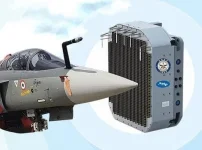
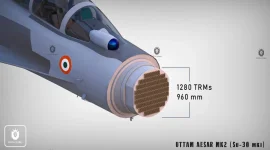
Recent flight tests have demonstrated that the indigenous Uttam Active Electronically Scanned Array (AESA) radar can successfully detect and track a target with a 10-square-metre Radar Cross-Section (RCS) at an impressive distance of 240 kilometres.

This breakthrough dramatically enhances the fighter's situational awareness and sets the stage for the platform's next major weapons upgrade: the integration of the advanced Astra Mk2 beyond-visual-range (BVR) air-to-air missile.

The 240-kilometre tracking capability was rigorously validated using Pilotless Target Aircraft (PTA) fitted with corner reflectors.

These reflectors are standard testing devices designed to artificially boost a drone's radar return, accurately imitating the electronic signature of a much larger combat jet without putting human pilots at risk during trials.

A 10m² RCS is roughly the radar signature of a standard multirole fighter burdened with external fuel tanks, heavy weapons, and electronic pods.

By spotting and firmly locking onto such a target at 240 kilometres, the Tejas Mk1A secures a critical "first-look, first-shot" advantage, enabling pilots to identify and track enemies long before they are themselves detected.

Developed indigenously by the Defence Research and Development Organisation’s (DRDO) Electronics and Radar Development Establishment (LRDE), the Uttam AESA radar represents a major leap in India's sensor capabilities.

Built with solid-state Gallium Arsenide (GaAs) transmit/receive modules, the radar features enhanced power generation, superior signal processing, and robust electronic counter-countermeasures (ECCM) designed to cut through heavy enemy jamming and clutter.

When this powerful radar is combined with the Tejas Mk1A’s naturally low radar cross-section—estimated to be a mere 0.5 to 1.5 m² when flying "clean" without external stores—the Hindustan Aeronautics Limited (HAL) manufactured fighter becomes exceptionally difficult for adversaries to target, yielding a distinct asymmetric advantage over regional rivals relying on older, mechanically scanned systems.

With the Uttam radar's extreme range envelope now validated, the logical next step is coupling the sensor with equally long-reaching weaponry.

The Astra Mk2 beyond-visual-range missile is currently being primed for full integration onto the Mk1A platform.

Building on the success of the baseline Astra Mk1, the newer Mk2 variant is powered by an advanced dual-pulse solid rocket motor.

This dual-pulse technology optimizes the missile's energy management, pushing engagement ranges well past the 160–200 km threshold and allowing it to strike highly manoeuvrable targets at terminal speeds around Mach 4.5.

Once operational, the Astra Mk2 will permit Indian pilots to neutralize high-value airborne threats at extreme standoff distances.

The successful pairing of the LRDE's Uttam radar with the Astra missile family underscores India’s accelerating drive towards complete self-reliance in cutting-edge defence technologies.

As the Tejas Mk1A fleet expands, this potent combination of low-observability, advanced AESA sensors, and lethal dual-pulse weaponry will serve as a formidable force multiplier.

Furthermore, ongoing DRDO research into next-generation Gallium Nitride (GaN) radar components ensures that India's indigenous combat platforms—from the Tejas Mk1A to heavier assets like the Su-30MKI and the upcoming Advanced Medium Combat Aircraft (AMCA)—will maintain their technological edge for decades to come.
 
what's the use of having the new radar on the MK1A when the plane is not fly worthy!!! like giving a diamond chain to a monkey.. 😂
 
Is it factual? URL says 'uttam-radar-tracks-10m2-rcs-target-at-240km-range-on-tejas-mk1a'

That means a Mk1A with Uttam installed tracked a 10 sq m RCS object while in flight. Or is the claim not true and it was a Tejas with the radar installed?

If it was a Mk1A, there is hope for Mk1A, isn't there? Even if HAL never gets Elta 2052 to work, a working radar should be possible.
 
Is it factual? URL says 'uttam-radar-tracks-10m2-rcs-target-at-240km-range-on-tejas-mk1a'

That means a Mk1A with Uttam installed tracked a 10 sq m RCS object while in flight. Or is the claim not true and it was a Tejas with the radar installed?

If it was a Mk1A, there is hope for Mk1A, isn't there? Even if HAL never gets Elta 2052 to work, a working radar should be possible.
Read clearly what was the target. It's apl given.
Don't jump into conclusions without that. And elementary is why would we reveal LCA signature keeping it as target for paki news.. it would be for you to dig. Remember LCA RCS is way too low like 0.5 at clean frontal regardless of nmi.

10 sq mt for gaas is extremely good test to track at 240 naits is fantastic. F16 profile was chosen. For real test we can fly near Pakistan.
 
Read clearly what was the target. It's apl given.
Don't jump into conclusions without that. And elementary is why would we reveal LCA signature keeping it as target for paki news.. it would be for you to dig. Remember LCA RCS is way too low like 0.5 at clean frontal regardless of nmi.

10 sq mt for gaas is extremely good test to track at 240 naits is fantastic. F16 profile was chosen. For real test we can fly near Pakistan.
It said

'Uttam Radar Tracks 10m² RCS Target at 240km Range on Tejas Mk1A'​

 
Given that the RCS of any Pakistani and Chinese fighter aircraft is measured in fractions of the achieved result indicates that the UTTAM radar can track (not target) a very large cargo or passenger aircraft at 200+ km. So, what exactly is there to celebrate ? Fyi .. The RCS of a 4th gen F-16 is 4 m2.
 
The Facts

Uttam AESA itself is not the problem — the integration of Uttam with Tejas Mk‑1A’s mission computer, EW suite, and certification pipeline is the bottleneck. HAL has therefore deferred Uttam to the second Tejas Mk‑1A order, keeping the Israeli EL/M‑2052 on the first 83 aircraft to avoid further delays.
Below is a structured, technical breakdown of the actual Uttam–Tejas Mk‑1A integration issues as of 2025–2026.

⚙️ 1. Certification Delays — The Core Issue​

Even though Uttam completed major flight‑test milestones by April 2025 and passed four phases of CEMILAC testing, HAL still could not integrate it into Mk‑1A production without triggering major delays.
Why?
  • Certification for a new radar + new EW suite + new weapons package must be done as a combined system, not individually.
  • Mk‑1A’s avionics architecture is already under stress due to EL/M‑2052 + Scorpius‑SP EW suite integration delays.
  • Adding Uttam would have required another full validation cycle, pushing deliveries even further.
Impact: HAL formally decided that integrating Uttam mid‑production would stall the Mk‑1A line, which is already behind schedule.

🧩 2. Avionics Integration Complexity​

Uttam is designed to work with:
  • Indian mission computer
  • Indian EW suite
  • Indian weapons (Astra family)
But Mk‑1A’s first batch uses:
  • Israeli EL/M‑2052 radar
  • Israeli Scorpius‑SP EW suite
This creates a mixed‑vendor avionics environment, which is the hardest scenario for radar integration.
Specific challenges:

a) Radar–EW Suite Synchronization​

Mk‑1A already faces interoperability issues between the EL/M‑2052 and the EW suite. Introducing Uttam would require rewriting:
  • threat libraries
  • jamming response logic
  • radar‑EW timing protocols

b) Radar–Weapon Interface​

Astra BVR missiles require:
  • mid‑course updates
  • seeker cueing
  • radar‑mission‑computer synchronization
These interfaces are still being refined even for the EL/M‑2052.
Integrating Uttam would require a second full integration cycle.

🛠️ 3. Production Line Stability​

HAL’s Mk‑1A line is already disrupted by:
  • F404 engine delivery delays
  • EW suite supply chain issues
  • Radar–EW software instability
HAL concluded that introducing Uttam into the first 83 aircraft would:
  • require new wiring harnesses
  • require new cooling and power validation
  • force re‑certification of the entire avionics suite
  • slow down the line by months to years
Thus, HAL froze the configuration: → First 83 aircraft = EL/M‑2052 → Uttam begins with the second batch of 97 aircraft

📡 4. Why Uttam is Ready — But Still Not Integrated​

Uttam completed:
  • 150+ test flights
  • 140 km tracking range validation
  • Hardware qualification
  • CEMILAC certification for flight testing
So the radar is not the problem. The issue is system‑level integration, not radar performance.

📌 Summary — Actual Uttam Integration Issues on Tejas Mk‑1A​

IssueExplanationSource
Certification bottleneckUttam requires full radar‑EW‑weapons recertification, delaying Mk‑1A deliveries
Mixed‑vendor avionicsIsraeli EW suite + Indian radar = complex integration
Weapon interface delaysAstra integration still unstable even with EL/M‑2052
Production line riskHAL wants to avoid mid‑production configuration changes
Strategic decisionUttam deferred to second batch of 97 Mk‑1A jets


🔮 What Happens Next (2026–2030)​

1. Uttam enters Mk‑1A from aircraft #84 onward

HAL confirmed Uttam will equip the second batch of 97 Mk‑1A.

2. GaN‑based Uttam variant

A more powerful GaN version is planned for:
  • Tejas Mk‑2
  • Super Sukhoi upgrade

3. Mk‑1A deliveries stabilize in 2026

Once EL/M‑2052 + EW suite issues are resolved, HAL expects to ramp up production.

1. Ground truth snapshot (early 2026)​

Key facts:

  • Contract 1: 83 Mk‑1A (73 fighters + 10 trainers), signed Feb 2021.
  • Additional approval: 97 more Mk‑1A cleared later (total ~180).
  • Line capacity (theoretical): 24 aircraft/year at full ramp.
  • Engines: 99 × F404‑GE‑IN20 ordered; only a handful delivered so far (5 in 2025 + 1 in Jan 2026).
  • Airframes built: 5 Mk‑1A fully ready + 9 more airframes flown but waiting engines.
  • Radar/EW issue: EL/M‑2052 AESA + EW suite integration and Astra interface still under refinement; HAL seeking “capability concessions” for first 5 jets.
So: airframes are not the main constraint—it’s engines first, radar/EW software second.


2. Core assumptions for the forecast model​

You can tweak these like sliders in a spreadsheet.

  • A1 – Engine delivery rate (F404):
    • Conservative: 10/year from FY 2026–27 onward
    • Base: 16/year (what HAL roughly needs to sustain 16–20 jets/year)
    • Optimistic: 20/year after 2027
  • A2 – Radar/EW maturity (EL/M‑2052 + EW + Astra):
    • First 5 jets delivered with limited concessions by mid‑FY 2026–27
    • Full ASQR‑compliant software baseline frozen by late FY 2026–27
  • A3 – Line capacity utilization (Nashik + existing lines):
    • 2025–26: effectively ~5–8 jets/year (engine‑limited)
    • 2026–28: ramp to 16/year
    • Post‑2028: 24/year possible if engines keep pace
  • A4 – Uttam AESA:
    • First 83 aircraft: EL/M‑2052 only
    • Second 97 aircraft: Uttam baseline (no impact on first‑batch schedule, but adds risk to second batch)

3. Base‑case delivery curve (what’s most plausible)​


1780887313827.webp

Interpretation:

  • First 83 Mk‑1A realistically complete around 2030–31 in the base case.
  • Full ~180 fleet (83 + 97) closes out around 2033–34, matching independent estimates that 180 Mk‑1A will only be fully in service early‑to‑mid 2030s.
 
Tejas MKIA RCS when clean is 0.5-1.5 m*2.
What's the RCS when Astra mk2 is mounted on Tejas MKIA?
Never put your childrens picture on chat boards. It can create unintended consequences.

Posting your child's picture on a Reddit chat board is strongly discouraged. Public forums pose severe risks, as predators actively scrape innocent family photos to train AI models and generate explicit content. Children cannot consent, and their images will leave a permanent digital footprint.

  • AI and Deepfake Exploitation: Any photo of a child, no matter how innocent or fully clothed, can be stolen and altered by AI technology to create harmful deepfakes. [1]
  • Predatory Scraping: Public chat boards are frequently monitored by individuals who harvest images of children for nefarious purposes. [1]
  • Metadata Risks: Original images often contain embedded data, like GPS coordinates, that can reveal your family's exact location. [1]
  • Loss of Privacy: Once an image is posted to a public board, it can be downloaded and reshared indefinitely across the internet, completely outside of your control. [1, 2, 3, 4, 5]
 
Never put your childrens picture on chat boards. It can create unintended consequences.

Posting your child's picture on a Reddit chat board is strongly discouraged. Public forums pose severe risks, as predators actively scrape innocent family photos to train AI models and generate explicit content. Children cannot consent, and their images will leave a permanent digital footprint.

  • AI and Deepfake Exploitation: Any photo of a child, no matter how innocent or fully clothed, can be stolen and altered by AI technology to create harmful deepfakes. [1]
  • Predatory Scraping: Public chat boards are frequently monitored by individuals who harvest images of children for nefarious purposes. [1]
  • Metadata Risks: Original images often contain embedded data, like GPS coordinates, that can reveal your family's exact location. [1]
  • Loss of Privacy: Once an image is posted to a public board, it can be downloaded and reshared indefinitely across the internet, completely outside of your control. [1, 2, 3, 4, 5]
lol what? hows that related to the Radar??!?! im so confused lol
 

Forum statistics

Threads
7,409
Messages
66,430
Members
5,460
Latest member
daone1987
Back
Top