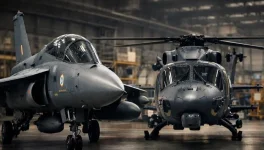
The Indian Air Force (IAF) is maintaining a clear distance from the Navy's Twin Engine Deck Based Fighter (TEDBF) programme.
This decision is not rooted in a lack of institutional cooperation, but rather driven by distinct operational needs, lifecycle costs, and a tightly scheduled modernisation plan.
While there has been intermittent speculation about a land-based derivative—frequently referred to as the Omni-Role Combat Aircraft (ORCA)—the IAF's current procurement strategy makes adopting such a platform highly unlikely.
The Problem of "Dead Weight" and Design Optimisation
The primary issue lies in the fundamental design differences between naval and air force jets.Carrier-based fighters like the TEDBF are built to withstand the extreme stresses of arrested landings and ski-jump takeoffs.
These operational realities necessitate heavy structural reinforcements, including toughened landing gear and fortified fuselage sections.
Additionally, naval jets require anti-corrosion treatments and wing-folding mechanisms for compact storage aboard aircraft carriers.
For a land-based air force, these naval-specific features are essentially "dead weight."
This added mass negatively impacts crucial combat metrics such as the thrust-to-weight ratio, maximum payload capacity, and internal fuel volume—all of which are vital for the IAF's high-altitude air superiority and deep-strike missions.
Divergent Mission Doctrines
The tactical philosophies of the Navy and the Air Force also diverge significantly.The Indian Navy requires a fighter that excels in low-speed handling, high lift, and stable approach profiles to safely land on a pitching carrier deck at sea.
In contrast, the IAF requires platforms optimised for high-altitude performance, sustained supersonic speeds, and rapid scramble responses.
Historically, attempting to combine these opposing requirements into a single joint-strike platform leads to operational compromises, severe delays, and spiralling development costs.
By allowing the TEDBF to focus strictly on Naval Qualitative Requirements (NQRs), the programme can avoid unnecessary integration risks.
Procurement Realities: The MRFA and Rafale Push
Faced with a declining squadron strength, the IAF is focused on rapidly inducting proven, mature platforms rather than waiting for a new, land-based derivative of a developing naval jet.Currently, the IAF's infrastructure for the Dassault Rafale—including maintenance hubs, training programmes, and weapons integration—is fully operational and actively expanding.
Latest Strategic Developments:
The IAF is heavily prioritising the procurement of 114 fighter jets under the Multi-Role Fighter Aircraft (MRFA) programme, offering a faster route to combat readiness.Recent developments in early 2026 indicate that the Defence Acquisition Council (DAC) has been pushing forward with the preliminary phases of this massive ₹3.25 lakh crore deal.
To ensure domestic sovereignty over weapons payloads, India is reportedly planning to "hardwire" an Interface Control Document (ICD) into the final MRFA contract.
This crucial step will allow the seamless integration of indigenous weapons—such as the Astra beyond-visual-range air-to-air missile and the Rudram anti-radiation missile—directly onto the new fleet, bypassing restrictions regarding French source code access.
Accelerated Focus on Tejas Mk2 and AMCA
A parallel land-based TEDBF programme would also create an opportunity cost, directly competing for the same financial resources and industrial bandwidth currently dedicated to the IAF's core future platforms.The IAF is relying on two major indigenous projects to secure its airspace:
- Tejas Mk2: Designed to replace legacy fleets, this medium-weight fighter is making rapid progress. According to recent Defence Research and Development Organisation (DRDO) updates, the Tejas Mk2 prototype is targeting its first flight by mid-2026, with induction planned for the late 2020s.
- Advanced Medium Combat Aircraft (AMCA): The AMCA represents the IAF's strategic leap into fifth-generation stealth technology. The DRDO has set a firm timeline, projecting the AMCA rollout for late 2028, followed by a maiden flight in early 2029.
Streamlining Logistics and Independent Timelines
Finally, fielding an entirely new aircraft type like the ORCA would require a massive logistical undertaking.The IAF would need to establish fresh supply chains for spare parts, distinct maintenance tooling, new flight simulators, and entirely separate training regimens.
Expanding existing fleets, such as the Rafale or the incoming Tejas variants, offers superior economies of scale and ensures higher operational availability without duplicating setup costs.
Keeping the development programmes separated makes pragmatic sense. Joint development projects frequently suffer from scope creep and bureaucratic friction.
By advancing independently, the Indian Navy can confidently push the TEDBF toward its expected first prototype flight in the early 2030s, while the IAF directs its resources towards the Tejas Mk2, AMCA, and MRFA programmes that perfectly align with its specific combat doctrine and immediate timeline constraints.