India is pushing the boundaries of aviation technology with its Advanced Medium Combat Aircraft (AMCA), an ambitious fifth-generation stealth fighter project backed by a ₹15,000 crore development budget.
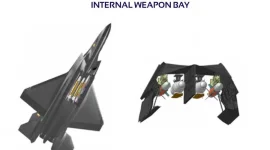
Recent updates from the Aeronautical Development Agency (ADA) reveal a groundbreaking design choice: the aircraft will utilise modular internal fuel tanks that fit seamlessly inside its weapons bay.
This unique engineering solution could make the AMCA the first stealth fighter in the world to adopt such a versatile fuelling approach.
Traditionally, combat aircraft must compromise between maintaining a low radar profile and carrying sufficient fuel for extended ranges.
The AMCA resolves this dilemma by using these internal tanks to increase flight endurance without disrupting the jet's stealth characteristics.
This feature is particularly advantageous during non-combat ferry flights, allowing the 25-tonne aircraft to transition between airbases undetected.
By concealing the additional fuel internally, the AMCA can deploy to frontline sectors without alerting enemy radar systems, ensuring absolute operational secrecy before a conflict even begins.
For active combat operations, the ADA and the Defence Research and Development Organisation (DRDO) are developing an equally innovative solution: low-observable external drop tanks.
Unlike standard external tanks, these are being designed with specific geometric shapes and specialised radar-absorbing materials to minimise detection. This allows the AMCA to take off with maximum fuel for deep-strike missions.
The fighter can travel vast distances through friendly airspace using the external tanks, while keeping its payload safely hidden in the weapons bay.
Just before entering hostile territory, the pilot can jettison the drop tanks, instantly returning the aircraft to its most stealthy configuration for the attack.
Operating in a highly contested region with complex multi-front threats, the ability to move assets covertly is a massive tactical advantage for the Indian Air Force.
True stealth goes beyond merely surviving an engagement; it fundamentally revolves around preventing adversaries from gathering crucial intelligence regarding troop movements and air defence postures.
Naturally, placing fuel inside the weapons bay reduces the space available for munitions. Because payload capacity is essential during offensive missions, the internal fuel modules are primarily intended for relocation purposes rather than combat sorties.
The ADA and DRDO are currently refining this internal tank technology as the AMCA progresses toward its anticipated prototype rollout later this decade.
Creating external tanks that do not compromise stealth is a formidable engineering challenge.
DRDO laboratories are tasked with developing advanced composite materials and specialised coatings that can effectively absorb radar waves while maintaining strict aerodynamic and structural safety standards.
Because perfecting these radar-absorbent technologies requires extensive research and testing, the internal modular tanks will provide a reliable, immediate solution for covert ferry missions until the stealthy external tanks are fully operational.
By concurrently developing internal modules for secretive transit and low-observable external tanks for combat range, the ADA is ensuring the AMCA is highly adaptable from day one.
This dual approach highlights a practical, mission-focused engineering philosophy that prioritises real-world battlefield effectiveness for India's future air fleet.