Dassault Aviation to Take Complete Responsibility for Indian-Made 114 Rafale MRFA Jets, Avoiding Past HAL-Led MMRCA Deal Failures

Dassault Aviation to Take Complete Responsibility for Indian-Made 114 Rafale MRFA Jets, Avoiding Past HAL-Led MMRCA Deal Failures


Dassault Aviation is adopting a radically altered strategy for India’s forthcoming 114 Rafale Multi-Role Fighter Aircraft (MRFA) procurement, a mega-deal estimated at roughly ₹3.25 lakh crore.

In a marked departure from the unsuccessful 126-jet Medium Multi-Role Combat Aircraft (MMRCA) initiative from a decade ago, the French aerospace manufacturer has committed to assuming direct oversight of the jets.

Furthermore, the company is exercising total independence in selecting its local industrial partners and intends to execute all flight and ground validations on Indian soil.

The previous MMRCA project primarily collapsed due to a fundamental disagreement over accountability. Under that framework, Hindustan Aeronautics Limited (HAL) was mandated to build 108 Rafale fighters through a technology transfer agreement.

However, Dassault declined to guarantee the operational quality of the HAL-manufactured aircraft, expressing concerns over the Indian state-owned firm's capacity to handle the sophisticated production process.

The Indian Ministry of Defence insisted that Dassault take full liability for the entire fleet, a dispute that ultimately caused the deal's cancellation and paved the way for a limited purchase of 36 off-the-shelf Rafales in 2016.

To avoid repeating history, Dassault’s leadership has confirmed that the company will serve as the primary integrator for the new MRFA programme.

By retaining full responsibility for the aircraft, Dassault ensures stringent oversight of manufacturing standards, delivery timelines, and complex systems integration.

Defence analysts have long cited this accountability shift as a necessary structural fix to revive a large-scale Rafale production line in India.

In alignment with this new framework, Dassault is actively curating its own network of Indian suppliers based on technical merit and manufacturing competence, rather than relying on a default government-assigned partner.

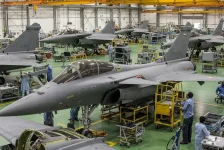
Tata Advanced Systems Limited (TASL) has already secured agreements to manufacture Rafale fuselages in Hyderabad—marking the first instance of these components being assembled outside of France.

The bidding process for additional structural elements, such as wing manufacturing, is expected to attract intense competition among both private and public sector aerospace entities, including HAL and Tata.

The scale of local production planned for the MRFA deal is substantial. Approximately 90 of the 114 fighters will be built domestically, while the remaining jets will be delivered directly from France in fly-away condition.

The initial indigenous manufacturing content is projected to be between 40 and 50 percent, with expectations for it to grow as local supply chains mature.

This decentralised manufacturing strategy, distributing work across multiple specialised domestic firms, closely mirrors the broader objectives of India’s Strategic Partnership model and aims to urgently address the Indian Air Force’s dwindling fighter squadron numbers, which currently sit at 29 against an authorised strength of 42.

Solidifying its commitment to domestic operations, Dassault plans to conduct all ground and flight testing for the locally produced Rafales within India, rather than relying on facilities in France.

This comprehensive quality-assurance strategy is designed to bypass the technical and bureaucratic hurdles that hindered past acquisitions.

Following clearance from the Defence Acquisition Council (DAC) earlier this year and the recent finalisation of the formal Letter of Request (LoR), Dassault aims to sign the final contract by the end of 2026, pending final approval from the Cabinet Committee on Security.
 
In my opinion, if Pakistan procures fifth generation fighter and Chnia develops sixth generation aircraft, then India has to reevaluate her strategy. Rafale is 4.5 generation aircraft . Will it be able to handle fifth and sixth generation of Chinese aircraft. If yes, then going for Rafale is fine or otherwise, India must go for a fifth-generation fighter.
 
In my opinion, if Pakistan procures fifth generation fighter and Chnia develops sixth generation aircraft, then India has to reevaluate her strategy. Rafale is 4.5 generation aircraft . Will it be able to handle fifth and sixth generation of Chinese aircraft. If yes, then going for Rafale is fine or otherwise, India must go for a fifth-generation fighter.
Pakistan already has F16s yet what are they able to do. The only problem is China. Rafale F4+ and in the future F5 is a value addition. Well integrated, large payload, advance sensors and weapons, nuclear strike capable. All these provided essential expertise as well. It is the best platform to fill the crippling gap left by the Tejas while waiting for the AMCA and possible Su57s.
 
Pakistan already has F16s yet what are they able to do. The only problem is China. Rafale F4+ and in the future F5 is a value addition. Well integrated, large payload, advance sensors and weapons, nuclear strike capable. All these provided essential expertise as well. It is the best platform to fill the crippling gap left by the Tejas while waiting for the AMCA and possible Su57s.
Even china's fighter jets are not combat proven
 
It is always the greed of corrupt persons in every stage which caused the delay in progress of any valuable acquisition or invention in India.
Untill the citizens raise their moral and act upon to curb the practice, nothing much can happen.
Presently in India satya vina sarvameva jayathe
 
The different this time is that Dassault does not need to use HAL. It was HAL's refusal to accept responsibility for the quality of the aircraft they built that prevented MMRCA going through in 2014, wasn't it? There might be no IAF fighter squadron number crisis now except for HAL.

Personally I question ordering a 4.5G aircraft now. 12 years ago, yes. Now, no. Especially at the astonishing cost reported to be more than 40 billion USD for 114 aircraft. India already has a 4.5G aircraft in development. Better to wait for Tejas Mk2 at less than half the price of Rafale IMO and in the meantime buy some Su-57 to raise squadron numbers. Should Tejas Mk2 need to be re-engined, buy more Su-57 to cover until AMCA Mk2 is available.

All these problems are greatly magnified by India's inability to make timely decisions and HAL's unreliability.

There is no certainty about when Mk1A will be delivered
There is no certainty about when Tejas Mk2 will be delivered
There is no certainty about when AMCA Mk1 will be delivered
There is no certainty about when AMCA Mk2 will be delivered

ORDER AN ENGINE FOR AMCA MK2! At least there will be a degree of certainty about something!
 
Last edited:
The earlier deal had technology transfer including full software access which would have given us the flexibility of integrating weapons and systems from different manufacturers. In the new deal, the assembly line will be owned by Dassault and there will be no technology transfer. So if we need more aircrafts we will need a new contract with Dassault. If we need to integrate systems from Russia, we'll need permission from Dassault. Is my interpretation correct?
 

Forum statistics

Threads
7,806
Messages
67,831
Members
5,675
Latest member
bharatiyavasi
Back
Top