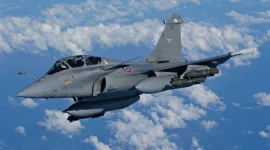
In a major development for India's aerospace sector, French aviation giant Dassault Aviation has guaranteed a 40-year comprehensive maintenance, spares, and upgrade support package for the upcoming "Made in India" Rafale fighter jets.
As the Indian Air Force (IAF) prepares for its large Multi-Role Fighter Aircraft (MRFA) procurement, this commitment ensures that the newly produced jets will remain operationally relevant and fully supported by the Original Equipment Manufacturer (OEM) well into the 2070s.
This long-term assurance provides a stark contrast to the ongoing maintenance struggles experienced with older aircraft fleets.
A Sustainable Production and Upgrade Timeline
Under the proposed production schedule, the first domestically manufactured Rafale is anticipated to roll out around 2030, with the entire batch slated for delivery by 2036-37.Because the 40-year OEM support starts from the delivery date of each individual jet, even the final aircraft produced will be fully backed by Dassault through the late 2070s.
This robust support framework is designed to cover both the current F4 standard and the next-generation F5 upgrade.
Reports data indicates that the future F5 standard, expected to enter service in the 2030s, will bring revolutionary capabilities to the fleet.
These advancements include a new RBE2 XG active electronically scanned array (AESA) radar utilising Gallium Nitride technology, the ability to command "loyal wingman" collaborative combat drones, and integration capabilities for hypersonic strike weapons.
Driving Deep Indigenisation
A central pillar of this new agreement is a strong focus on localising the aerospace supply chain, aligning perfectly with India’s Atmanirbhar Bharat initiative. Dassault plans to deeply involve the Indian defence industry in manufacturing major systems, components, and spares.Key partnerships with Indian conglomerates such as Tata Advanced Systems and Reliance are expected to drive component production, while French engine manufacturer Safran is likely to establish local Maintenance, Repair, and Overhaul (MRO) facilities.
By producing these critical elements domestically, India aims to drastically cut down its dependence on foreign supply chains, reduce the overall lifecycle costs of the aircraft, and cultivate a highly capable domestic aviation ecosystem.
Avoiding the Pitfalls of Legacy Fleets
The IAF's experience with the Mirage 2000 fleet has significantly influenced this proactive approach.While the Mirage 2000 was highly capable during its peak, the closure of its global production lines resulted in severe shortages of spare parts.
This forced India to search worldwide for retired airframes to strip for parts and face expensive, yet limited, upgrade programs.
By embedding long-term OEM support and widespread local manufacturing into the Rafale deal from day one, the Ministry of Defence aims to completely avoid these historical maintenance traps.
Bridging the Gap for Indigenous Fighters
The introduction of the advanced Rafale F4 and F5 variants will bring a massive leap in combat capability.Alongside cutting-edge sensors and network-centric warfare features, these jets will be heavily customised to carry indigenous Indian weapons, such as the Astra air-to-air and Rudram anti-radiation missiles.
Ultimately, Dassault’s firm guarantee of support until 2070 gives the IAF critical operational stability and clear budgetary forecasting.
As India continues to invest heavily in its own domestic fighter programmes, such as the Tejas Mk2 and the Advanced Medium Combat Aircraft (AMCA), a modernised and fully supported Rafale fleet will provide the necessary combat strength to secure the skies during this transitional period.