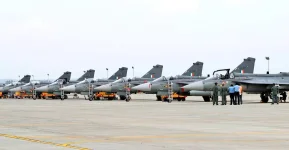
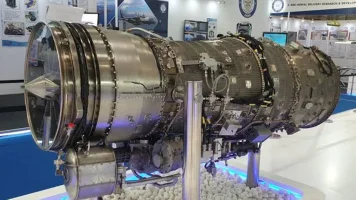
Recent technical blueprints for India’s Tejas Mk2 Medium Weight Fighter (MWF) confirm a significant design shift: the aircraft will replace its traditional fixed internal cannon with a detachable external gun pod.
This marks a major departure from the internal gun layouts seen on the earlier Tejas Mk1 and Mk1A variants.
Official design documents outlining the jet's structural points reveal that the internal space previously reserved for the cannon is being repurposed to house next-generation mission avionics and electronic warfare systems.
Maximising Premium Internal Volume
The decision by the Aeronautical Development Agency (ADA) and Hindustan Aeronautics Limited (HAL) to externalise the gun addresses a common challenge in modern aerospace engineering.Internal space in today's fighters is highly limited and critically needed for advanced technology. By removing the permanent gun and its ammunition feed, engineers can create a highly adaptable internal bay.
Instead of dedicating valuable fuselage volume to a mechanical system that serves only one specific combat role, the freed space will host upgradable hardware.
Open-source data indicates this internal volume will help accommodate processing units for the indigenous Uttam Active Electronically Scanned Array (AESA) radar, integrated Electronic Warfare (EW) suites, and Infrared Search and Track (IRST) architecture.
Enhanced Mission Flexibility
By moving the cannon to a detachable pod, the Indian Air Force gains immense operational flexibility.Pilots will only equip the gun pod for missions that explicitly demand close-quarter combat capabilities. For long-range strike or reconnaissance missions, the aircraft can fly in a "clean" configuration without the pod.
Removing this external attachment reduces aerodynamic drag and lowers the jet's radar cross-section, directly improving its survivability and fuel efficiency in hostile airspace.
This modular approach aligns with global trends in 4.5-generation fighter design, ensuring the airframe is not burdened by unnecessary weight.
Powered by the more robust GE-F414-INS6 engine, this streamlined configuration will allow the jet to fully capitalise on its enhanced thrust of 98 kN and its extended combat radius.
Bridging the Gap to the Future
The multipurpose internal station resulting from this design choice provides the Tejas Mk2 with long-term adaptability.The aircraft is strategically positioned to bridge the operational gap between the lighter Tejas Mk1A and India's upcoming fifth-generation Advanced Medium Combat Aircraft (AMCA).
Transitioning from a light combat aircraft to a Medium Weight Fighter, the Mk2 boasts an upgraded payload capacity of up to 6,500 kg across 11 to 13 hardpoints.
By prioritising internal space for sensor fusion and networked warfare capabilities, defence planners are ensuring the fighter remains a highly lethal and relevant asset for decades, without sacrificing close-combat firepower when a specific sortie requires it.