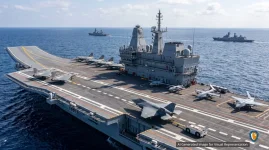
The history of the INS Vikramaditya serves as a harsh warning for India's maritime strategy. What began as a seemingly lucrative deal for a Soviet-era vessel has evolved into a multi-billion dollar liability.
As the Indian Navy looks toward the future, the stark contrast between this imported carrier and the domestically built INS Vikrant highlights why indigenous manufacturing is the only viable path forward for India's defence.
The Illusion of a "Free" Warship
In 2004, Russia offered India the Admiral Gorshkov, a decommissioned Kiev-class cruiser, at no initial cost. Moscow was eager to dispose of a ship it could no longer sustain.However, the catch was that India had to fund its extensive refit at the Sevmash shipyard. Initial estimates projected a refit cost of $974 million, alongside another $1 billion to acquire its air wing and upgrade its combat systems.
The timeline and budget quickly derailed. Originally slated for a 2008 handover, the ship was delayed by five long years, finally arriving in 2013. By then, the final price tag had surged to $2.35 billion, with Russia demanding the balance upfront.
Since New Delhi had already heavily invested in the overhaul, it was trapped in the deal.
The complications continued even after completion; during its transit to India, the vessel suffered severe propulsion breakdowns that Russian engineers blamed on Chinese-made parts—a claim Beijing firmly denied.
A Plagued Operational History
Since joining the fleet, the Vikramaditya has been marred by a series of tragic and costly mishaps. These frequent safety issues and technical failures have severely restricted the carrier's time on the open seas:- June 2016: A toxic gas leak during routine maintenance in Karwar claimed the lives of two personnel.
- February 2017: A hydraulic failure forced a MiG-29K into an emergency landing at Mangalore airport.
- April 2019: A devastating fire in the boiler room left one officer dead and seven others injured.
- November 2020: A MiG-29KUB trainer crashed into the Arabian Sea, resulting in the death of Commander Nishant Singh.
- July 2022: Another fire erupted during planned sea trials off the coast of Karwar.
The MiG-29K Challenge
The most critical weakness of the Vikramaditya lies in its aviation wing. India spent over ₹10,000 crore to acquire 45 MiG-29K and KUB fighter jets as part of the overarching carrier agreement. However, these aircraft have proven highly unreliable.A blistering 2016 report from the Comptroller and Auditor General (CAG) highlighted that the jets were plagued with defects. During the audit, the fleet's serviceability hovered dismally between 21% and 47%, meaning that, at best, fewer than half the jets were ready for combat operations when required.
The engines are a particular point of failure. Out of 65 RD-33MK engines delivered, a staggering 62% (40 engines) were rejected or withdrawn due to fundamental design flaws. This unreliability has led to numerous mid-air engine failures and dangerous single-engine landings.
Since 2018, at least five of these fighters have been destroyed in crashes. To mitigate this glaring capability gap across its carrier fleet, the Indian government was forced to sign a massive ₹63,000 crore agreement with France in April 2025 to procure 26 Rafale-Marine fighters for the Navy.
The Indigenous Success of INS Vikrant
In sharp contrast to the endless troubles of the Vikramaditya, India’s first domestically constructed aircraft carrier, the INS Vikrant, has proven to be a resounding success.Demonstrating the strength of indigenous engineering, the Vikrant achieved a flawless safety record by completing 1,000 arrested landings by early 2026 without a single mishap.
Further solidifying its operational readiness, the Vikrant successfully hosted the multinational MILAN 2026 naval exercise off the coast of Visakhapatnam, coordinating with 42 vessels and 29 aircraft from allied nations.
The Case for IAC-2 (INS Vishal)
Despite the Vikrant's triumphs, the Navy's overall carrier strength remains vulnerable. Both current carriers still depend on the troubled MiG-29K fleet while awaiting the full integration of the new Rafale-M jets.Furthermore, the much-needed third carrier—the 65,000-tonne CATOBAR vessel known as IAC-2 or INS Vishal—is still awaiting official government approval.
Building the INS Vishal is projected to cost upwards of ₹50,000 crore, with a construction timeline extending well into the next decade. However, delaying this project carries immense risk.
The INS Vikramaditya is expected to serve into the 2030s, but keeping its aging hull and Russian-made propulsion systems operational will demand continuous financial bailouts.
This dependency is especially precarious given the massive strain the ongoing Ukraine conflict has placed on Russia’s defence manufacturing sector.
Conclusion
The turbulent saga of the INS Vikramaditya offers a clear verdict: importing second-hand carriers is a false economy.The "free" Russian ship has drained billions from the defence budget, cost the lives of dedicated sailors, and tethered India's naval aviation to an underperforming fighter jet for more than a decade.
As the Navy prepares for the strategic challenges of the coming decades, the lesson is unequivocal—India’s next aircraft carrier must be built in domestic shipyards, or not at all.