- Views: 2K
- Replies: 6
The Ghatak Unmanned Combat Aerial Vehicle (UCAV), previously designated as the AURA project, has rapidly evolved into a cornerstone of India’s future military aviation strategy.
In a landmark decision in March 2026, the Defence Acquisition Council (DAC) approved the procurement of four squadrons—translating to roughly 60 to 80 units—for the Indian Air Force (IAF).
This major clearance underscores a strategic pivot towards deploying stealth-enabled, autonomous drones for frontline combat operations.
Unlike standard fighter jets, the Ghatak relies on a tailless, flying-wing architecture that prioritises invisibility to radar over pure aerodynamic agility.
Conventional stealth fighters, such as the F-35, still feature vertical tail fins that can reflect radar waves, especially during sharp turns.
By completely removing these vertical stabilisers, the Ghatak’s design ensures a dramatically lower radar profile, keeping it hidden from enemy detection even while manoeuvring.
Insights gathered from the successful test flights of the SWiFT (Stealth Wing Flying Testbed) demonstrator reveal that the Ghatak will boast an exceptionally low radar cross-section (RCS), particularly in the highly scrutinised X-band frequencies.
When viewed from the front, its RCS is estimated to be incredibly minuscule—between 0.0001 and 0.0005 square metres—making it appear no larger than a small bird or insect on enemy screens.
Side-profile reflections are projected at just 0.01 to 0.05 square metres, while the rear profile, traditionally the easiest to spot, is managed at a highly competitive 0.1 to 0.5 square metres.
This uniform stealth is largely achieved because the flying-wing design eliminates the "corner reflectors" created by standard tail fins, which typically bounce radar energy straight back to the source. As a result, the drone maintains a consistent veil of low observability regardless of its flight angle.
Securing the rear-aspect stealth was one of the programme's greatest engineering hurdles.
To solve this, the Ghatak will utilise a "dry" Kaveri Derivative Engine (KDE) capable of 49 kN of thrust, meaning it operates without a highly visible, fuel-heavy afterburner.
Recently, the Gas Turbine Research Establishment (GTRE) partnered with private industry leaders like Godrej & Boyce to mass-produce these engines as fully assembled units.
Combined with a specialised S-duct air intake and a winding exhaust system, this engine layout effectively hides the spinning turbine blades from radar and significantly cools the exhaust to mask its infrared heat signature.
The Defence Research and Development Organisation (DRDO) has carefully balanced the drone's stealth characteristics, attributing 70% of its invisibility to its physical shape and 30% to specialised materials.
The aircraft’s sweeping edges are constructed in perfect parallel alignment, a technique that ensures any incoming radar waves are deflected away into empty space rather than echoing back to the enemy's radar receiver.
To keep its exterior perfectly smooth, the Ghatak houses all its weaponry in an internal payload bay rather than hanging them on the wings. It is designed to carry up to 1.5 tonnes of precision strike munitions safely inside its body.
Furthermore, the seamless blending of the wings into the main fuselage eliminates any sharp angles that might cause radar flashes, or "glints," ensuring a quiet electromagnetic footprint.
Structurally, the UCAV makes extensive use of advanced, domestically produced carbon-fibre composites, which are naturally less reflective than standard aviation metals.
Instead of simply painting the drone with radar-absorbing materials, DRDO engineers have successfully embedded Radar Absorbent Structures (RAS) directly into the composite skin.
This innovative method not only absorbs enemy radar but also makes the aircraft far more durable and easier to maintain under harsh conditions.
At the front of the aircraft, the radome incorporates Frequency-Selective Surfaces (FSS).
This advanced material acts as a smart filter, allowing the Ghatak’s own sensors to transmit signals outward while absorbing or blocking the specific frequencies used by incoming enemy tracking systems.
In battlefield scenarios, the IAF plans to use the Ghatak as the tip of the spear in high-risk environments.
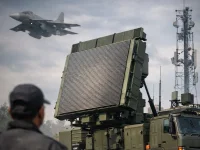
It will fly deep into hostile territory ahead of human pilots to execute Suppression and Destruction of Enemy Air Defences (SEAD/DEAD).
Its primary targets will include sophisticated, long-range missile shields like the HQ-9B and S-400 systems, as well as crucial early-warning radar installations.
Ultimately, the Ghatak will not fight alone; it is a vital component of a Manned-Unmanned Teaming (MUM-T) strategy.
Through this operational concept, a single pilot in an advanced fighter like the Tejas Mk2 will act as a flying commander, directing a swarm of autonomous Ghatak drones.
This networked approach will allow India to execute complex, multi-pronged strikes and dismantle heavily guarded enemy airspace without putting human pilots in the direct line of fire.