DRDO to Expand LRAShM Hypersonic Programme With Dedicated Surface Strike Variants For Army And Air Force

DRDO to Expand LRAShM Hypersonic Programme With Dedicated Surface Strike Variants For Army And Air Force


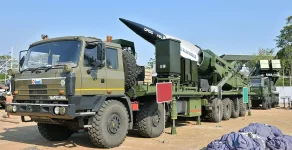
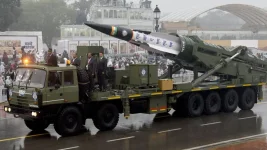
The Defence Research and Development Organisation (DRDO) has confirmed the expansion of its Long Range Anti-Ship Missile (LRAShM) project.

Originally designed to bolster the Indian Navy's maritime security, the programme is now evolving into a multi-service platform with specialized ground-strike versions being developed for both the Indian Army and the Indian Air Force.

Technical Advancements and Flight Profile​

The LRAShM is a sophisticated boost-glide hypersonic weapon designed to secure India's coastlines and maritime interests.

The system utilizes a powerful two-stage solid rocket motor to propel the missile into the upper atmosphere. Upon reaching the desired altitude, it releases a hypersonic glide vehicle (HGV) that descends toward its objective.

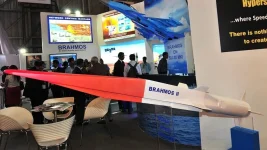
Unlike traditional ballistic missiles that follow a predictable path, the LRAShM employs a quasi-ballistic trajectory. It maintains extreme speeds—reportedly reaching a peak of Mach 10—while performing unpredictable maneuvers and atmospheric "skips."

This unique flight profile, combined with its ability to fly at lower altitudes, makes the missile nearly impossible for current radar and air defence systems to track or intercept.

Strategic Expansion to Land and Air​

While the naval variant remains a priority for coastal batteries, the programme's scope has widened following significant interest from other military branches.
  • Indian Army: Leading the broader developmental effort, the Army seeks a surface-to-surface version to hit high-value, fortified targets.
  • Indian Air Force: The aviation wing is expected to adopt a variant that mirrors the performance of the land-based version, providing a high-speed deep-strike capability.
Weighing approximately 12 tonnes, the LRAShM occupies a critical gap in India's missile hierarchy.

It offers nearly three times the operational range of the Pralay tactical missile, allowing India to conduct conventional strikes against heavily protected assets without resorting to long-range strategic (nuclear) systems.

Operational Impact and Deterrence​

In maritime scenarios, the missile is specifically engineered to neutralize large surface combatants, such as aircraft carriers, by overwhelming their layered interceptors.

For land operations, its precision and hypersonic penetration will allow the military to strike command centres and hardened infrastructure deep within hostile territory.

The LRAShM represents a shift toward a unified "family of missiles" approach. By sharing technology across naval, land, and air platforms, DRDO aims to maximize resource efficiency while providing the armed forces with a cutting-edge tool for Anti-Access/Area Denial (A2/AD) missions.

Once fully operational, the system is expected to significantly strengthen India's deterrence posture across the Indo-Pacific and its continental borders.
 
DRDO is all media bites and fake hype but not real deliverables to our armed forces.
Total operational missiles in
IAF: IAF aresnal are more than 80% foreign imported missiles like MICA, METEOR, BARAK, RAMPAGE, SCALP, BRAHMOS(50% Indian).
Army: rudimentary shells are desi but GPS guided and long range goes to imported one. Anti tank missiles are Russians.
Navy: similar story on their landscape from Spainish torpedo to Russians and Israeli dominated weaponry.
Priority of nation defence not employment of DRDO 5000 engineers + 25,000 support staff at cost of U$3billion a year cost to poor tax payers.
just outsource to private sector.
Since 2014to 2026 : U$2Billion on average x 11 year = U$22 billions spent and output?? Please someone enlighten me any outstanding defence operation product?
 
DRDO is all media bites and fake hype but not real deliverables to our armed forces.
Total operational missiles in
IAF: IAF aresnal are more than 80% foreign imported missiles like MICA, METEOR, BARAK, RAMPAGE, SCALP, BRAHMOS(50% Indian).
Army: rudimentary shells are desi but GPS guided and long range goes to imported one. Anti tank missiles are Russians.
Navy: similar story on their landscape from Spainish torpedo to Russians and Israeli dominated weaponry.
Priority of nation defence not employment of DRDO 5000 engineers + 25,000 support staff at cost of U$3billion a year cost to poor tax payers.
just outsource to private sector.
Since 2014to 2026 : U$2Billion on average x 11 year = U$22 billions spent and output?? Please someone enlighten me any outstanding defence operation product?
Astra is Indian homegrown A2A missile, Astra mk1 is integrated with fighter jets, mk2 and mk3 (Gandiva) are the ones with extended ranges in different stages of production and trials respectively. Brahmos is more than 50% Indian. Rudram missiles are also there for the SEAD/DEAD operations.

For Barak and S400, we have our own Akash AD as well forming the layer of Air Defence. Plus Kusha is another homegrown AD which is bound to takeover S400 and become a major exporter. Pinaka is also planned for integration with Airforce.

In Navy, we have produced Varunastra, the home grown heavy hitter, anti submarine torpedo. Only Torpedo in the world to have GPS based locating aid. It's set to replace foreign torpedoes and is currently ordered for mass productions. Infact, Naval arm of Indian Armed forces is way ahead in terms of indigenization. Our home grown K series missiles are in league of their own.

Army wise....we have pvt players building tanks, Whaps apart from DRDO. Missiles like Pralay are set to become the bridge between Prithvi Series and Agni Series.

You're right that we've relied a lot on imports, but things are under change. There are close to 500+ items which govt has put in "no-import" list.
 
Astra is Indian homegrown A2A missile, Astra mk1 is integrated with fighter jets, mk2 and mk3 (Gandiva) are the ones with extended ranges in different stages of production and trials respectively. Brahmos is more than 50% Indian. Rudram missiles are also there for the SEAD/DEAD operations.

For Barak and S400, we have our own Akash AD as well forming the layer of Air Defence. Plus Kusha is another homegrown AD which is bound to takeover S400 and become a major exporter. Pinaka is also planned for integration with Airforce.

In Navy, we have produced Varunastra, the home grown heavy hitter, anti submarine torpedo. Only Torpedo in the world to have GPS based locating aid. It's set to replace foreign torpedoes and is currently ordered for mass productions. Infact, Naval arm of Indian Armed forces is way ahead in terms of indigenization. Our home grown K series missiles are in league of their own.

Army wise....we have pvt players building tanks, Whaps apart from DRDO. Missiles like Pralay are set to become the bridge between Prithvi Series and Agni Series.

You're right that we've relied a lot on imports, but things are under change. There are close to 500+ items which govt has put in "no-import" list.
Parroting media bites from these indian mil-industrial complex IAS chief and MoD are not worth much.
Apart from Brahmos, nothing much used from desi firms but heavy lifting was done by all imported weaponry.
i liked Air-def but that was improvised and training but not reliance on tech. (U$20-30 billions spent do have some few saving grace)
Writing paragraphs on desi weapon testing but nothing much in operational life.
 
Parroting media bites from these indian mil-industrial complex IAS chief and MoD are not worth much.
Apart from Brahmos, nothing much used from desi firms but heavy lifting was done by all imported weaponry.
i liked Air-def but that was improvised and training but not reliance on tech.
Writing paragraphs on desi weapon testing but nothing much in operational life.
AD has no reliance on tech ? DRDO integrated old Pechora guns with tech to shoot down Pooki drones precisely in Op Sindoor, that cant happen without tech integration...guess Pook did won in narrative warfare.

Improvisation is the part and parcel of any tech. Brahmos used to have a range of 290, then it got extended to 400 and now the newer variants will have an extension upto 800km...Brahmos NG is being developed for fighter jets only.

Op Sindoor was a limited scale conflict...hence India used missiles which can cause precision strikes. Minimum usage and maximum impact. If the war had prolonged then desi missiles would also have came in the picture....imagine the havoc which Prithvi or Agni would have caused.
 

Forum statistics

Threads
6,461
Messages
63,217
Members
5,009
Latest member
Deeps
Back
Top