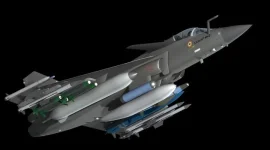
The Indian Air Force (IAF) is preparing to arm its fleet of French-made Rafale fighter jets with domestically developed Astra Mark-1 and Mark-2 beyond-visual-range air-to-air missiles (BVRAAMs).
According to defence sources, official integration trials for these advanced weapons are scheduled to begin by 2028.
This initiative represents a major leap in India's push to equip its frontline combat aircraft with homegrown firepower, thereby expanding tactical flexibility and reducing reliance on imported munitions.
To ensure a smooth and efficient upgrade, the integration project is being carried out with direct technical assistance from the original French manufacturers, Dassault Aviation and Thales.
By collaborating with these original equipment manufacturers (OEMs), the IAF avoids the complicated and time-consuming reverse-engineering workarounds usually required for integrating third-party weapons.
The French defense firms will supply the critical software codes and interface architectures needed to seamlessly link the Astra missiles with the Rafale’s advanced RBE2 Active Electronically Scanned Array (AESA) radar and combat management systems.
Before any real-world flights take place, the campaign will kick off with rigorous computer simulations and virtual validations.
Joint teams of Indian and French engineers will utilize highly advanced digital models to study how the missiles affect the aircraft's aerodynamics.
This digital phase will also ensure that structural limits, electrical systems, and software interfaces are perfectly synchronized before the aircraft ever leaves the ground.
Once the software is deemed stable and mature, a specific IAF Rafale will be modified to serve as a dedicated flying testbed for the real-world trials.
The flight-testing process will be conducted in three gradual stages. Initially, the aircraft will undergo "carriage trials," where the jet flies with the Astra Mk1 and Mk2 missiles physically attached to its wings to monitor structural safety and flight handling.
Next will be "captive-carry trials," which involve flying with the missiles to test electronic communications, radar targeting, and weapon health monitoring without actually dropping or launching the missile.
Finally, the program will conclude with live-fire tests, launching the weapons under various speeds, altitudes, and combat manoeuvres to achieve full operational certification.
The Astra missile family, spearheaded by India's Defence Research and Development Organisation (DRDO), offers formidable combat capabilities.
The Astra Mk1 can strike aerial targets at distances of approximately 110 kilometers, while the advanced Astra Mk2 utilizes a dual-pulse solid rocket motor to extend its engagement range beyond 160 kilometers.
Currently, the IAF's Rafales rely on high-end imported weaponry, such as the European Meteor missile. Successfully integrating the Astra series will provide the IAF with a highly capable and cost-effective indigenous alternative for long-range air combat.
Ultimately, this integration program heavily supports the government's "Aatmanirbhar Bharat" initiative by shielding the military from global supply chain disruptions.
Furthermore, sources note that the technical expertise gained from mating the Astra with the IAF Rafales will be crucial for the future.
It will lay the groundwork for easily arming the upcoming Rafale Marine (Rafale M) fighter jets, which are slated to eventually join the Indian Navy's aircraft carrier fleet.