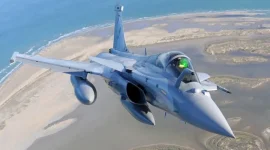
Elite TACDE Unit May Receive Tejas Mk2 Early Production Models to Refine Network-Centric and BVR Capabilities

Elite TACDE Unit May Receive Tejas Mk2 Early Production Models to Refine Network-Centric and BVR Capabilities


India’s highly anticipated medium-weight fighter, the HAL Tejas Mk2, is advancing toward a critical new phase that will define its combat role within the Indian Air Force (IAF).

Hindustan Aeronautics Limited (HAL) has recently proposed providing a limited initial batch of the aircraft to the IAF.

According to defence sources, this move would allow the military to induct a baseline squadron early on, speeding up the process of developing operational tactics and combat guidelines before mass manufacturing begins.

Under this proposed strategy, a small number of early production airframes—likely between six and eight jets—would be handed over for active service. The decision to proceed hinges on the developmental progress of the Tejas Mk2.

If greenlit, these initial jets will be stationed with the Tactics and Air Combat Development Establishment (TACDE), a premier IAF institution based in Gwalior that operates similarly to the famous "Top Gun" school, focusing exclusively on aerial warfare strategies.

This strategy is a common practice among leading global air forces, which often introduce advanced fighters in limited numbers to perfect combat maneuvers while the final developmental tweaks are still underway.

For India, integrating the Tejas Mk2 into TACDE early on ensures that the military knows exactly how to deploy the aircraft effectively in real-world combat long before standard squadrons receive them.

Within the IAF's broader testing framework, different divisions handle distinct phases of an aircraft's evaluation.

While the Aircraft and Systems Testing Establishment (ASTE) is tasked with checking the jet's fundamental flight safety, mechanical performance, and system reliability, TACDE is strictly focused on the battlefield. Its sole mission is to determine how the fighter performs in simulated dogfights and complex wartime scenarios.

Should the induction go as planned, elite TACDE pilots will push the Tejas Mk2 to its limits to test its upgraded design.

The Mk2 features significant structural and technological enhancements over its predecessor, including a heavier payload capacity of up to 6,500 kg powered by a robust General Electric F414 engine, close-coupled canards for agility, and a new Infrared Search and Track (IRST) system.

These additions are designed to give pilots better maneuverability and superior target detection in hostile airspace.

Through rigorous mock battles, TACDE will author the official tactical manual, or "playbook," for the Tejas Mk2. Pilots will execute complex two-on-two and four-on-four aerial drills, refine electronic warfare responses, and map out protocols for Beyond Visual Range (BVR) missile combat.

A crucial part of TACDE’s mission will be testing the array of advanced indigenous weapons the jet is slated to carry.

The early baseline models are expected to be armed with the Astra Mk1 air-to-air missile, but the unit will also prepare the platform for future integration of the longer-range Astra Mk2 and the Rudram anti-radiation missile.

During this phase, pilots will calculate the "Launch Success Zones" for these weapons—identifying the exact speeds, altitudes, and distances required to guarantee a direct hit on an enemy target.

The operational data gathered by TACDE pilots will not stay within the Air Force; it will form a direct feedback loop with the Aeronautical Development Agency (ADA), which designed the jet, and HAL, the manufacturer.

This real-world input will allow engineers to fine-tune flight control software, radar tracking algorithms, and electronic defence systems before the jet enters large-scale production.

Modern aerial combat relies heavily on information sharing, making network-centric warfare a top priority for these early trials.

TACDE will rigorously test the Tejas Mk2’s domestic Software Defined Radio (SDR) systems to ensure the jet can securely and instantly share battlefield data with other allied assets, such as the DRDO Netra airborne early warning planes and ground command centres.

Ultimately, this early integration could drastically accelerate the Tejas Mk2's overall readiness.

By the time Full-Scale Production models begin rolling out—expected around 2029 to 2030—the IAF will already possess a highly trained group of veteran instructors.

These experts will be ready to train incoming pilots immediately, a move that defence insiders estimate could reduce the time it takes to make new Tejas Mk2 squadrons fully combat-ready by as much as 50 percent.
 
At last, IAF has awakened to the need of testing and flying the new model aircraft right from the flyaway condition with basic features. This would also help identifying kinks, bends, and do fine tuning in real conditions. IAF must also stagger new upgrades/updates to subsequent versions rather than keep on adding new features, missiles, while an acceptable version is getting ready. 🙂
 
HAL aware that AMCA with pvt players will deliver ahead of Tejas MK2 whose prototype has been in making for last 4 years. As per the latest update only 70% work is finished and will take another 2 years to fly. Then it will take another 10 years to complete testing. So by 2038 or 2040 it will be ready. Where as AMCA MK1 will be production ready by 2033. So govt may scrap the need of Tejas MK2.
 
First let HAL produce one frame fit for take off. Then a citizen can dream
 
This is nothing but fooling IAF and Nation, they're not completing first prototype and talking about 7-8 Airframe. HAL must be disinterested into several private cum Govt PSU and all workers and boss should be fired immediately. They just post something fake post at the end of month so government won't scrap the organisation and they all get their salary.
 
HAL aware that AMCA with pvt players will deliver ahead of Tejas MK2 whose prototype has been in making for last 4 years. As per the latest update only 70% work is finished and will take another 2 years to fly. Then it will take another 10 years to complete testing. So by 2038 or 2040 it will be ready. Where as AMCA MK1 will be production ready by 2033. So govt may scrap the need of Tejas MK2.
Tejas MK2 is running delayed not just because of HAL. Though MOD approved this project in 2022, I remember to have read that fund allocation was done at the end of 2024. Is it fair to accuse HAL for the delayed start? Then, there are delays in getting inputs from various agencies of DRDO.
Any high tech project usually runs with cost and time delays anywhere in the world. F-35 and SU-57 are the latest examples. They don't even come out perfect on release. More iterations happen before becoming good enough!🙂
 
Tejas MK2 is running delayed not just because of HAL. Though MOD approved this project in 2022, I remember to have read that fund allocation was done at the end of 2024. Is it fair to accuse HAL for the delayed start? Then, there are delays in getting inputs from various agencies of DRDO.
Any high tech project usually runs with cost and time delays anywhere in the world. F-35 and SU-57 are the latest examples. They don't even come out perfect on release. More iterations happen before becoming good enough!🙂
What about Tejas? How many are delivered?
 
Article is a result of somebody's pipe dream. Wont happen. TACDE can not accept the ac unless it has been certified. Need I say more??
 
What about Tejas? How many are delivered?
As of now, 5 aircrafts are ready after meeting all weapon trials for delivery quite sometime. IAF tried to put in new conditions as usual insisting on formal certificates (pending) and all season repeat trials. HAL approached MOD who directed IAF to take delivery as the IAF test pilots have approved those aircrafts at Bangalore.
 
As of now, 5 aircrafts are ready after meeting all weapon trials for delivery quite sometime. IAF tried to put in new conditions as usual insisting on formal certificates (pending) and all season repeat trials. HAL approached MOD who directed IAF to take delivery as the IAF test pilots have approved those aircrafts at Bangalore.
No one can direct IAF to accept uncertified airplanes. It is illegal. Test pilots have a special mandate to fly experimental aircraft. Ordinary line pilots do not. So the best the MoD can do is park them in IAF hangars but no regular IAF pilot can fly them.
 
As of now, 5 aircrafts are ready after meeting all weapon trials for delivery quite sometime. IAF tried to put in new conditions as usual insisting on formal certificates (pending) and all season repeat trials. HAL approached MOD who directed IAF to take delivery as the IAF test pilots have approved those aircrafts at Bangalore.
So HAL is pressurising MOD and the babus are forcing IAF who are in the battlefield directly confronting enemies. It is a tragedy and definitely the inept engineers and designers of HAL should be compulsorily retired and sent out. Better to employ foreign settled experts of Indian origin from Boeing. Lockheed Martin etc by recognising their merit and meeting their requirements. They can train our young meritorious candidates for future
 
No one can direct IAF to accept uncertified airplanes. It is illegal. Test pilots have a special mandate to fly experimental aircraft. Ordinary line pilots do not. So the best the MoD can do is park them in IAF hangars but no regular IAF pilot can fly them.
I would be with you if the certificate issues involve untested flight/security related factors.These aircrafts have been flown to extreme levels by the test pilots before approval. When an aircraft is cleared by the test teams, normally the worst is over for it. In any case the normal pilots won't fly any aircraft to extreme ends. So, these aircrafts are quite safe and flight worthy. Otherwise MOD after hearing both sides, would not have directed IAF to take delivery. This incident only shows IAF's questionable attitude and behavior. If they have any genuine difficulty, let them come out openly.

On the tested devices, if the test results are quite satisfactory, and it's just a question of time, where's the need to insist on actual hard copy - especially when you keep crying about dwindling assets. When the government itself instructs, there's no illegality. I know, IAF would have got the test results of certification. Otherwise, HAL wouldn't have demanded delivering aircrafts to them. 🙂
 
So HAL is pressurising MOD and the babus are forcing IAF who are in the battlefield directly confronting enemies. It is a tragedy and definitely the inept engineers and designers of HAL should be compulsorily retired and sent out. Better to employ foreign settled experts of Indian origin from Boeing. Lockheed Martin etc by recognising their merit and meeting their requirements. They can train our young meritorious candidates for future
Please refer my reply to Muks. That applies to you as well!
 
I would be with you if the certificate issues involve untested flight/security related factors.These aircrafts have been flown to extreme levels by the test pilots before approval. When an aircraft is cleared by the test teams, normally the worst is over for it. In any case the normal pilots won't fly any aircraft to extreme ends. So, these aircrafts are quite safe and flight worthy. Otherwise MOD after hearing both sides, would not have directed IAF to take delivery. This incident only shows IAF's questionable attitude and behavior. If they have any genuine difficulty, let them come out openly.

On the tested devices, if the test results are quite satisfactory, and it's just a question of time, where's the need to insist on actual hard copy - especially when you keep crying about dwindling assets. When the government itself instructs, there's no illegality. I know, IAF would have got the test results of certification. Otherwise, HAL wouldn't have demanded delivering aircrafts to them. 🙂
Your reply makes it clear, you have no clue whatsoever, about testing procedures and certification.

Tell me, why is the HAL not putting the same effort on getting the planes certified as it is putting in lobbying the MoD. After all the moment the planes are certified the IAF is bound to accept them.

Is it because the HAL are better expert at lobbying than actually producing a faultless plane that must be certified?? We have been hearing about this pending certification business for about six months now. Why have they not been certified yet??
 
Your reply makes it clear, you have no clue whatsoever, about testing procedures and certification.

Tell me, why is the HAL not putting the same effort on getting the planes certified as it is putting in lobbying the MoD. After all the moment the planes are certified the IAF is bound to accept them.

Is it because the HAL are better expert at lobbying than actually producing a faultless plane that must be certified?? We have been hearing about this pending certification business for about six months now. Why have they not been certified yet??
Your reply clearly shows that you don't know the test protocol either. Yet, you abuse me. It's a poor assumption that HAL haven't followed up on certification, and have gone for MOD's help instead. MOD ruled in favour of HAL only because IAF couldn't justify its belligerent behaviour.

Additional argument will be that if IAF is so unsure of Tejas MK 1A quality, why it rushed to place the follow up order when it has not even received a single aircraft from the first order yet? 🤔 One possibility is that their test pilots might have given a very good test experience report on the completed one or two aircrafts of MK 1A at that time.

No manufacturer, especially the high tech - high critical systems like fighter aircrafts will take certification issue easy. I recall our Defense Minister Rajnath Singh's call to GE for expediting engine supplies. That shows how serious this government is on Tejas.

I don't know why you keep abusing me consistently with all sorts of nonsense accusations. If you don't have any valid argument against mine, the best thing you can do is to let them pass by.
Elsewhere on this website, you all might have read that HAL has lined up about 16 aircrafts awaiting engines for completion and trials. That proves conclusively HAL's sincerity in meeting the delivery schedule.
 
Your reply clearly shows that you don't know the test protocol either. Yet, you abuse me. It's a poor assumption that HAL haven't followed up on certification, and have gone for MOD's help instead. MOD ruled in favour of HAL only because IAF couldn't justify its belligerent behaviour.

Additional argument will be that if IAF is so unsure of Tejas MK 1A quality, why it rushed to place the follow up order when it has not even received a single aircraft from the first order yet? 🤔 One possibility is that their test pilots might have given a very good test experience report on the completed one or two aircrafts of MK 1A at that time.

No manufacturer, especially the high tech - high critical systems like fighter aircrafts will take certification issue easy. I recall our Defense Minister Rajnath Singh's call to GE for expediting engine supplies. That shows how serious this government is on Tejas.

I don't know why you keep abusing me consistently with all sorts of nonsense accusations. If you don't have any valid argument against mine, the best thing you can do is to let them pass by.
Elsewhere on this website, you all might have read that HAL has lined up about 16 aircrafts awaiting engines for completion and trials. That proves conclusively HAL's sincerity in meeting the delivery schedule.
I am making a sincere request to you. Please do not display your ignorance here. First thing. Certification is the law. IAF can only accept the ac after certification. That is the law. Period. No arguements / logic etc can cut it. There is no beligerence by IAF. They are simply following the law.

Second point. IAF never spoke about the quality of the Mk1A or the lack of it. They simply asked for certified ac as per the law.

Orders for ac are placed based on projected timelines and force structure considerations and perforce have to be done years in advance. It isn't like buying a bundle of Corriander leaves from the market. Try and understand the difference. You also mentioned about a possibility of a highly favourable report. Obvious that you have no clue about it. A test pilot report is not a story or a novel. Ut is completely objective report, where the pilots report on various test points. Whether the test point was met or not and what were the recorded parameters vis a vis the expected ones. There is no scope or format for a glowing reference as happens in a civil job interview. It is a completed data point report. Yes the report is discussed between the pilots and designer / engineers in case of variations. That is all. So it is not a sample survey. It does not matter what the first ac parameters were. Each and every ac must meet those paramerers and must be certified to be so before Induction into service. No deviations are permitted. I doubt the MoD has ordered the IAF to accept uncertified ac, becaise they know they would be out of order.
 
I am making a sincere request to you. Please do not display your ignorance here. First thing. Certification is the law. IAF can only accept the ac after certification. That is the law. Period. No arguements / logic etc can cut it. There is no beligerence by IAF. They are simply following the law.

Second point. IAF never spoke about the quality of the Mk1A or the lack of it. They simply asked for certified ac as per the law.

Orders for ac are placed based on projected timelines and force structure considerations and perforce have to be done years in advance. It isn't like buying a bundle of Corriander leaves from the market. Try and understand the difference. You also mentioned about a possibility of a highly favourable report. Obvious that you have no clue about it. A test pilot report is not a story or a novel. Ut is completely objective report, where the pilots report on various test points. Whether the test point was met or not and what were the recorded parameters vis a vis the expected ones. There is no scope or format for a glowing reference as happens in a civil job interview. It is a completed data point report. Yes the report is discussed between the pilots and designer / engineers in case of variations. That is all. So it is not a sample survey. It does not matter what the first ac parameters were. Each and every ac must meet those paramerers and must be certified to be so before Induction into service. No deviations are permitted. I doubt the MoD has ordered the IAF to accept uncertified ac, becaise they know they would be out of order.
Hi Muks,
You are the only person I have seen in forums who counters arguments with personal abuse. There's no use in giving counter arguments, as you don't have any sensible counters.
So, go ahead, wallow in your hatred for HAL and me. Neither HAL nor do I care for your abuse. Let the readers here decide whose arguments make sense. Good bye!🙂
 
Hi Muks,
You are the only person I have seen in forums who counters arguments with personal abuse. There's no use in giving counter arguments, as you don't have any sensible counters.
So, go ahead, wallow in your hatred for HAL and me. Neither HAL nor do I care for your abuse. Let the readers here decide whose arguments make sense. Good bye!🙂
That is funny. One does not make sincere requests to people one hates. Instead of accusing others of personal attacks, answer the question about law that I raised. That would make things clear.

Second. Normally certification of a production ac does not take more than a month to check if everything is hunky dory. Would you like to look for the answer as to why these ac are not yet certified after 6 months??

After all the tussle is between HAL and IAF. The certification agency is independent and has nothing to do with it and must be continuing their job. But the ac are not yet certified after prolonged delay. Why is that?? Look there. You will find the reason.
 

Forum statistics

Threads
6,831
Messages
64,568
Members
5,189
Latest member
Rambabu
Back
Top