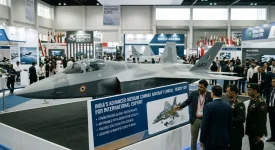
As India nears a final decision on a foreign collaborator to co-develop a 120-kilonewton (kN) thrust engine for the Advanced Medium Combat Aircraft (AMCA) Mk2, the competition between British manufacturer Rolls-Royce and French firm Safran has reached a critical strategic juncture.
The ultimate selection goes beyond mere engine performance. It represents a profound debate between widening the network of defence suppliers and maintaining established alliances, a verdict that will shape the nation's aerospace sovereignty for generations to come.
With the Indian government committing substantial financial resources—including an estimated ₹61,000 crore ($7 billion) proposal for the joint venture—New Delhi firmly demands full ownership of the intellectual property (IP) rights, refusing to concede them to the overseas partner.
This immense capital investment has fundamentally altered the dynamics of the negotiations.
Consequently, the two European aviation titans find themselves in a fierce contest, presenting unparalleled offers of complete technology transfer and domestic industrial integration to secure the monumental contract.
In a recent development, Rolls-Royce intensified the rivalry by proposing comprehensive IP ownership to design a completely new engine, while Safran countered with an assurance of unrestricted technology transfer and zero export limitations, building upon its successful M88 engine architecture.
Additionally, Rolls-Royce has highlighted its unique capability to adapt fighter engines for naval warships, an aspect missing from the French offer.
A major rationale for favouring Rolls-Royce centres on the necessity for strategic variety. Currently, India maintains a strong and deep-rooted defence relationship with France, which is most visibly highlighted by the ongoing Rafale fighter aircraft initiative.
Nevertheless, defence strategists caution against the risks of depending excessively on one country for such crucial aerospace advancements.
If global geopolitical dynamics or internal policy shifts in a partner nation were to interrupt military exports, India might encounter significant difficulties in sustaining and modernising its aerial squadrons.
Bringing the United Kingdom into the future fighter development plan would effectively distribute this strategic risk, ensuring the country avoids an unhealthy dependence on any single provider.
Moreover, the fierce competition between these two leading engine makers directly benefits Indian interests.
By placing Safran and Rolls-Royce in direct competition, the government has sparked an intensive bidding war focused on delivering the most favourable IP rights and technical transparency.
This competitive atmosphere significantly enhances the nation's negotiating leverage, facilitating the acquisition of cutting-edge propulsion capabilities that foreign powers typically restrict.
The prospective uplift for domestic manufacturing serves as another crucial consideration.
Rolls-Royce has reportedly suggested establishing a dedicated Aerospace Gas Turbine Complex in India, which recently saw the British firm announce a strategic intent with Reliance Industries, alongside potential involvement from other private giants.
Such an endeavour would introduce local engineers to novel design concepts and dramatically broaden the nation's indigenous manufacturing capacity.
On the other hand, Safran offers a compelling argument founded on reliability and demonstrated expertise. The French corporation is already thoroughly integrated into the country's aerospace sector through numerous active defence collaborations.
Since Safran possesses an intimate understanding of the operational requirements of the military and the capabilities of local manufacturing, aligning with them could substantially minimise the technical uncertainties associated with such a sophisticated undertaking.
Their proposal also features a faster ten-year development cycle compared to the initial British timeline.
In the end, constructing a fifth-generation combat aircraft involves far more than simply installing a high-thrust powerplant into a fuselage.
The engine must be seamlessly combined with the jet's stealth characteristics, flight management software, and heat regulation mechanisms.
Attaining this perfect synthesis requires years of intimate cooperation and exhaustive trials, dictating that India must select a collaborator it can rely on for the extended future.
Thankfully, the staggered development schedule for the AMCA programme offers a vital time cushion.
The first AMCA Mk1 prototypes, which are projected to be unveiled around 2026 or 2027, will be equipped with the dependable American General Electric F414 engines.
This guarantees that vital flight evaluations and progress can continue without interruption. Since the high-power Mk2 engine will not be necessary until the 2030s—with Rolls-Royce recently accelerating its pitch to offer core testing by 2030—the country holds the advantage of time.
India can therefore afford to bargain assertively for the best possible IP and technology transfer agreement, securing genuine strategic independence without delaying the broader AMCA schedule.