- Views: 2K
- Replies: 4
The Indian aerospace industry is reaching new heights as the Aeronautical Development Agency (ADA) and Hindustan Aeronautics Limited (HAL) make significant progress on the Tejas Mk2.
Moving beyond the light-combat roots of the original Mk1, this new aircraft is a fully capable Medium Weight Fighter (MWF).
Designed to phase out the Indian Air Force’s older jets, such as the Jaguar, Mirage 2000, and MiG-29, the Tejas Mk2 is stepping into a highly competitive global market.
Here is a look at how India’s homegrown 4.5-generation multirole aircraft compares to some of the world's most prominent fighter jets.
1. Tejas Mk2 vs. Lockheed Martin F-16 Block 70
- The Historic Rival: The F-16 Block 70 comes with a long history of combat success, massive international production, and widespread use by numerous air forces worldwide.
- The Tejas Edge: Although the F-16 boasts extensive real-world combat experience, the Tejas Mk2 features a thoroughly modern design. It incorporates an open-architecture avionics system, cutting-edge sensor fusion, and close-coupled canards that give it exceptional agility and turning speed. Importantly, because the Mk2 relies on Indian software and hardware, it is free from strict foreign export laws and end-user limitations, allowing for unrestricted future upgrades.
2. Tejas Mk2 vs. Saab Gripen E
- The Nimble Competitor: Sweden’s Gripen E is built on concepts similar to the Tejas Mk2. Both aircraft focus on keeping operating costs low while delivering top-tier electronic warfare (EW) and network-connected combat capabilities.
- The Tejas Edge: The Gripen E is already in active service, but the Tejas Mk2 benefits greatly from being manufactured in India. Producing the jet locally significantly lowers the long-term costs of maintenance and gives India complete control over its supply chain. It also allows for the seamless addition of homegrown weaponry, such as the Astra series of beyond-visual-range (BVR) missiles.
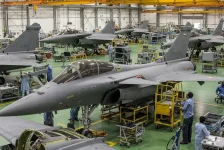
3. Tejas Mk2 vs. Dassault Rafale
- The Heavyweight Benchmark: The French Rafale is a larger, twin-engine aircraft known for performing multiple roles in a single mission. It has a proven combat record and can carry a very large amount of weaponry.
- The Tejas Edge: The Rafale sits in a much higher weight and price category. However, the Tejas Mk2 is engineered to offer many of the same high-end features at a fraction of the cost. Equipped with India’s indigenous Uttam Active Electronically Scanned Array (AESA) radar and an advanced Infrared Search and Track (IRST) system, the Mk2 can carry a heavy 6.5-tonne payload across its 11 active weapon stations. This makes it an affordable, highly capable partner to the Rafale in a mixed fleet.
4. Tejas Mk2 vs. Boeing F/A-18E/F Super Hornet
- The Naval Specialist: Comparing these two jets reveals very different design goals. The Super Hornet is a large, twin-engine aircraft specifically constructed to withstand the immense physical stress of operating from naval aircraft carriers.
- The Tejas Edge: The Tejas Mk2, on the other hand, is a single-engine fighter designed specifically for land-based operations. It is fine-tuned for high-speed agility, rapid air defence, and precision ground strikes, making it perfectly suited for the specific geographic and strategic requirements of the Indian subcontinent.
The Road Ahead for Indian Air Power
As the Tejas Mk2 prepares for its upcoming maiden flight—expected around 2026—it represents far more than a simple replacement for older aircraft.Open-source data confirms that the Mk2 will be powered by the robust General Electric F414-INS6 engine, producing 98 kN of thrust, which provides a massive boost in speed, payload, and overall performance over the older Mk1.
Furthermore, combined with its advanced radar suite, it will be armed with next-generation Indian weapons like the long-range Astra MK2 missiles and the anti-radiation Rudram series.
By delivering true 4.5-generation technology, a modern sensor network, and an attractive price tag, the Tejas Mk2 is not just securing India's skies.
It is also emerging as a highly attractive option for allied nations seeking a top-tier fighter jet without the enormous financial burden of Western alternatives.