- Views: 2K
- Replies: 1
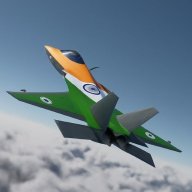
India's comprehensive Super Sukhoi modernisation initiative is advancing steadily, with the indigenous Virupaksha Active Electronically Scanned Array (AESA) radar on track for its first pre-production batch by late 2026.
Developed by the Defence Research and Development Organisation's (DRDO) Electronics and Radar Development Establishment (LRDE), the cutting-edge sensor has successfully passed its critical "First Light" evaluation.
This paves the way for its eventual integration into the Indian Air Force's (IAF) frontline Su-30MKI fighter fleet.
According to defence sources, the radar accomplished its initial power-on and signal transmission test—known as First Light—in February 2026.
This milestone is essential in modern radar development, as it proves the core hardware architecture works properly. It verified that the radar's advanced transmit-receive modules, power distribution networks, and signal processors are functioning seamlessly together.
Following this achievement, engineering teams have shifted their focus to rigorous ground assessments.
The radar is currently being tested inside a specialised X-Band Radome Test Jig to measure electromagnetic performance, signal clarity, and beam-steering precision through simulated nose cones.
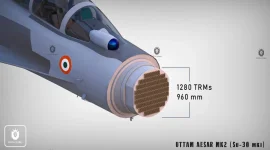
Notably, the Virupaksha radar incorporates approximately 2,400 Transmit/Receive Modules (TRMs) built on state-of-the-art Gallium Nitride (GaN) semiconductor technology. This represents a massive leap over the jet's current Russian-origin N011M Bars passive radar.
The GaN architecture allows for significantly higher power output and superior cooling, extending detection ranges to over 400 kilometres while reducing the system's overall weight by more than half.
With ground validation progressing, the Virupaksha radar will soon take to the skies. A modified Hawker 800 executive jet, which frequently serves as a dedicated DRDO flying testbed, has been selected for the initial airborne trials scheduled to begin around mid-2027.
These flights will allow technicians to evaluate the system's real-world capabilities, focusing on long-range detection, tracking accuracy, environmental durability, and resistance to electronic jamming.
The data gathered during the Hawker 800 flights will be crucial before installing the radar onto a combat jet.
By early 2028, testing is projected to transition to a specially modified Su-30MKI operated by the Aircraft and Systems Testing Establishment (ASTE).
This demanding phase will push the radar to its limits through complex combat simulations, evaluating its ability to handle air-to-air tracking, ground targeting, and operations in dense electronic warfare environments, all while communicating with the aircraft's modernised avionics.
Defence officials note that final certification for such a complex system is a lengthy procedure. It may take up to five years to thoroughly test, validate, and approve the radar alongside its related software and electronic warfare systems for fleet-wide induction.
To handle the scale of manufacturing, DRDO is collaborating with a consortium of domestic aerospace partners, including Astra Microwave Products for the high-frequency GaN modules, alongside heavyweights like Larsen & Toubro (L&T) and Hindustan Aeronautics Limited (HAL).
Valued at an estimated Rs 65,000 crore, the Super Sukhoi programme aims to completely overhaul an initial batch of 84 IAF Su-30MKI aircraft, keeping them dominant and combat-ready well into the 2050s.
The Virupaksha AESA radar serves as the technological cornerstone of this package, which also features advanced mission computers, new electronic warfare suites, improved data fusion, and modernised cockpits to support network-centric warfare.
Because integrating such complex systems takes time, the IAF is expected to introduce the upgrades in calculated phases.
The first batch of modernised jets will likely prioritise the Virupaksha radar and the new electronic warfare suite.
Other planned enhancements, such as an upgraded indigenous Infrared Search and Track (IRST) system, may be deferred to a future "Block II" configuration.
This phased strategy allows the Air Force to deploy the most critical technologies rapidly while refining other subsystems, ultimately strengthening India's aerial defence network while minimising integration risks.