- Views: 3K
- Replies: 15
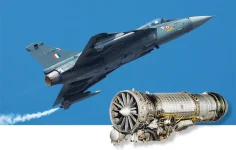
The Hindustan Aeronautics Limited (HAL) Tejas Mk2 fighter jet programme has successfully achieved a structural weight reduction of approximately 200 kilograms.
This milestone was accomplished through the implementation of advanced modular construction and jig-less assembly methods, which have vastly enhanced the aircraft's structural efficiency.
Developed jointly by the Aeronautical Development Agency (ADA) and HAL, the Tejas Mk2—envisioned as a 4.5-generation medium-weight fighter for the Indian Air Force—is adopting highly modernised manufacturing techniques.
Programme engineers note that transitioning to monolithic machining and utilising advanced carbon-fibre composites has allowed the jet's airframe to shed excess weight without compromising strength.
A major factor in this weight loss is the shift to single-piece, or monolithic, machining for vital structural sections.
In the older Tejas Mk1 model, components like the internal bulkheads and the wing-fuselage joint were built from several smaller pieces joined by heavy steel rivets, requiring extra reinforcement.
Conversely, the Tejas Mk2 uses large, continuous titanium frames carved from a single block of metal.
By eliminating the need for hundreds of heavy fasteners and subcomponents, this single-piece manufacturing approach alone has saved around 120 kilograms, while simultaneously boosting the airframe's fatigue resistance.
Furthermore, the project has embraced jig-less assembly.
Historically, aircraft construction required massive steel jigs to clamp the frame together during the riveting process.
These heavy fixtures put immense mechanical stress on the structure, forcing designers to add internal support frames solely to survive the assembly stage—adding weight but no flight value.
By switching to digital alignment tools and modular techniques, the Tejas Mk2 avoids these assembly stresses entirely, allowing engineers to remove those unnecessary internal reinforcements.
The new fighter also makes extensive use of cutting-edge materials.
Programme engineers confirm that carbon-fibre composites will make up roughly 90 percent of the Mk2's surface area.
Because these composites possess a far superior strength-to-weight ratio compared to standard metal alloys, the aircraft gains significant protection against corrosion and wear while keeping its overall mass to a minimum.
Structurally, the centre fuselage of the jet was entirely redesigned to house the new General Electric F414-INS6 engine.
Replacing the F404 engine of the Mk1, the new F414 produces a substantially higher 98 kN of thrust.
During this necessary redesign to fit the larger engine, designers took the opportunity to optimise the engine bay's layout and streamline the wing-root area for better aerodynamic efficiency.
Instead of just creating a lighter jet, developers have reinvested the 200-kilogram saving directly into the aircraft's combat performance.
Consequently, the internal fuel capacity has jumped to over 3,300 kilograms—a major increase from the Mk1’s roughly 2,450 kilograms—granting the aircraft a much wider combat radius.
Moreover, this structural optimisation translates into approximately 1.5 tons of extra payload capacity.
The Mk2 is now expected to carry up to 6,500 kilograms of weaponry across 11 hardpoints, equipping it to deploy heavy, advanced munitions like the indigenous Astra beyond-visual-range missile, Rudram anti-radiation missiles, and potentially the BrahMos-NG cruise missile.
Ultimately, these manufacturing upgrades demonstrate the increasing sophistication of India’s domestic aviation and defence sectors.
Set to replace ageing fleets of Mirage-2000, Jaguar, and MiG-29 jets, the first Tejas Mk2 prototype is currently in its advanced stages of assembly, with a highly anticipated public rollout expected in the near future.
By successfully implementing globally recognised techniques, India is firmly establishing its capability to build modern, world-class fighter aircraft.