- Views: 2K
- Replies: 2
The ambitious "Super Sukhoi" modernization program for the Indian Air Force has reached a pivotal technical milestone.
Engineers from the Hindustan Aeronautics Limited (HAL) Nashik division, in collaboration with the Defence Research and Development Organisation (DRDO) and the Electronics and Radar Development Establishment (LRDE), have commenced critical aerodynamic load testing on the Su-30MKI’s radome.
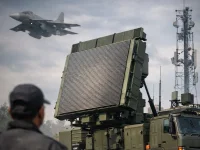
This phase is essential for the seamless integration of the indigenous Virupaksha Active Electronically Scanned Array (AESA) radar.
The Engineering Challenge of the Radome
While modernizing a fighter jet often focuses on the "brain" of the aircraft, the radome—the protective nose cone—is a complex piece of engineering.It must be strong enough to withstand extreme environmental conditions while remaining "transparent" to radar waves.
The transition to the Virupaksha radar represents a significant shift from the current N011M Bars radar.
The Virupaksha features a larger antenna, measuring approximately 950 mm, and a new internal layout.
Because the Su-30MKI can fly at speeds exceeding Mach 2, the radome is subjected to immense air pressure and friction-induced heat.
Scientists are currently validating that the composite materials used in the nose cone can handle these thermal and structural stresses without distorting the radar signals.
Precision Across the Flight Envelope
Current research is mapping how the radome reacts during various stages of flight, including cruising and high-speed supersonic dashes.At high speeds, even microscopic cracks or slight deformations in the material can interfere with the radar's accuracy.
For an advanced AESA system like the Virupaksha, maintaining a perfect signal is vital for identifying and tracking long-range targets with precision.
Furthermore, the Su-30MKI is famous for its extreme maneuverability and "high angle-of-attack" (AoA) flight, where the nose points significantly away from the direction of travel.
These maneuvers create uneven air pressure on the radome. The joint team is ensuring that the nose cone does not flex or vibrate under these conditions, as even a tiny shift could cause the radar to lose its "lock" on an enemy aircraft during combat.
Advanced Technology and Weight Distribution
One of the most significant improvements in the Super Sukhoi project is the move toward Gallium Nitride (GaN) technology.This allows the Virupaksha radar to be more powerful yet much lighter than its predecessor.
Estimates suggest the new radar weighs less than 300 kg, compared to the 650 kg Bars system.
While a lighter radar is generally an advantage, it shifts the aircraft’s center of gravity.
HAL is currently redesigning the internal mounting structures to ensure the Su-30MKI retains its world-class balance and handling characteristics.
Material Science and Thermal Management
The upgrade also involves "material optimization."The radome’s layers are being fine-tuned to handle dual-band frequencies (S-band and X-band) without scattering the signals.
Additionally, because AESA radars generate significant heat from thousands of small transmit-receive modules, a new liquid-cooling system is being integrated.
The radome must be shaped to assist in this cooling process without increasing the aircraft's drag.
A Strategic Leap for Atmanirbhar Bharat
The Super Sukhoi program, valued at over ₹60,000 crore, aims to upgrade nearly 84 aircraft in the first phase.The Virupaksha radar is considered a domestic evolution of the 'Uttam' radar series, scaled up specifically for the heavy-duty requirements of the Flanker fleet.
These studies prove that the upgrade is not a simple "plug-and-play" replacement but a comprehensive redesign of the airframe-sensor interface.
By mastering these aerodynamic and electromagnetic challenges, India is ensuring that the Su-30MKI remains the backbone of national defence for decades to come.