India’s Gas Turbine Research Establishment (GTRE) and French aerospace leader Safran are collaborating to build a powerful new 110–120 kN class turbofan engine for the Advanced Medium Combat Aircraft (AMCA) Mk2.
Recent open-source reports indicate this ambitious ₹61,000 crore ($7 billion) joint venture will result in a clean-sheet engine design, granting India full intellectual property rights and comprehensive technology transfer.
Beyond pure power, this new engine addresses a crucial requirement of modern aerial warfare and defence: aggressively shrinking the fighter jet's heat signature to achieve thermal stealth.
In the era of fifth-generation combat, hiding from radar is no longer sufficient.
The rapid evolution of infrared search-and-track (IRST) sensors and advanced heat-seeking missiles means aircraft must also hide their thermal emissions.
To counter these threats, the upcoming GTRE-Safran engine is purposefully engineered to lower the exhaust heat that adversary systems rely on to lock onto stealth jets, all while producing greater thrust than India's existing fighter powerplants.
A core component of this thermal management strategy is a newly designed, stealth-focused variable geometry afterburner.
Historically, afterburners are vital for providing the explosive acceleration needed during takeoff, supersonic flight, and intense dogfights.
Unfortunately, they also act as massive heat beacons, making the aircraft highly visible to infrared detection.
When a standard afterburner engages, it pumps extra fuel directly into the exhaust and ignites it to surge engine power. This reaction blasts out a scorching exhaust trail that acts as a glaring target for modern air-to-air missiles and long-range thermal sensors.
For a highly advanced stealth platform like the AMCA Mk2, suppressing this massive heat emission is a strict necessity.
To solve this, developers are equipping the GTRE-Safran engine with a revolutionary nozzle system specifically built to cool the exhaust before it escapes into the air.
Instead of blasting superheated gas straight out of the rear, this innovative architecture rapidly blends cooler bypass air with the intense exhaust stream internally.
By cooling the external exhaust plume in this manner, the engine drastically cuts down the aircraft's infrared visibility, making it exceptionally hard for enemy missiles and thermal tracking networks to spot the fighter.
This advanced nozzle effectively turns heat management into a critical survival tool, mirroring the sophisticated thermal reduction techniques seen on the world’s most elite stealth aircraft.
Furthermore, cutting-edge material science plays a massive role in this engine's stealth profile.
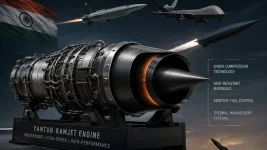
The afterburner and exhaust components will be heavily constructed from advanced heat-resistant ceramics and Ceramic Matrix Composites (CMCs), marking a significant leap over standard metal parts.
These next-generation materials can endure extreme operating temperatures without breaking down, boosting both performance and fuel efficiency.
More crucially for stealth, CMCs excel at absorbing and trapping intense heat inside the engine, stopping it from radiating outward.
By keeping the internal heat away from the aircraft's outer skin, these composites ensure the airframe stays much cooler, further starving enemy infrared sensors of a detectable target.
Alongside these materials, the engine will feature complex internal cooling systems designed to regulate heat across vital sections.
This technology safely dissipates the intense thermal energy created during high-speed combat, ensuring the exterior of the aircraft remains as cool as possible.
These advanced cooling measures are becoming mandatory for survival, as tomorrow's battlefields will be dominated by highly sensitive, passive detection networks that track aircraft purely by their heat, even when they successfully evade radar.
Beyond its stealth capabilities, the new powerplant is built to be highly reactive. Reports suggest the afterburner is tuned for rapid ignition and incredibly fast spool-up times.
This agility allows a pilot to instantly switch from standard flight to maximum afterburner power, a crucial edge when executing evasive maneuvers, dodging incoming fire, or engaging in fast-paced dogfights.
Expected to deliver between 110 and 120 kN of maximum thrust, this engine will be the most powerful ever fielded in an indigenous Indian fighter.
This massive power upgrade is vital to meet the AMCA Mk2's goals, allowing it to carry heavier weapons, accelerate faster, and perform with unmatched versatility.
Ultimately, the vision for the AMCA Mk2's propulsion goes beyond simply upgrading the afterburner.
The fighter is engineered to achieve "supercruise"—the rare ability to fly at supersonic speeds continuously without ever turning the afterburner on.
Supercruise is a hallmark of elite fifth and sixth-generation jets, offering a lethal combination of high speed, massive fuel savings, and a drastically reduced thermal footprint.
By maintaining supersonic flight on standard thrust alone, the aircraft completely avoids creating the giant, glowing heat plume caused by an afterburner.
This not only extends the fighter's combat endurance but also makes it far more difficult for adversaries to detect.
Supercruise will serve as a fundamental pillar of the AMCA Mk2’s stealth capabilities.
While the high-tech afterburner will be ready for extreme combat situations, the fighter will primarily rely on its highly efficient, low-heat dry thrust for high-speed dominance.