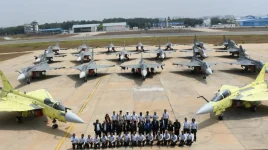
Hindustan Aeronautics Limited (HAL) has successfully completed the repair and overhaul of its 1,000th AL-31FP turbofan engine, which was recently handed over to the Indian Air Force (IAF). This engine powers the Su-30MKI, the most prominent heavy fighter aircraft in India's fleet.
While this landmark event showcases India's expanding ability to maintain its critical combat aircraft, it also brings attention to a major hurdle in the nation's aerospace journey: the lack of a fully homegrown, high-performance fighter jet engine.
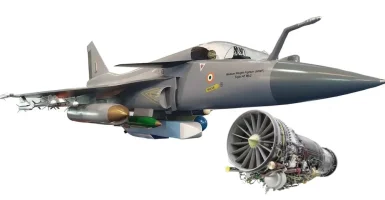
This milestone arrives exactly when India is deeply engaged in talks with American manufacturer GE Aerospace. The discussions revolve around acquiring and locally producing the F414-INS6 engines to power future projects, including the Advanced Medium Combat Aircraft (AMCA) and the Tejas Mk2.
The intricate nature of these negotiations once again underlines India's heavy reliance on foreign technology for its primary combat jets.
A Triumph in Maintenance and Overhaul
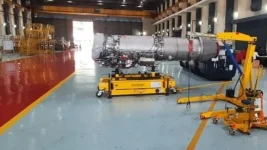
HAL's Engine Division, located in Koraput, Odisha, has grown into a highly advanced military aviation maintenance hub. The recent delivery of the 1,000th overhauled engine is a testament to the facility's decades of experience in the maintenance, repair, and overhaul (MRO) sector.Originally designed by Russia's Saturn Design Bureau, the AL-31FP is a powerful twin-spool engine that serves as the heart of the Su-30MKI. It generates an impressive 123 kN (kilonewtons) of thrust when using its afterburner.
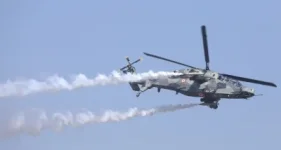
Notably, it features a thrust-vectoring nozzle capable of deflecting up to 15 degrees in the vertical plane, which allows the aircraft to execute highly complex post-stall aerial manoeuvres, such as the famous "Cobra" and "Kulbit" movements.
By conducting these complex overhauls within the country, India drastically cuts down its need to send engines abroad for repairs. This domestic capability ensures that more aircraft are ready for flight at any given time and significantly reduces long-term maintenance costs.
HAL reports that its Koraput facility can now process over 100 AL-31FP engines every year.
To further secure the fleet's future, the Ministry of Defence also signed a major $3 billion contract with HAL in September 2024 to build 240 new AL-31FP engines to gradually replace ageing units.
The Need for Complete Self-Reliance
While mastering the overhaul process is a major industrial victory, defence experts warn that fixing engines is not the same as designing them from scratch.Repairing an engine prolongs its life and limits expensive imports, but India still remains dependent on other nations for the core designs and critical technologies of modern fighter engines.
This ongoing reliance leaves India vulnerable. Changes in global politics, sudden export restrictions, or delayed negotiations can quickly disrupt the supply of engines needed for upcoming aircraft programs.
The current talks with GE Aerospace regarding the F414 engine have put India's long-standing aero-engine struggles back in the spotlight.
Although both sides have expressed a commitment to sharing technology, the most crucial elements of engine manufacturing are kept highly secretive globally.
Creating a modern fighter engine requires mastering incredibly complex engineering, including handling advanced metallurgy, single-crystal turbine blades, specialized high-temperature coatings, and intricate digital controls.
Historically, even the most advanced aerospace nations have taken several decades to perfect these skills.
Paving the Way for an Engine Mission
Former scientists and defence professionals are urging the government to launch a dedicated, long-term national mission specifically for developing aero-engines, much like India's successful space and missile programs.India's Gas Turbine Research Establishment (GTRE) has already gained significant knowledge through the earlier Kaveri engine project.
Even though the Kaveri engine ultimately did not produce enough thrust to power a fighter jet, it allowed Indian engineers to learn heavily about engine architecture, material science, and testing procedures.
Many experts now view the Kaveri project not as a failure, but as an essential technology-building effort. They point out that countries like the United States, France, and the UK spent decades building their expertise before producing world-class engines.
Notable voices in the defence sector, such as former BrahMos Aerospace CEO Sudhir Kumar Mishra and former DRDO Chairman Dr. G. Satheesh Reddy, have stressed that India possesses the scientific talent required for this challenge.
However, they argue that achieving true strategic autonomy will require a long-term roadmap, stable financial backing, and deep collaboration between the government laboratories, military industries, and academic institutions, rather than expecting rapid breakthroughs.
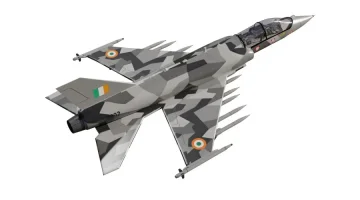
Looking to the future, India's aviation plans include the Tejas Mk2, the AMCA, the Twin Engine Deck-Based Fighter (TEDBF), and various unmanned combat drones. All of these will rely on powerful and dependable high-thrust engines.
Creating a domestic engine ecosystem would give India complete control over its aircraft development, make future upgrades much easier, and allow the country to export its fighter jets without needing permission from foreign engine suppliers.
Until that happens, HAL's achievement in Koraput remains a vital pillar of India's current defence strategy, proving the nation's maturity in sustaining one of the largest heavy fighter fleets in the world.