- Views: 2K
- Replies: 2
During the high-stakes environment of Operation Sindoor in May 2025, an extraordinary display of aerial evasion took place.
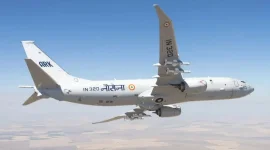
Indian Navy Commander Saurabh Kumar, operating under the callsign "Whiskey," was at the helm of a $250 million Boeing P-8I Neptune maritime patrol aircraft.
In the midst of active hostilities, his aircraft was targeted by a Chinese-origin surface-to-air missile—suspected to be an HQ-9 or a PL-15—launched by Pakistani forces.
Against significant odds, Commander Kumar managed to safely navigate his aircraft away from the incoming threat.
At the time of the engagement, Commander Kumar was spearheading a specialised Intelligence, Surveillance, and Reconnaissance (ISR) detachment from a frontline airbase.
Although the P-8I is primarily renowned as a long-range maritime patrol and anti-submarine warfare platform, its advanced electronic intelligence capabilities were repurposed for overland operations.
The aircraft was tasked with supplying real-time target coordinates to the Indian Army and the Indian Air Force.
This continuous stream of intelligence was vital in shaping the tri-services campaign, which was launched as a calibrated response to the tragic April 2025 Pahalgam terror attack.
The mission demanded flying over treacherous mountain landscapes while confronting adverse weather and a completely GPS-denied environment.
Without warning, the aircraft's systems indicated a radar lock from a Pakistani air defence missile.
Because large patrol aircraft like the P-8I normally operate at a safe standoff distance from active borders, this direct targeting represented a major escalation.
Relying on his rigorous training, Commander Kumar immediately executed a series of aggressive, calculated manoeuvres to break the missile's tracking, securing the survival of his crew and the aircraft.
Remaining composed under direct enemy fire, the pilot demonstrated profound expertise over the P-8I platform despite facing severe electronic warfare interference and a lack of satellite navigation.
By skillfully employing the aircraft's integrated Electronic Support Measures (ESM) to spoof the missile's seeker head, the crew successfully shattered the hostile lock.
This evasion not only preserved a critical strategic asset but also ensured the uninterrupted flow of crucial battlefield intelligence, heavily contributing to India's counter-terrorism operations during the conflict.
In recognition of his outstanding leadership, tactical brilliance, and bravery during combat, Commander Saurabh Kumar (Service No. 52743) was awarded the prestigious Nao Sena Medal (Gallantry).
The honour, which was formally highlighted during the April 2026 Naval Investiture Ceremony by Admiral Dinesh K Tripathi, reflects the officer's rapid decision-making.
The official citation prominently outlines how his actions transformed a highly lethal situation into a defining moment for Indian naval aviation.
This wartime encounter also brought the operational credibility of heavily exported Chinese air defence systems into sharp focus.
Despite being promoted as highly sophisticated long-range interceptors, the hardware failed to achieve its objective when met with competent evasion flying and modern electronic countermeasures.
Furthermore, the P-8I's successful survival in heavily contested airspace highlighted the Indian Navy's expanding integration into unified combat strategies, proving that its maritime assets can effectively assist overland air and ground offensives.
Ultimately, the successful evasion stands out as a significant milestone in modern Indian military history. It perfectly illustrates the necessary combination of advanced technology and fearless human command.
The event clearly communicated India's unwavering commitment to securing its national interests, demonstrating that its armed forces can execute precise, intelligence-heavy missions even while operating under direct hostile fire.