The retrieval of largely undamaged PL-15E air-to-air missiles during the May 2025 events of Operation Sindoor stands as a monumental intelligence victory for India.
Recovered near Kamahi Devi village in the Hoshiarpur district of Punjab, these beyond-visual-range (BVR) weapons have given the Indian Air Force unparalleled access to the technology behind one of China’s premier combat systems, which is actively used by Pakistan.
Originally developed by China, the PL-15E is an export variant boasting a reported range of up to 145 kilometres.
Debris from these missiles, which failed to detonate after being launched by platforms such as the J-10C and JF-17 during the aerial skirmishes, was found sufficiently preserved.
This rare condition has enabled specialists from the Defence Research and Development Organisation (DRDO) and the Indian Air Force to conduct comprehensive laboratory evaluations of the weapon's internal mechanisms.
Such discoveries hold immense strategic weight because contemporary long-range missiles operate as complex, highly networked electronic machines rather than just aerodynamic projectiles.
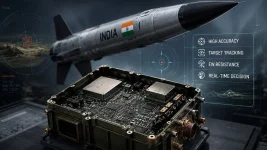
They are equipped with sophisticated active radar seekers, encrypted communication links, and intricate guidance algorithms.
Having physical access to the hardware means Indian experts no longer have to rely on theoretical intelligence or external estimates to understand how the missile communicates and tracks its targets.
A major breakthrough from this analysis is the extraction of the missile’s electronic signature.
Defence teams successfully decoded the PL-15E's specific communication patterns, radar emissions, and frequency-hopping behaviours.
This crucial data is being systematically fed into the electronic warfare databases of India's frontline fighter squadrons.
Understanding these precise electronic traits has profound implications for modern aerial combat, where controlling the electromagnetic spectrum is as important as speed and firepower.
Armed with exact emission profiles, Indian fighters equipped with modern electronic warfare suites can more readily detect, categorise, and disrupt incoming PL-15E threats.
This vital intelligence has already prompted software and threat profile upgrades across India’s fighter fleets.
The indigenous electronic warfare architectures aboard the Tejas Mk1A and Su-30MKI, as well as the advanced SPECTRA suite on the Rafale, have been updated with new jamming logic tailored specifically to counteract the Chinese-designed missile.
The analysis also shed light on the missile's secure datalink architecture.
Long-range engagements require mid-course guidance updates sent from airborne early warning aircraft or the launching fighter.
To evade jamming, these links rapidly switch frequencies using complex encryption.
By dissecting the physical hardware, Indian engineers mapped the sequencing and spectral shifts of these links, greatly enhancing the ability of Indian jets to sever the missile's communication during flight.
Beyond the electronic spectrum, the recovery provided invaluable physical data regarding the missile's flight dynamics.
Analysts have studied the propulsion residue and internal fuel structure of the PL-15E's dual-pulse solid-fuel rocket motor.
This real-world data paints a much more accurate picture of the missile's actual range, energy retention, and manoeuvrability across different altitudes than publicly advertised figures.
Armed with this kinematic analysis, the Indian Air Force has actively revised its combat doctrines.
Pilots operating in high-risk zones near the Line of Control have received updated guidance on the exact timing windows required for evasive manoeuvres, greatly increasing their chances of survival against PL-15E-class weapons.
The global and regional significance of this intelligence windfall cannot be overstated.
The PL-15 family is central to Pakistan’s modern beyond-visual-range combat strategy, and its long-range capabilities had previously caused concern among defence analysts.
However, possessing advanced hardware is only one piece of the puzzle in modern warfare, which relies heavily on the integration of sensors, jamming suites, and pilot training.
Acquiring the intact PL-15E has transformed India’s defensive posture from estimating theoretical risks to exploiting proven vulnerabilities.
The global defence community has taken notice, with nations like the United States, France, and Japan reportedly expressing interest in the findings to understand the missile's active electronically scanned array (AESA) radar and dual-pulse motor.
Ultimately, this recovery mirrors historic Cold War intelligence coups, where captured enemy technology spurred rapid advancements in countermeasures.
The insights gained from the PL-15E will not only refine current combat tactics but also serve as a foundational benchmark for developing India's next-generation indigenous air-to-air missiles and advanced electronic warfare systems.