- Views: 2K
- Replies: 7
The Indian Air Force (IAF) is currently navigating a critical juncture, balancing a persistent shortage in combat squadrons with an increasingly outdated fleet.
A central dilemma revolves around the future of its deep-penetration strike force: is it feasible to retire the remaining 115-strong SEPECAT Jaguar fleet and replace their distinct capabilities with Hindustan Aeronautics Limited’s (HAL) modernised "Super Su-30MKI" fighters?
The Jaguars, now approaching 45 years of service, are plagued by high-temperature engine performance issues and recent accidents.
While standardising the IAF around a heavy, multirole platform like the upgraded Sukhoi presents obvious logistical advantages, it also necessitates a major doctrinal shift away from the highly specialised, low-level strike tactics the Jaguar was built to execute.
The Dawn of the Deep-Penetration Era
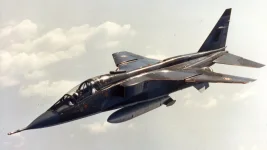
When the first Anglo-French Jaguars arrived at the Ambala airbase in July 1979, they revolutionised the IAF’s tactical capabilities.Conceived in the 1960s, these twin-engine supersonic jets were specifically engineered to fly fast and low—hugging the terrain to evade enemy radar.
This capability allowed them to penetrate deep into hostile airspace to deliver precision strikes.
During the high-stakes geopolitical climate of the 1980s, the Jaguar was the undisputed platform of choice for battlefield interdiction, close air support, and potential nuclear delivery missions, proving its worth in numerous exercises and early strategic deployments.
A Legacy of Service and Upgrades
Over four decades, India became the largest operator of the Jaguar, inducting 145 aircraft and establishing six active squadrons that reached a peak strength of around 130 jets.Through successive upgrades—most notably the DARIN navigation-attack system and the integration of ASRAAM over-wing missiles—the IAF kept the fleet combat-relevant.
Despite misconceptions, the "Shamsher" (as it is known in the IAF) has an active combat record.
During the 1999 Kargil War, the fleet executed high-altitude bombing missions and vital reconnaissance operations.
Two decades later, during the 2019 Balakot airstrikes, Jaguars were successfully deployed as decoys to draw enemy fighter screens away from the primary Mirage-2000 strike package.
The Twilight of "Fast and Low"
However, the realities of modern warfare in 2026 have rendered the Jaguar’s original mission profile highly vulnerable.The widespread proliferation of advanced surface-to-air missiles, portable air defence systems (MANPADS), and integrated, multi-layered radar networks makes low-altitude penetration extremely perilous.
Furthermore, the advent of sophisticated drone swarms and long-range stand-off munitions has drastically reduced the need for a human pilot to physically penetrate enemy airspace.
The Jaguar also struggles in the medium-to-high altitudes where modern air combat predominantly occurs.
Its non-afterburning Adour engines suffer significant thrust degradation in India's hot climate, and a heavily debated 2023 proposal to integrate more powerful Honeywell F125IN engines was ultimately abandoned due to exorbitant costs and integration hurdles.
Sidelined by Modern Demands
By today’s standards, the Jaguar's physical limitations are glaring.Its compact airframe—once an asset for avoiding visual detection—now restricts its payload capacity to a mere fraction of modern fighters, typically maxing out at four 1,000-pound bombs or basic rocket pods.
Lacking state-of-the-art electronic warfare (EW) capabilities, the aircraft requires protective escorts from superior fighters like the Rafale or Su-30MKI to survive contested environments.
Even equipped with the latest DARIN-III avionics, the Jaguar remains a single-mission specialist in an era dominated by versatile, multirole platforms.
The retirement of the Jaguar's more advanced European cousin, the Panavia Tornado, by NATO allies further highlights that dedicated 1980s-era strike aircraft have little place in modern, network-centric battlefields.
A Fleet on Life Support
The operational reality of the Jaguar fleet today is grim.Out of the 115 remaining airframes, only around 83 are flight-ready, resulting in a suboptimal serviceability rate of roughly 72%.
To keep these ageing jets in the sky and manage severe spare part shortages, India has resorted to a global campaign of scavenging.
The IAF has actively acquired decommissioned Jaguar airframes and spare parts from Oman, France, the UK, and even Ecuador solely for cannibalisation.
This logistical nightmare often reignites historical debates over whether the IAF should have chosen the French Mirage F1 back in 1978, which offered greater multirole flexibility, though the Jaguar ultimately won out due to its unmatched low-level ruggedness.
The "Super Sukhoi" Solution
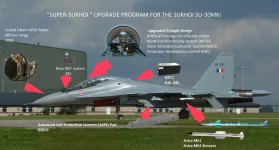
To fill the impending void, India is looking toward the "Super Sukhoi" modernisation programme.Spearheaded by HAL and the Defence Research and Development Organisation (DRDO), this initiative aims to elevate the IAF's backbone fleet of 272 Su-30MKIs to 4.5+ generation standards.
Open-source intelligence indicates that final approval from the Cabinet Committee on Security (CCS) for the first batch of 84 jets is imminent.
Valued at an estimated ₹60,000 to ₹65,000 crore, the upgrade will feature the indigenous 'Virupaksha' Active Electronically Scanned Array (AESA) radar—which boasts vastly superior detection ranges compared to the older Russian PESA systems—alongside advanced glass cockpits and powerful GaN-based electronic warfare suites.
While there are long-term discussions regarding engine replacements, the current modernisation heavily prioritises avionics and the seamless integration of indigenous weaponry, including the Astra series of air-to-air missiles, BrahMos-NG, and Rudram anti-radiation missiles.
Multirole Dominance Over Niche Strikes
Expected to commence around 2026, the Super Sukhoi upgrades will secure the platform's relevance well into the 2050s while achieving nearly 78% indigenisation.A crucial advantage of this domestic upgrade is source code ownership; HAL will be able to integrate new weapons and sensors independently, avoiding the steep fees often charged by foreign manufacturers.
In combat, the upgraded Su-30MKI outclasses the Jaguar in every metric: it can deliver strikes from hundreds of kilometres away using stand-off munitions, suppress enemy air defences, achieve air superiority, and carry three times the payload of a Jaguar—all while flying at Mach 2.
The Path Forward
Phasing out the Jaguar fleet entirely between 2030 and 2033 in favour of the Super Su-30MKI is a strategically sound proposition, but it requires aggressive execution.The IAF currently operates with roughly 31 fighter squadrons against an authorised strength of 42.
Because the Jaguars account for six of these existing squadrons, retiring them without immediate replacements will severely exacerbate the shortfall.
To successfully bridge this gap and modernise its strike capabilities, the IAF and HAL must dramatically accelerate the Super Sukhoi upgrade process to 24–30 aircraft per year.
If achieved, the Super Sukhoi's vast multirole capabilities will comfortably absorb the Jaguar's historical duties, transitioning the IAF from outdated low-level infiltration to dominant, high-tech, multi-domain air power.