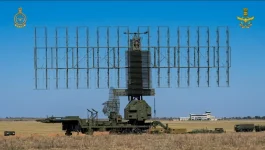
The Russian-made Nebo-UM (also known by its export designation 55Zh6ME) Very High Frequency (VHF) surveillance radar is proving to be a game-changer for modern integrated air defence networks.
Developed by the Nizhny Novgorod Research Institute of Radio Engineering (NNIIRT) under the Almaz-Antey corporation, this radar acts as a vital force multiplier, especially when paired with advanced surface-to-air missile batteries like the S-400 Triumf.
While the Nebo-UM cannot guide missiles to their targets directly, its exceptional capacity to spot and monitor stealth aircraft from far distances drastically boosts the lethality and readiness of the entire defence grid.
Built as a highly mobile, three-dimensional (3D) early warning system, the radar conducts broad surveillance using the VHF spectrum—specifically operating between the 133–144 MHz and 216–225 MHz frequency ranges.
Because these bands are completely different from those used by standard missile-tracking radars, the Nebo-UM can easily identify incoming airborne threats that are otherwise invisible to conventional, higher-frequency defence systems.
Standard fire-control systems generally rely on X-band or C-band frequencies to lock onto targets with high precision. In contrast, the Nebo-UM's VHF waves measure over a metre in length.
These elongated radio waves bounce off the physical shapes of an aircraft—such as its wings, tail, and main body—in a completely different manner.
Consequently, fifth-generation fighter jets that are heavily modified with radar-absorbent materials and special shaping to hide from standard radars will still create a strong, visible echo on a VHF screen.
Because of these unique physics, the Nebo-UM stands out as an outstanding early warning tool against stealth threats, such as China's advanced J-20 or J-35 stealth fighters.
Open-source data suggests the radar can detect low-observable aircraft from over 250 kilometres away, while its general tracking reach for conventional planes and ballistic missiles extends up to 600 kilometres.
This massive range ensures that hostile aircraft are identified well before they get close enough to be engaged by standard fire-control radars.
Rather than fighting on its own, the Nebo-UM acts as the central eyes of a broader, network-centric military shield.
As soon as it spots a target, the radar calculates the exact distance, direction, and altitude of the threat, painting a complete 3D picture of the airspace.
This vital tracking data is instantly shared with central command hubs and other interconnected anti-aircraft networks.
When linked with formidable weapons like the S-400, this shared information tells the missile system exactly where to look.
Instead of wasting time scanning the entire sky, the S-400’s own targeting radars can immediately focus on a specific, narrow pocket of airspace.
This rapid hand-off cuts down the time needed to lock onto the target, ensuring that the final missile engagement is both faster and more accurate.
Deploying such a multi-tiered strategy is absolutely vital for defeating modern stealth technology. Today's advanced air defence networks do not rely on just one type of radar; they blend various sensors across the electromagnetic spectrum.
In this setup, the Nebo-UM casts a wide, low-frequency net for long-distance early warning, while the high-frequency radars built into the S-400 take over to provide pinpoint tracking as the enemy aircraft draws nearer.
This cooperative framework means that different radar technologies work together to cover each other's blind spots. By diversifying the types of sensors in use, military commanders gain a flawless view of the battlefield.
More importantly, it ensures that an adversary cannot simply use one trick—like specialized stealth shaping or electronic jamming—to bypass a nation's entire defence perimeter.
To guarantee its survival during wartime, the Nebo-UM is designed for extreme mobility.
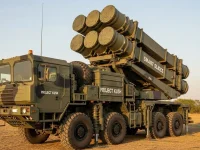
The entire radar complex is carried on heavy-duty, 8x8 wheeled military trucks, such as the BAZ-6909 chassis.
This "shoot-and-scoot" design means crews can set up the radar quickly and then drive it to a new location in minutes.
By constantly moving, the system makes it incredibly difficult for enemy forces to destroy it using long-range missiles or weapons that home in on radar signals.
Furthermore, the latest Nebo-UM model is equipped with cutting-edge digital signal processing.
This advanced computing power allows the system to easily filter out false echoes from the ground and strongly resist enemy jamming attempts.
Even in a chaotic wartime environment flooded with electronic interference, the radar maintains a clear and reliable picture of the sky.
Ultimately, the Nebo-UM is not meant to be a lone anti-stealth weapon, but rather the cornerstone of a comprehensive, multi-layered air defence strategy.
Capable of tracking targets flying as fast as Mach 6.4 at altitudes over 80 kilometres, it feeds critical early warning data directly to heavy hitters like the S-400.
In doing so, it creates an almost impenetrable shield against everything from standard fighter jets and cruise missiles to next-generation stealth platforms.