The Astra Mk-3 initiative, recently named 'Gandiva', is shaping up to be a monumental achievement for India's Defence Research and Development Organisation (DRDO).
While frequently viewed as just an upgrade to the existing Astra series of beyond-visual-range air-to-air missiles, the Mk-3 actually represents a massive leap, establishing itself in an entirely new, highly lethal category of aerial weaponry.
This new missile is not merely an extension of its predecessors, the Mk-1 and Mk-2. Instead, it signals India's arrival into an exclusive global club of ultra-long-range air-to-air missiles.
This positions the Astra Mk-3 alongside some of the world's most advanced systems, including Europe’s Meteor, China’s PL-15, and the United States' upcoming AIM-260 Joint Advanced Tactical Missile.
What sets the Astra Mk-3 apart is not just its impressive flight distance. Its true value comes from the remarkable amount of energy and speed it maintains right up until the moment it strikes an adversary.
The Science of Sustained Lethality
Over the years, the Astra series has consistently improved its striking reach.The initial Astra Mk-1 was capable of engaging targets around 110 kilometres away. The subsequent Mk-2 variant pushed this boundary to between 160 and 200 kilometres, varying with altitude and target movement. The Mk-3, however, bypasses these milestones entirely.
Driven by the cutting-edge Solid Fuel Ducted Ramjet (SFDR) technology—which DRDO successfully flight-tested recently—the Astra Mk-3 is anticipated to strike targets at distances approaching 350 kilometres under optimal conditions. Yet, this extraordinary range is only one piece of the puzzle.
The most critical innovation of this weapon is found in its advanced propulsion mechanism.
Traditional long-range missiles generally use a standard rocket motor that delivers a short, intense burst of speed. After this initial fuel burns out, the missile simply glides toward its target, gradually losing momentum.
Consequently, when it finally nears its maximum range, it lacks the kinetic energy required to make sharp, aggressive turns, giving enemy aircraft a chance to escape.
The integration of SFDR technology completely transforms this dynamic. Rather than depending entirely on a quick launch boost, the Astra Mk-3 uses air-breathing ramjet technology to maintain continuous thrust.
By using atmospheric oxygen, it relies less on heavy internal oxidisers, ensuring the missile stays powered for the majority of its flight.
This sustained propulsion ensures the weapon retains immense speed and agility deep into enemy airspace, remaining a lethal threat long after conventional missiles would have stalled.
This sustained power is the exact same feature that has earned the European Meteor missile its fearsome reputation.
The Meteor is highly regarded not just for its maximum range, but because it arrives at distant targets with enough remaining energy to execute sharp turns. This creates a massive "No-Escape Zone" (NEZ)—an area where enemy fighters cannot outmanoeuvre the incoming threat.
The No-Escape Zone defines the specific distance at which a targeted aircraft has virtually no chance of survival, no matter how aggressively the pilot tries to dodge.
In contemporary aerial warfare, enlarging this inescapable area is frequently viewed as a greater tactical advantage than simply extending the missile's absolute maximum reach.
DRDO’s recent SFDR testing milestones, including successful trials off the coast of Odisha in early 2026, indicate that India has adopted this identical combat strategy.
These rigorous tests have proven the viability of essential components, such as air intake systems, stable combustion, controllable thrust, and prolonged powered flight. These validated achievements act as the foundational building blocks for the Astra Mk-3 programme.
The Tejas Mk-2 and Uttam Advantage
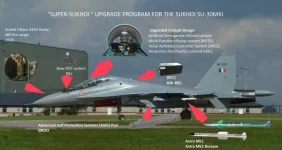
Although the formidable Su-30MKI fighter is widely expected to be the main carrier for this weapon, current trends suggest that India’s upcoming Tejas Mk-2 fighter jet might be the ultimate platform to harness the Astra Mk-3’s true potential.This synergy stems largely from the jet's fundamental design. Older aircraft often need complex, time-consuming upgrades to carry new missiles.
In contrast, the Tejas Mk-2 is being built from the ground up with domestic mission computers, tailored weapon interfaces, and modern data-fusion systems.
This built-in compatibility streamlines the weapon integration process, ensuring the missile functions at its absolute best.
The Tejas Mk-2’s sophisticated sensor array is equally crucial. The jet will be equipped with the advanced indigenous Uttam Mk-2 Active Electronically Scanned Array (AESA) radar, paired with modern electronic warfare tools and precise infrared tracking sensors.
Because ultra-long-range missiles heavily depend on accurate target data, the Astra Mk-3 requires the high-quality tracking and mid-flight guidance that only a state-of-the-art radar like the Uttam can provide.
Building a Networked Kill Chain
This highlights a crucial, yet frequently ignored, dimension of the entire project. The most significant engineering hurdle for the Astra Mk-3 is likely not its engine, but its tracking and guidance systems.Hitting a fast-moving enemy jet from over 300 kilometres away demands much more than pure speed. As the missile travels over such vast distances, the target will inevitably change its direction, height, and velocity.
To ensure a successful strike, the missile must be constantly fed real-time updates regarding the enemy's location.
This absolute need for continuous communication shifts the Astra Mk-3 from a simple standalone weapon into a highly interconnected, network-centric system.
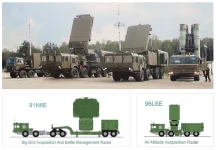
To function flawlessly, the Gandiva will depend on a cooperative network of fighter jets, surveillance planes, and ground radars. Ongoing mid-flight data updates regarding the enemy's path and speed are absolutely necessary for the missile to close the distance accurately.
Reports also indicate the weapon will utilize an advanced indigenous Gallium Nitride (GaN)-based AESA seeker, granting it strong resistance to enemy electronic jamming during its final approach.
This is exactly why the integration of the Astra Mk-3 with India’s upcoming airborne surveillance network is so vital to national defence.
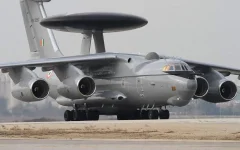
Surveillance aircraft like the Netra Mk-2 and the broader AWACS (Airborne Warning and Control System) India initiative will serve as massive force multipliers.
Because these planes fly at high altitudes and carry powerful radar arrays, they can spot and monitor enemy aircraft from much further away than standard fighter jets ever could.
In a theoretical future battle, a Netra Mk-2 could detect a hostile plane from hundreds of kilometres out and seamlessly share this data with a Tejas Mk-2. The fighter pilot could then fire the Astra Mk-3 without ever seeing the target on their own radar.
The Netra aircraft would continuously guide the missile during its flight until the Astra activates its own internal seeker for the final, deadly strike.
This capability is specifically designed to allow Indian forces to safely eliminate high-value targets, such as enemy AWACS and refuelling tankers, from safe distances.
This interconnected sequence, often referred to as a "kill chain," would significantly boost the combat range of Indian fighter squadrons.
It also provides pilots with a distinct tactical advantage: they can launch their weapons and immediately turn away, an ability known as "lock-on-after-launch," drastically reducing their own exposure to enemy fire.
Strategic Independence and Future Prospects
Naturally, defence experts frequently compare the Astra Mk-3 to China’s PL-15, which is currently considered a premier long-range aerial weapon. However, DRDO's primary goal may not simply be to outdistance the Chinese missile in raw numbers.The true focus seems to be on matching top-tier global effectiveness by combining substantial reach with high impact energy, all while ensuring local production.
Attaining this level of advanced capability using strictly homegrown technology and eliminating reliance on foreign suppliers represents a monumental strategic victory for India's defence sector.
Furthermore, the success of this project carries weight far beyond a single weapon system. The advanced ramjet engine driving the Astra Mk-3 opens the door for a completely new generation of weaponry.
Expected to receive production clearance by 2028 and be battle-ready by the early 2030s, future iterations of this technology could include naval versions designed specifically for the Twin Engine Deck Based Fighter (TEDBF) or compact models built to fit inside the internal stealth bays of the Advanced Medium Combat Aircraft (AMCA).
Ultimately, these advancements will pave the way for a highly networked, cooperative-engagement arsenal capable of dominating the skies.