- Views: 3K
- Replies: 3
The Indian Navy is preparing for a significant technological leap with the development of Project 17B, the successor to the current Nilgiri-class (Project 17A) frigates.
This new initiative represents more than a simple upgrade; it marks a strategic shift in naval doctrine.
While previous designs focused on the survival of individual ships, Project 17B is designed to dominate the maritime battlespace.
These vessels will act as advanced "lethality nodes," capable of protecting large fleets and striking high-priority targets at distances usually handled by much larger destroyers.
Expanded Firepower and Magazine Depth
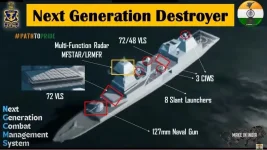
The most visible change in the Project 17B design is the increase in the Vertical Launch System (VLS) capacity, moving from 32 to 48 cells.In modern naval combat, adversaries often use "saturation attacks"—launching dozens of supersonic or hypersonic missiles simultaneously to overwhelm a ship’s defences.
By carrying 50% more missiles, Project 17B ensures it has the "magazine depth" required to survive multiple waves of attacks without running out of ammunition, providing a level of resilience that smaller configurations cannot match.
Layered Defence through "Quad-Packing"
Beyond the number of cells, the efficiency of the weaponry is being overhauled.By utilizing systems like the VL-SRSAM (Vertical Launch Short Range Surface-to-Air Missile), the Navy can "quad-pack" missiles—fitting four smaller interceptors into a single VLS cell.
This allows the ship to create a multi-layered shield:
- Long-range: Engaging threats far from the fleet.
- Intermediate: Picking off remaining targets.
- Terminal: Utilizing quad-packed missiles for close-in protection.This tiered approach ensures the ship can defeat complex, multi-directional attacks while preserving its heavier long-range missiles for the most dangerous threats.
The Shift to a Universal Missile Architecture
Project 17B is expected to feature a universal VLS architecture, a modular system that allows the ship to carry different types of weapons in the same silos.Depending on the mission, a frigate could be loaded with:
- Air defence interceptors for escorting aircraft carriers.
- Anti-ship missiles for sea battles.
- Land-attack cruise missiles for precision strikes.
Project Kusha: The Long-Range "Sniper" Capability
The defining feature of Project 17B’s reach is the integration of Project Kusha, India’s indigenous long-range air defence system.Specifically, the naval version (XRSAM) is expected to provide an engagement range exceeding 350 km.
This transforms the frigate into a long-range "sniper" capable of shooting down critical enemy assets such as:
- AWACS: Airborne early warning and control aircraft.
- Tankers: Aerial refuelling planes that keep enemy fighters in the air.
- Maritime Patrol Aircraft: Long-range sensors used to track Indian ships.
Advanced Sensors and Stealth Technology
To utilize 350 km missiles effectively, the ship requires world-class "eyes."Project 17B will likely feature an upgraded AESA (Active Electronically Scanned Array) radar, potentially an advanced version of the EL/M-2248 MF-STAR or a completely indigenous solution.
These sensors are vital for tracking low-flying or stealthy targets at long distances.
Furthermore, the ship's survivability is enhanced by an integrated stealth mast, similar to Japan’s UNICORN concept.
This design houses all sensors and antennas inside a single, smooth structure, drastically reducing the ship’s radar signature.
This creates a powerful tactical advantage: a vessel that is extremely hard for the enemy to see, yet can see and strike the enemy from hundreds of kilometres away.
Strategic Importance in the Indo-Pacific
In the broader context of Indo-Pacific security, Project 17B is a direct response to the rapid expansion of regional navies, particularly the deployment of large vessels like China’s Type 055 destroyers.While Project 17B is technically a "frigate," its combination of 48 VLS cells, Project Kusha missiles, and advanced stealth makes it functionally equivalent to many of the world's most powerful destroyers.