Recent reports indicate that the Indian Air Force (IAF) and the Defence Research and Development Organisation (DRDO) are planning their next major aerial surveillance project.
Moving past the current Netra Mk2, they are aiming to develop a heavy Airborne Early Warning and Control (AWACS) system, tentatively known as the Mk3, slated for the 2030s.
Although the government has not yet given official approval, this future aircraft holds a central place in India's long-term defence strategy.
It is seen as the natural next step in building domestic airborne radar systems once the Netra Mk2 aircraft are fully operational.
India's existing Netra Mk1 uses the Embraer ERJ-145 jet, while the upcoming Mk2 relies on the narrow-body Airbus A321.
In contrast, the proposed Mk3 will utilise a heavy, widebody aircraft. This larger size will allow the plane to stay in the air much longer, scan a wider area, and manage complex combat situations more effectively.
Early assessments have highlighted the Airbus A330 as a prime candidate for this role.
A widebody jet like the A330 offers a massive payload capacity and generates the high electrical power needed for advanced defence electronics.
Furthermore, its spacious interior can comfortably house a larger crew, more computer consoles, and the heavy processing equipment required to direct modern air battles.
Interestingly, India had previously considered the A330 for an AWACS project approved in 2015 before shifting focus to the Netra Mk2.
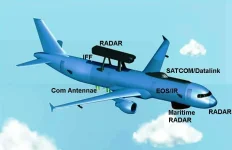
A major upgrade for the Mk3 will be its ability to see in all directions without any blind spots, providing a full 360-degree radar view. This could be achieved using a large rotating radar dome on top of the plane, similar to traditional heavy AWACS.
This is a significant improvement over the Netra Mk2, which uses a combination of top and nose-mounted radars to cover a 300-degree arc. The Mk3's unbroken coverage will be vital for monitoring massive conflict zones.
Once built, the Mk3 will rank alongside the heavy AWACS flown by the world's most advanced militaries. It will function as a highly sophisticated flying headquarters, doing much more than just spotting enemy planes.
The crew will be able to guide fleets of friendly fighter jets, connect with ground-based missile defence systems, and assist in long-range naval attacks.
Currently, the IAF relies on three Israeli Phalcon radar systems mounted on Russian IL-76 heavy transport planes for these demanding, large-scale tasks.
Despite these ambitious plans for the future, the DRDO's Centre for Airborne Systems (CABS) is currently dedicating all its efforts to finishing the ongoing Netra Mk2 project.
Right now, CABS engineers are busy installing home-grown defence systems onto six Airbus A321 planes acquired from Air India.
This massive undertaking involves structural modifications by AI Engineering Services Limited (AIESL) and the integration of mission electronics by Adani Defence Systems & Technologies Limited, which was awarded the production contract.
The Mk2 is a highly complex project that requires fitting the aircraft with advanced Indian-made radars, spy sensors, communication trackers, and central computers, all of which must pass strict flight certifications.
Because of this heavy workload, CABS will ensure the Mk2 is fully operational before officially starting work on the larger Mk3 AWACS.
This step-by-step development shows the DRDO's strategy of progressively mastering complex aviation technology. The original Netra Mk1 proved that India could build a working radar plane for regional use.
The current Mk2 will offer better sensors and longer flight times. Finally, the Mk3 will become India's first fully home-built heavy AWACS, designed to control the skies over an entire war theatre.
When the heavy Mk3 eventually takes to the skies, it will not replace the smaller Netra Mk2s. Instead, the two types of aircraft will work together.
The Mk2 planes are cheaper to fly and perfect for everyday border patrols. The massive Mk3s will be reserved for serious conflicts where their huge radars, large crews, and extended flying times are absolutely necessary.
While the Mk3 is still just an idea on paper, it proves that the Indian Air Force is carefully planning for the future. By investing in different sizes of radar planes, the IAF is building a multi-layered aerial defence network capable of handling any type of mission or threat.