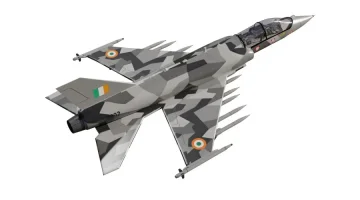
The Indian Air Force's (IAF) reliance on its ageing Jaguar fleet is sparking discussions, especially following recent news that India is importing nine decommissioned Jaguars from the United Kingdom to keep its active jets airborne.
Since Hindustan Aeronautics Limited (HAL) built these jets locally, many wonder why the state-run manufacturer cannot simply fabricate the required spare parts internally instead of relying on overseas scrapyards.
The situation seems confusing on the surface, given that HAL delivered the last locally manufactured Jaguar as recently as 2008.
While the youngest airframes in the current fleet of roughly 120 jets are only around 18 years old—a relatively standard operational age for military aircraft—the IAF is forced to acquire grounded fighters from former operators like the UK, France, and Oman just to keep its six active squadrons at bases in Ambala, Gorakhpur, and Jamnagar operational.
The core problem does not stem from the actual age of the planes, but rather from the complex nature of aviation manufacturing, strict intellectual property rules, and the heavy financial burden of maintaining an aircraft type that no other country flies anymore.
It is crucial to note that HAL did not design the Jaguar platform. The jet was originally created in the 1960s by SEPECAT, a collaborative venture between British and French aerospace companies.
Although HAL held a licence to assemble and build over a hundred units for the IAF, it never possessed the fundamental engineering authority, a limitation that has created severe bottlenecks today.
As global production of the Jaguar ceased, the vast industrial network supporting it vanished. Unlike civilian car factories, military aviation plants cannot be easily paused and restarted.
Building jet fighters requires thousands of unique tools, specific calibration gauges, and dedicated assembly fixtures, which are simply too expensive to keep in storage once a production line officially shuts down.
Consequently, the original manufacturing equipment was dismantled or scrapped long ago. Attempting to rebuild these complex assembly lines just to produce a few replacement parts would demand massive financial resources with almost zero commercial return.
Moreover, this problem is not limited strictly to HAL's production floors.
The Jaguar relies on technology spanning the 1970s and 1980s, which originally depended on countless smaller suppliers for custom alloys, hydraulic systems, and unique structural fasteners.
Today, many of those original vendor companies have gone out of business, merged, or completely shifted their focus. Restoring that specific global supply chain for a single operator would essentially mean rebuilding decades of industrial history from scratch.
Having the original technical blueprints is also not enough to ensure easy manufacturing. The older components were created using obsolete industrial methods, specific chemical treatments, and outdated materials.
Trying to recreate these identical parts today while adhering to strict modern aviation safety standards requires intense and complicated engineering efforts.
Lacking the primary design authority creates an enormous hurdle. Contemporary fighter maintenance depends on deep digital archives, 3D computer models, and modern stress-testing data.
Unfortunately, the vast majority of the Jaguar’s foundational engineering was drafted long before the era of modern digital design.
Even with paper diagrams available, producing fresh structural elements demands official certification data that simply cannot be found anymore.
Attempting to reverse-engineer essential safety components like landing gear mounts or wing frames is risky and must pass rigorous modern safety checks.
This immense technical barrier is the primary reason the IAF has turned to cannibalising old jets.
While it sounds drastic, cannibalising aircraft is a widely accepted strategy in global aviation, particularly for older planes nearing retirement.
Since India remains the sole active operator of the Jaguar, international logistics networks have dried up, transforming retired airframes abroad into vital spare parts warehouses.
Through the procurement of decommissioned jets—like the 31 airframes gifted by France in 2018 or the over 20 acquired from Oman—the IAF can extract functional hydraulics, landing gear, and even Rolls-Royce Adour engines that would otherwise be impossible to make affordably.
These rescued parts are carefully inspected, refurbished, and re-installed, which proves to be much more financially sound than funding a new factory line.
Manufacturing small batches of aerospace components is remarkably costly.
The defence industry relies on mass production to lower prices, meaning that setting up a machine to make ten parts costs almost as much as setting it up to make a thousand. Thus, buying retired jets outright remains the most logical and cost-effective remedy.
These decommissioned jets function as "donor platforms," granting technicians instant access to thousands of critical components for a fraction of the cost of raw manufacturing. Furthermore, this method solves the pressing issue of sourcing items that simply can no longer be manufactured anywhere.
Many older parts were formed using highly guarded corporate processes or chemical material treatments that are banned or unavailable in the modern commercial market.
For these specific items, pulling them from an old, donated airframe is the only viable path forward, especially as even major international defence contractors struggle to support legacy systems.
A clear example is the Jaguar's Martin-Baker ejection seat. While the company still actively supplies modern jets worldwide, keeping legacy production lines open for a single customer becomes incredibly difficult.
Consequently, keeping an ageing fleet airborne requires a relentless global hunt for surplus stock and complicated refurbishment efforts.
Ultimately, the defence establishment must evaluate if continuing to fund these ageing fighters is financially prudent.
The IAF has already had to make tough calls regarding upgrades, notably cancelling a massive project to install new Honeywell F-125IN engines into the jets.
Despite the obvious performance benefits, the engine replacement was scrapped due to prohibitive costs—reportedly over $13 million per engine—and the heavy structural modifications required.
Although half the fleet has received the DARIN III upgrade, adding active electronically scanned array (AESA) radars and modern displays, the economic logic of investing further in an old airframe is diminishing.
The core dilemma extends beyond the airframe's physical age. It centres on the soaring financial burden of supporting a unique fleet with zero international backup.
As usable spare parts dry up, the cost of keeping the aircraft in the sky balloons. Eventually, it becomes far more expensive to patch up a legacy fighter than it is to simply buy a new one.
The Jaguar fleet, which is expected to begin phased retirements around 2028, is rapidly nearing this economic tipping point. While it still serves as a highly effective deep-penetration strike asset, keeping it combat-ready grows more complicated with each passing year.
Consequently, the IAF must carefully weigh the costs of sustaining these legacy jets against funding modern replacements like the Tejas Mk1A, Tejas Mk2, and other next-generation fighter programmes.