The Indian Air Force (IAF) is laying the groundwork for a major leap in its strike capabilities by pairing its homegrown fighter jets with advanced drones and robotic wingmen.
This strategy, known globally as Manned-Unmanned Teaming (MUM-T), is designed to completely change how aerial battles are fought, allowing human pilots to command autonomous systems to safely breach heavily guarded enemy skies.
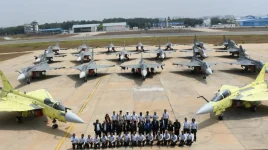
According to defence sources, the IAF's immediate goal is to arm its locally built fighters—specifically the current Tejas Mk1A and the upcoming 17.5-ton Tejas Mk2—with air-launched loitering munitions.
These kamikaze-style drones are expected to have a striking distance of 150 to 300 kilometres.
To make this a reality, the military will soon begin talks with Indian defence manufacturers to outline the necessary technology and production plans.
Publicly known initiatives, such as Hindustan Aeronautics Limited's (HAL) CATS ALFA (Air Launched Flexible Asset) project, closely align with these requirements.
Launching these explosive drones from a fighter jet mid-air offers a massive tactical edge over firing them from the ground. Because they are dropped at high altitudes and speeds, they can glide much deeper into hostile areas.
Furthermore, this method of deployment gives enemy air-defence radars far less time to spot and react to the incoming threat compared to a ground launch.
The initial phase of this upgrade focuses on relatively small kamikaze drones built for pinpoint accuracy.
Their primary job will be to hunt down and destroy critical enemy infrastructure—like radar stations, surface-to-air missile (SAM) sites, supply depots, and command hubs—located deep within hostile territory, ensuring that human pilots stay out of the most dangerous zones.
Looking further ahead, the IAF plans to turn its fighter jets into flying command centres.
In this second phase, manned jets will act as "mother ships" that release and control larger Collaborative Combat Aircraft (CCA)—often referred to as "loyal wingmen"—while still carrying their own missiles and bombs.
Projects like HAL's CATS Warrior are prime examples of this technology. This setup dramatically increases a fighter's reach, allowing it to send robotic assets into the fight while staying safely behind.
These loyal wingmen are being designed for an impressive operational range of 400 to 600 kilometres.
They are built to be far more than just one-way disposable weapons. Instead, they will act as smart, flying partners capable of conducting both offensive strikes and defensive manoeuvres alongside human pilots during complicated missions.
In a game-changing move, these robotic wingmen could even be armed with air-to-air weapons, such as the indigenous Astra missile, which currently boasts ranges of up to 160 kilometres in its Mk1 variant.
By carrying these weapons, the drones can act as flying bodyguards. They can escort the mother ship, fend off enemy jets, and secure contested airspace, giving the human pilot a wider and safer defensive bubble.
To make this work, the drones will be continuously linked to a massive combat network.
While the pilot in the Tejas fighter assigns the targets, additional tracking data will be fed directly from Airborne Warning and Control Systems (AWACS) and the fighter's own powerful Uttam Active Electronically Scanned Array (AESA) radar.
This secure data link allows the unmanned drones to strike deep into enemy territory while relying on the "big picture" provided by assets flying safely miles away.
Using this interconnected system, an AWACS plane could spot an enemy jet and instantly beam the coordinates to a loyal wingman. The drone could then fire its Astra missile at the target without ever using its own sensors to find the enemy.
This spiderweb of attacks makes it incredibly difficult for adversaries to defend themselves, as threats can come from multiple unmanned platforms while the manned jets remain out of reach.
For nations with limited geographical depth, such as Pakistan, this technology presents a severe defence nightmare. Drones launched from the sky that can penetrate deep across the border will drastically cut down the reaction time for their military.
Instead of just tracking a clear formation of traditional fighter jets, enemy radar operators will be forced to identify and shoot down swarms of autonomous drones attacking from every direction.